1238-second window · 3 observations · Measured Aug 26, 2026, 11:41 AM UTC · Provider: go_recent_snapshot_v2
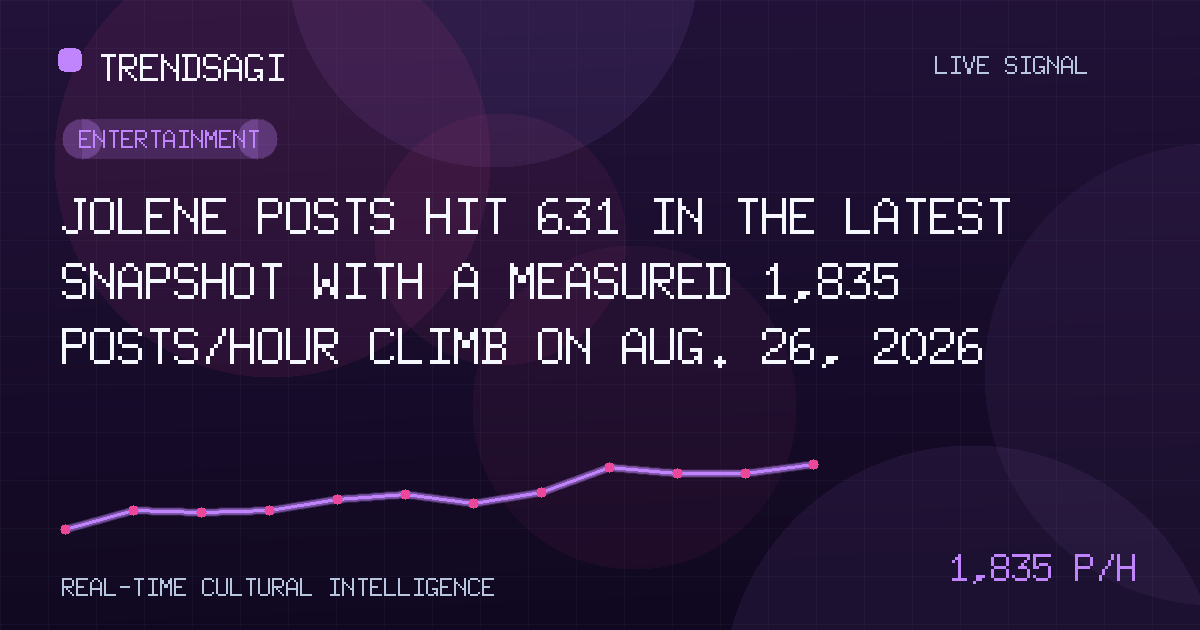
Jolene posts hit 631 in the latest snapshot with a measured 1,835 posts/hour climb on Aug. 26, 2026
Jolene posts reached 631 in the latest snapshot, a measured 1,835 posts/hour climb over a 21-minute window; here is what the signal shows and what to verify.
Automated briefing. Generated from stored signal measurements and source-backed research; it is not manually reviewed. Read the methodology and limitations.
Metrics in this briefing are a snapshot associated with its publication date and may not reflect current conditions.
What changed
Tracked posting under the topic label “Jolene” climbed sharply on August 26, 2026. At the 11:41:59 UTC snapshot, the latest capture held 631 posts, and the measured change rate was 1,835.0 posts per hour, computed across an exact 1,238-second window — about 20 minutes 38 seconds — using three stored observations.
The two figures describe different things. The 631 is a volume count: posts captured in a single snapshot. The 1,835 posts-per-hour figure is a measured snapshot rate — the pace of increase across the observation window. It is not a live or current rate, not a forecast, and not a measure of reach, engagement, impressions, or unique people. Treat it strictly as a description of what the data did inside that window.
| Metric | Reading |
|---|---|
| Observation time | 2026-08-26T11:41:59Z |
| Measured posts per hour | 1,835.0 |
| Snapshot volume | 631 posts |
| Measurement basis | Exact 1,238-second window; 3 stored observations |
The stored record offers little context: the topic sits in the generic “Other” category with no description attached, and no verified public explanation had been linked to this spike at the time of writing. Put plainly, the cause is not yet confirmed. Everything below explains what the signal does establish, who should care, and how to pin down the driver.
We know the shape of this movement — a fast rise measured across a window of roughly twenty-one minutes — but not its cause. A number this specific deserves an explanation just as specific before anyone builds on it.
Why this topic may be moving
“Jolene” is a deceptively ambiguous term for a trend tracker. It is widely associated with a classic country song of the same name — one of the most frequently covered recordings in popular music — so the word reliably resurfaces whenever a new performance, chart milestone, anniversary, or pop-culture reference puts it back in circulation. It is also an ordinary personal name, which means a burst can just as easily track a person: a public figure, athlete, contestant, or fictional character suddenly entering the news cycle.
Past behavior of name-and-song labels like this one suggests a short checklist of likely drivers:
- A music moment tied to the song — a high-profile cover, live performance, licensing deal, or chart resurgence.
- A person named Jolene making headlines in sports, entertainment, politics, or a viral incident.
- A screen appearance — a film, series, or reality episode featuring the name or the song.
- An anniversary, tribute, or commemorative date that prompts nostalgic posting.
- Coordinated fan or community activity that lifts raw counts without broad public awareness.
None of these has been verified for this window. They are listed as the first checks a researcher would run, not as findings. If reputable reporting identifies the actual trigger, it should replace every item above.
Why it matters
Different readers get different value from a spike like this:
- Social and assignment editors need to know quickly whether a fast-moving name is a flash spike or the leading edge of a story. One short measurement cannot settle that, but it flags the topic for a human look now rather than tomorrow.
- Music and marketing teams care about timing. If the driver turns out to be entertainment-related, relevance windows around songs and artists are short, and verification speed determines whether anyone can act on it.
- Researchers and analysts get a clean case study: a narrow spike on an ambiguous label is a good test of how quickly attribution can be established from post content alone.
- Brand and communications teams monitor namesakes. If a person named Jolene becomes the center of a negative story, organizations with executives, customers, or characters sharing the name will want early notice.
What to watch next
The fastest way to turn this signal into something usable is to track a handful of concrete indicators over coming snapshots:
- Persistence. Do subsequent captures hold near or above 631 posts, or does volume decay within hours? Decay points to a passing mention wave; persistence points to an ongoing event.
- Rate direction. Whether the posts-per-hour measurement accelerates or slows in future windows matters more than any single reading.
- Named entities. If posts begin clustering around identifiable accounts, venues, songs, or places, attribution usually follows quickly.
- Platform spread. A burst confined to one platform often reflects fandom or coordination; simultaneous movement across several platforms suggests broader pickup.
- Co-occurring language. The words appearing alongside “Jolene” will reveal which of the possible meanings is driving the count.
- Mainstream confirmation. Coverage from established publishers is the strongest external validation and should anchor any public claim about the cause.
Methodology and limitations
The rate figure comes from three stored observations spanning an exact 1,238-second window ending at 2026-08-26T11:41:59Z, yielding 1,835.0 posts per hour. The latest individual snapshot counted 631 posts. Both numbers are reported exactly as stored.
Limitations worth keeping in mind:
- A window of roughly twenty-one minutes is short; one burst or lull inside it can swing the rate substantially.
- Snapshot counts are raw post totals, not unique authors, and typically include reposts and replies.
- No sentiment, geography, audience, or demographic data is attached to the signal.
- The topic is filed as “Other” with no stored description, so automated classification contributed nothing here.
- The cause of the spike was unverified at publication; this briefing will age until attribution lands.
The practical takeaway: treat this as a lead, not a finished story. Verify against primary posts and reputable publishers before repeating the number or acting on it, and expect the picture to sharpen quickly if the driver turns out to be a public event.
Track This Topic for New Signals
Set alerts for future velocity or sentiment changes around this topic.
Explore Tracking PlansAbout TrendsAGI research
TrendsAGI's automated research pipeline publishes dated signal snapshots, methodology notes, and practical workflows for teams evaluating cultural momentum. Read how signals are scoped, scored, and limited in our research methodology.