1799-second window · 3 observations · Measured Sep 11, 2026, 10:59 PM UTC · Provider: go_recent_snapshot_v2
Jhene posts rose 800.5 posts per hour in a 30-minute measured window
Jhene showed a measured 800.5 posts/hour window and 765 snapshot posts on 2026-09-11, with cause unconfirmed.
Automated briefing. Generated from stored signal measurements and source-backed research; it is not manually reviewed. Read the methodology and limitations.
Metrics in this briefing are a snapshot associated with its publication date and may not reflect current conditions.
What changed
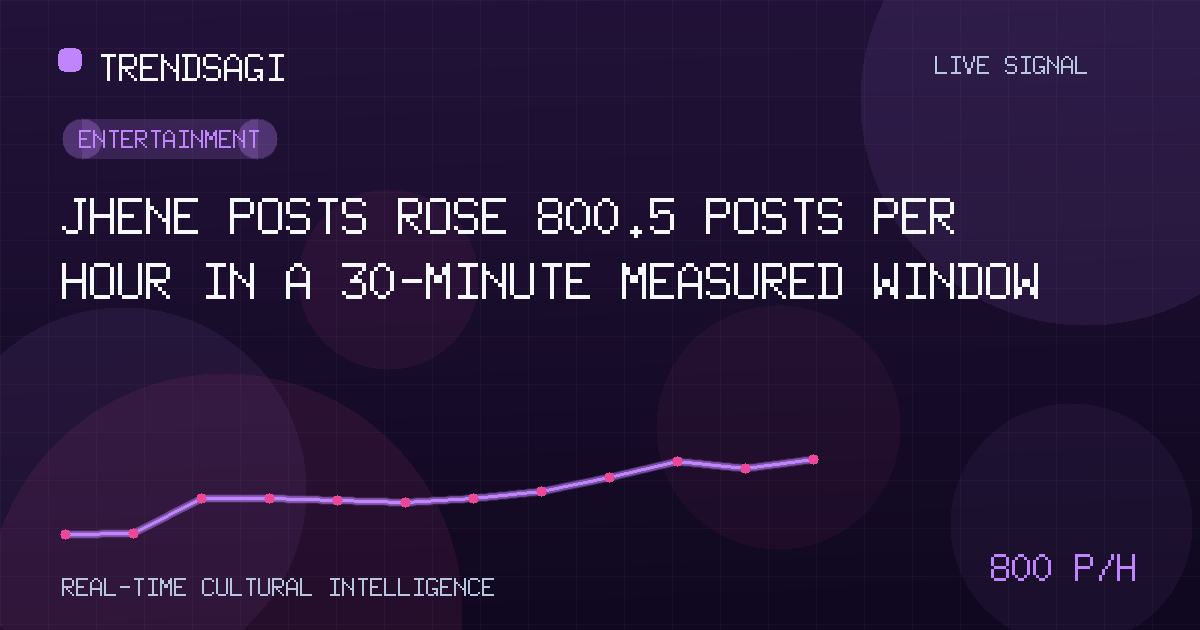
“Jhene” recorded a measured snapshot rate of 800.5 posts/hour during an exact 1,799-second window, measured at 2026-09-11T22:59:37Z. The latest snapshot volume was 765 posts. That is a short-window posting-rate observation, not proof that 800.5 new people, engagements, searches, or live current conversations occurred at that moment.
In practical terms, the topic moved quickly in the monitored store for a brief interval. The signal says the label is posting heavily around the observation time, but it does not yet identify the cause, confirm that “Jhene” refers to one specific celebrity, news event, artist, brand, or viral moment, or measure audience size beyond the observed post count.
| Observation time | 2026-09-11T22:59:37Z |
| Measured posts/hour | 800.5 posts/hour over an exact 1799-second window |
| Snapshot volume | 765 posts |
Why this topic may be moving
The stored category is Entertainment, so the most likely context is a celebrity, music, television, social-media, or fan-driven topic. The name “Jhene” could point to a person, alias, handle, song, campaign, or entertainment-related phrase, but the stored signal includes no description. Without verified public context, the cause should be treated as unclear.
A short spike in post volume often reflects one of several patterns:
- A new clip, photo, interview, award, red-carpet appearance, or music release enters the feed.
- A fan account or celebrity page reshares older material, creating a temporary wave of posts.
- A news outlet reports a development involving a public figure whose name is abbreviated or stylized as “Jhene.”
- A social-platform recommendation system or trending page amplifies the label after initial activity.
- A misattributed or misspelled topic merges into the same monitoring label.
Because the monitored value is a post count and a calculated rate from stored observations, it can establish that something related to “Jhene” was being posted at high frequency. It cannot establish that the posts are all on the same platform, from the same creators, about the same subject, or that the rate will continue after the measurement window.
Why it matters
Entertainment signals like this matter when editors, brand teams, talent agencies, media monitors, or fan-community operators need to know whether a name is beginning to spread. A measured rate of 800.5 posts/hour is useful as an early warning: it shows the topic has enough volume to merit a quick review, even if the snapshot volume of 765 posts is modest in absolute terms.
The distinction between volume and rate matters. The snapshot volume tells us how many posts were recorded in the latest snapshot. The measured posts/hour figure tells us how fast the stored observations were changing over the specified window. Neither figure should be read as total reach, total engagement, unique audience size, search volume, or a forecast of future growth.
The useful question is not only “How many posts?” but “What is the topic referring to, and would the next observation show continuation, a spike, or a fade?”
For entertainment monitoring, that question often determines whether the item is a routine social moment, a developing news story, or a brief platform artifact. A single high-rate window is worth checking, but it should not become a conclusion by itself.
What to watch next
The next checks should focus on identifying the subject and testing whether the rate persists.
- Identify the entity: Confirm whether “Jhene” refers to a specific public figure, project, song, clip, or phrase. Look for full names, associated handles, media titles, or recent news headlines.
- Check the next observation: If the next stored snapshot continues at a similar measured posts/hour, the topic is more likely to be sustained. If it falls sharply, the event may have been a short burst.
- Compare platforms: Determine whether the volume is concentrated in one platform, one type of account, or one content format.
- Review content samples: Look for repeated photos, video clips, quotes, event names, or recurring hashtags that identify the core story.
- Watch for authoritative confirmation: A verified entertainment news outlet, official account, or major media report can help establish the cause. If no verified context is available, the cause should remain stated as unclear.
- Monitor related labels: Track adjacent names, full names, event names, or hashtags that may clarify whether “Jhene” is a partial or stylized label.
Concrete watch signals include a second consecutive high measured posts/hour window, the appearance of a clear news explanation, a shift from fan reposts to original reporting, or a visible drop in snapshot volume that suggests the topic has already peaked.
Methodology and limitations
This briefing is based on the canonical stored signal: a latest snapshot volume of 765 posts and a measured change rate of 800.5 posts/hover over an exact 1,799-second window using 3 stored observations, measured at 2026-09-11T22:59:37Z. The rate is described as a measured snapshot rate because it is calculated from stored observations, not measured as a live real-time feed at the time of reading.
The signal has clear limitations:
- The stored signal description is empty, so the subject’s exact identity is not supplied by the monitoring data.
- The observation window is short, meaning the rate may not represent a longer trend.
- Snapshot volume and measured posts/hour are different metrics; one is a count at a snapshot, the other is a rate derived from observations.
- The data does not identify platforms, authors, location, sentiment, duplication, bot activity, or total audience exposure.
- The cause of the movement is not verified in the supplied signal, so this briefing avoids assigning a specific news reason.
For readers, the bottom line is straightforward: “Jhene” showed a measurable burst of posting activity around 2026-09-11T22:59:37Z. The entertainment label suggests a celebrity or media-related topic, but the reason for the movement remains unclear until the subject is identified and the next observation is checked.
Track This Topic for New Signals
Set alerts for future velocity or sentiment changes around this topic.
Explore Tracking PlansAbout TrendsAGI research
TrendsAGI's automated research pipeline publishes dated signal snapshots, methodology notes, and practical workflows for teams evaluating cultural momentum. Read how signals are scoped, scored, and limited in our research methodology.


