687-second window · 3 observations · Measured Sep 28, 2026, 12:21 AM UTC · Provider: go_recent_snapshot_v2
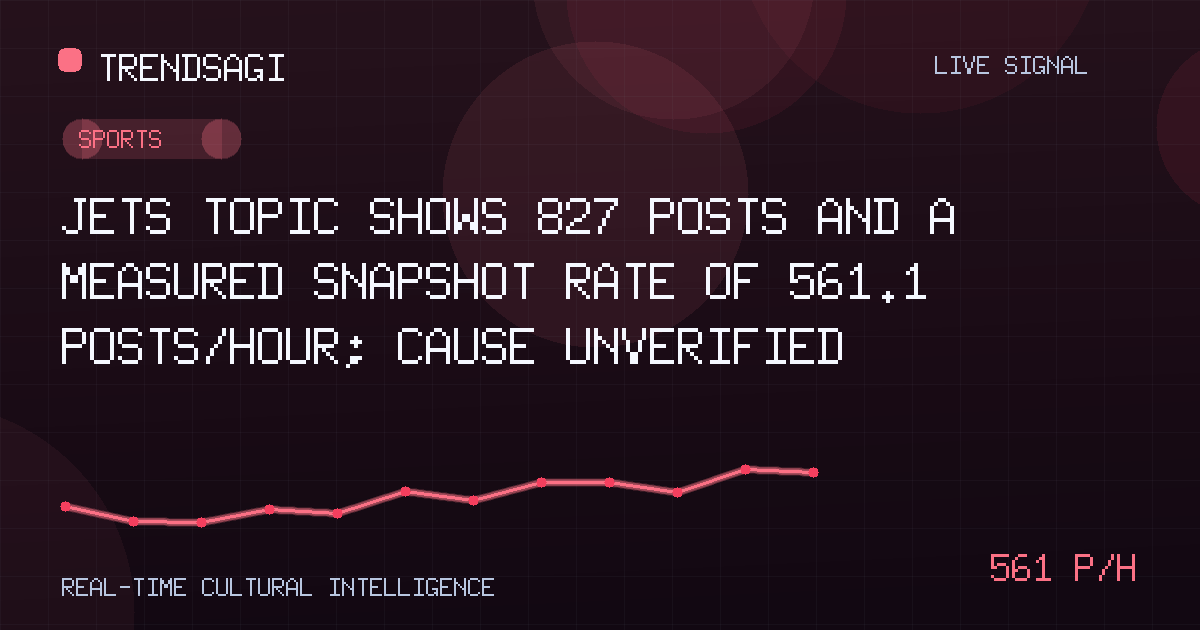
Jets topic shows 827 posts and a measured snapshot rate of 561.1 posts/hour; cause unverified
The Jets signal shows 827 posts and a measured 561.1 posts/hour snapshot rate, while the cause remains unverified and the data has clear limits.
Automated briefing. Generated from stored signal measurements and source-backed research; it is not manually reviewed. Read the methodology and limitations.
Metrics in this briefing are a snapshot associated with its publication date and may not reflect current conditions.
What changed
The stored Jets signal shows concentrated activity, but its cause is not verified. The latest snapshot contains 827 posts, and the measured snapshot rate is 561.1 posts/hour. It remains unverified whether “Jets” refers to the New York Jets, another subject, or a mixture of entities, so this is an entity-ambiguous monitoring alert rather than a confirmed team trend.
The rate was measured at 2026-09-28T00:21:42Z across an exact 687-second window using 3 stored observations. It describes only what the monitor captured in that snapshot. It is not a live or current rate, forecast, reach, engagement result, or unique-person count. No comparison period was supplied, so the record does not show whether 561.1 posts/hour is unusually high; 827 is snapshot volume, not a rate.
| Observation time | 2026-09-28T00:21:42Z |
|---|---|
| Measured snapshot rate | 561.1 posts/hour |
| Snapshot volume | 827 posts |
Why this topic may be moving
No verified public context could be tied to the measured interval, so the catalyst remains unclear. It would be misleading to attribute the activity to a game, roster move, injury, schedule release, viral item, or another event without a timestamped source. The stored Sports category makes a team interpretation plausible, but it does not resolve the entity or identify a trigger.
Possible explanations should remain hypotheses:
- Event-driven discussion: A confirmed development could concentrate comments, but no such development is verified here.
- Entity collision: The label may combine multiple subjects that share the word “Jets,” fragmenting the apparent signal.
- Monitoring change: A changed query, source mix, or collection rule could alter captured volume without a real-world change.
- Amplified repetition: Replies, reposts, copied text, or automated-looking accounts could inflate posts without equivalent conversation.
Because the window is brief and rests on 3 observations, none can be ranked confidently. A defensible causal account needs a public item whose publication time aligns with the activity and independent evidence that the monitored posts refer to the same entity.
Why it matters
The value here is rapid triage. A measured rate tells editors where to look; it does not tell them what happened, why it happened, or whether the activity is broad.
- Sports editors should verify the team and catalyst before using a breaking-news headline.
- Audience researchers should separate post volume from unique authors, original posts, and engagement.
- Team or league communications staff should respond only after confirming that the signal concerns their subject.
- Social and trend teams should check whether the burst is concentrated on one platform or account cluster.
The evidence supports a verification task: confirm what Jets denotes, locate the earliest substantive trigger, and test whether activity persists. It does not support a causal headline.
Until the entity and trigger are confirmed, the responsible label is “activity detected, cause unknown,” not a speculative explanation.
What to watch next
Use the next checks in this order; each can prevent a false causal match.
- Resolve the entity. Review a representative sample of posts and account metadata. Determine whether authors are discussing one team, several subjects, or the word in unrelated contexts. Record the dominant interpretation before calling this a New York Jets trend.
- Find the earliest substantive item. Inspect the 687-second interval and the adjacent period for the first original post, official update, result, media report, or clip that later posts cite. Separate the source from the reactions it receives.
- Verify timing and attribution. A candidate catalyst should come from a public publisher, carry a verifiable publication time, and precede or overlap the measured activity. Attribute the claim to that publisher; do not upgrade a repost into an independently confirmed event.
- Test persistence against a baseline. Compare the same query and source mix across adjacent equal-length windows and prior comparable periods. Treat 561.1 posts/hour as a reference point, not proof of a normal or exceptional level.
- Measure composition. Break the volume into original posts, replies, reposts, duplicates, and account clusters. Check whether independent credible publishers join the discussion. A narrow cascade and broad conversation are different developments even if their post totals look similar.
Concrete warning signs are unresolved entity labels, a timestamp mismatch, a query change, or nearly identical wording across otherwise unrelated accounts. Positive signs are a source-backed catalyst, independent confirmation, and activity that persists under a stable query.
Methodology and limitations
The reported 561.1 posts/hour is a supplied measured snapshot rate based on 3 stored observations over an exact 687-second window associated with the stated observation time. It is not recalculated or extrapolated here. The 827 figure is the latest snapshot volume. The record does not identify it as the count generated during the 687-second window, so it should not be reconciled arithmetically with the rate.
The record does not provide the monitor’s platforms, geography, query wording, collection limits, deduplication method, or account rules. It also lacks a topic description. The Sports label indicates classification, not entity-level identification. Without those details, the rate cannot show distribution, sentiment, organic reach, or bot activity.
No verified external catalyst was available to support a more specific explanation, so none is asserted. The short window, limited observation set, and absence of a prior baseline limit claims about magnitude or duration.
Bottom line: the signal establishes that the monitor captured Jets-labeled posting; it does not establish a cause. Entity resolution, timestamped verification, and same-query baseline comparisons are the next steps before publication or response.
Track This Topic for New Signals
Set alerts for future velocity or sentiment changes around this topic.
Explore Tracking PlansAbout TrendsAGI research
TrendsAGI's automated research pipeline publishes dated signal snapshots, methodology notes, and practical workflows for teams evaluating cultural momentum. Read how signals are scoped, scored, and limited in our research methodology.