978-second window · 3 observations · Measured Sep 26, 2026, 9:57 AM UTC · Provider: go_recent_snapshot_v2
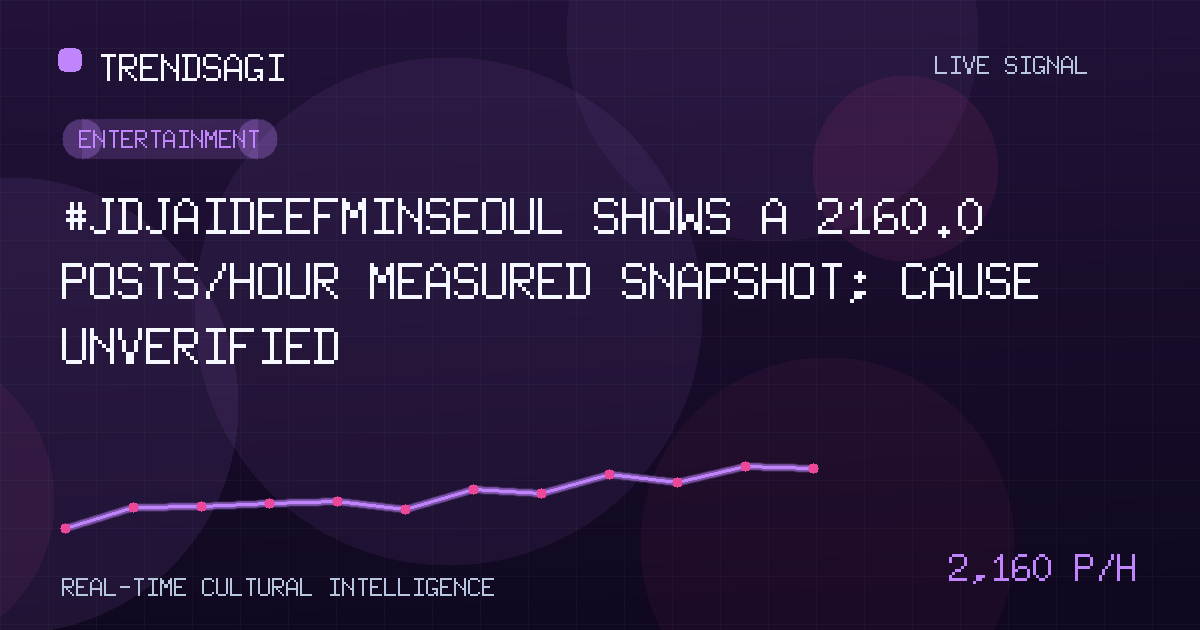
#JDJaideeFMinSeoul shows a 2160.0 posts/hour measured snapshot; cause unverified
#JDJaideeFMinSeoul shows a 2160.0 posts/hour measured snapshot, with interpretation, limits, and checks before assigning a cause.
Automated briefing. Generated from stored signal measurements and source-backed research; it is not manually reviewed. Read the methodology and limitations.
Metrics in this briefing are a snapshot associated with its publication date and may not reflect current conditions.
What changed
The latest stored observation records a burst of posts associated with #JDJaideeFMinSeoul, but it does not establish what caused the activity. No verified public context connects the measured change to a named event, announcement, appearance, controversy, or fan action. The defensible conclusion is narrow: the tag, classified in the stored record as Entertainment, showed measurable posting activity at the observed moment, while its trigger remains unresolved.
At 2026-09-26T09:57:29Z, the measured snapshot rate was 2160.0 posts/hour across an exact 978-second window using 3 stored observations. The latest snapshot volume was 1945 posts. These are different measures: the rate describes the defined historical window, while the volume is the stored post count at the snapshot. Neither is a live rate, forecast, reach estimate, engagement total, or unique-person count.
| Observation time | 2026-09-26T09:57:29Z |
|---|---|
| Measured snapshot rate | 2160.0 posts/hour |
| Snapshot volume | 1945 posts |
What the signal establishes
The rate supports a volume-and-timing conclusion: posts matching the tracked topic were captured at 2160.0 posts/hour during the stated window. It does not show the tag’s normal baseline, whether activity continued, or whether the change was exceptional against prior periods. Without comparison data, “surge” describes the measured change but cannot establish a record or lasting trend.
A measured rate establishes the timing and scale of captured posting activity; it cannot identify the event, the intent of posters, or the importance of the discussion.
The signal is aggregate. It cannot identify authors, independence, original versus reposted content, sentiment, or location. The reported rate uses 3 stored observations, so it may also be sensitive to where those observations fell within the exact 978-second window.
- The tracked query captured posting activity during the measured interval.
- It does not show that the same volume persisted beyond the snapshot.
- It does not establish that the tag maps to one person, event, or fandom.
- It does not demonstrate consensus, importance, authenticity, or organic reach.
Why this topic may be moving
Because no trigger is verified, possible explanations remain hypotheses. A concentrated burst could have several sources:
- Event response: An announcement, appearance, release, broadcast, or gathering may have prompted posting; no specific event is confirmed.
- Fan coordination or reaction: Appreciation, criticism, instructions, or confusion may have mobilized participants, but the aggregate data cannot distinguish motive.
- Controversy or amplification: A disputed claim, duplicate copy, repost network, or recommendation system may increase activity. None is demonstrated here.
- Ambiguous naming: The tag may combine names, abbreviations, or event wording. Its text alone does not identify the subject, and “Seoul” does not establish participant location or event location.
The strongest causal evidence would be a timestamped first-party statement or reputable independent reporting tied to the activity. Evidence published only after the burst may describe the reaction rather than cause it. “Entertainment” remains a stored category, not an explanation.
Why it matters
For editors, this signal is a prompt to verify quickly, not a license to attach the nearest news event. Hashtags can be reused, divided between meanings, or temporarily dominated by repeated content. A useful briefing must separate the observed change from any proposed cause.
For community and fandom teams, the operational question is whether the activity reflects a genuine gathering, coordinated response, misinformation, or mechanical amplification. Each possibility calls for a different response. The aggregate measurement cannot make that diagnosis without post-level and account-level inspection.
For readers, the main takeaway is simple: the dataset establishes increased captured posting around the tag, not what participants believed, why they joined in, or whether the topic became more important. Those conclusions require separate evidence.
What to watch next
The next checks should separate a genuine event response from repetition, measurement artifacts, or an unrelated use of the tag.
- Take another like-for-like snapshot. Reuse the exact tag, case treatment, language scope, and collection boundary. Compare the new post count and measured rate separately; neither should substitute for the other.
- Review the earliest accessible posts. Look for an initiating announcement, a specific claim, or wording repeated across accounts. Do not rely only on visible or high-engagement posts, which may be downstream reactions.
- Examine account and timing concentration. Near-simultaneous wording, repeated text, or forwarding chains may indicate coordination or amplification. Concentration warrants inspection but does not prove manipulation.
- Verify the alleged trigger and its timing. Seek a first-party statement and independent reputable coverage, then compare publication times with the activity. Evidence appearing only afterward should be labeled retrospective context.
- Test adjacent tags, variants, and geography. Keep counts for each exact label and confirm any claimed Seoul connection from participant evidence or a verified source rather than from the hashtag itself.
- Monitor persistence and migration. Continued activity, decay, another burst, or movement to related tags would change the interpretation. None should be forecast from this snapshot alone.
Concrete warning signs include unsupported allegations attached to a specific event label, repeated text with little original information, or a sudden migration to another tag. Stronger confirmation would combine a timestamped primary statement, independent reporting, varied original posts, and follow-through in later snapshots.
Methodology and limitations
The reported measurement comes from 3 stored observations across an exact 978-second window ending at 2026-09-26T09:57:29Z. The latest snapshot contains 1945 posts, while the separately reported measured snapshot rate is 2160.0 posts/hour. The two values should not be recalculated into one another or described as interchangeable.
No historical baseline, account deduplication, sentiment analysis, geographic distribution, identity confirmation, or verified event link is supplied. Snapshot volume may include duplicate or reposted material and therefore is not a count of unique people. The stored Entertainment classification provides context but does not verify why the topic was moving. Until a trigger is independently confirmed, the defensible description is a measured burst of posts with an unresolved cause.
Track This Topic for New Signals
Set alerts for future velocity or sentiment changes around this topic.
Explore Tracking PlansAbout TrendsAGI research
TrendsAGI's automated research pipeline publishes dated signal snapshots, methodology notes, and practical workflows for teams evaluating cultural momentum. Read how signals are scoped, scored, and limited in our research methodology.