898-second window · 3 observations · Measured Sep 2, 2026, 11:03 AM UTC · Provider: go_recent_snapshot_v2
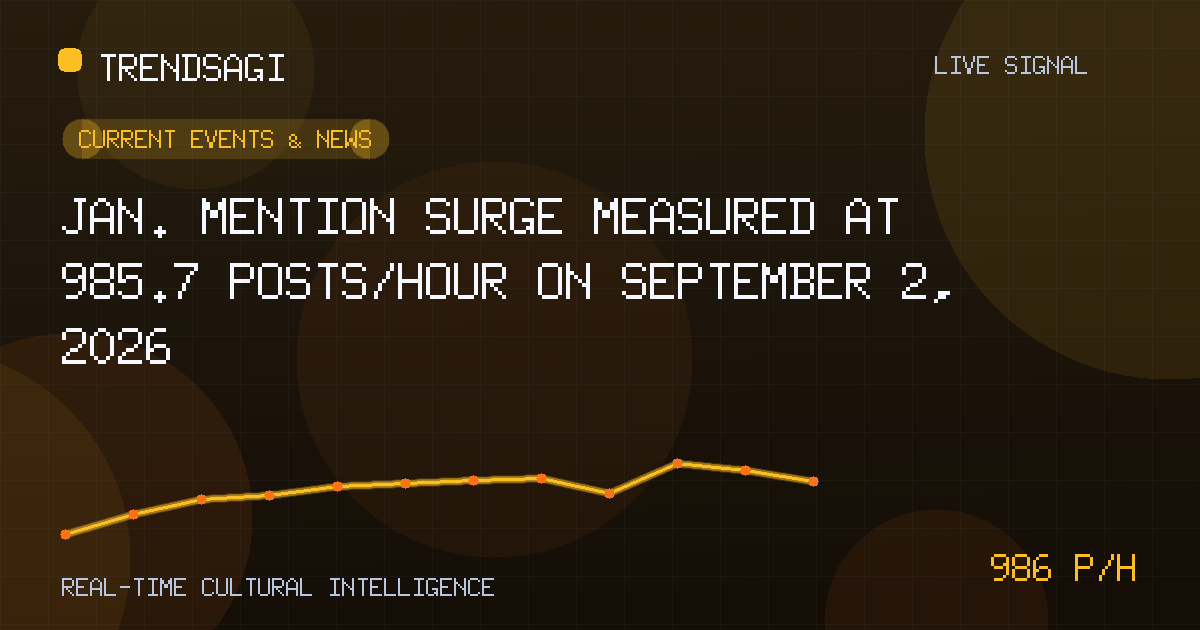
Jan. mention surge measured at 985.7 posts/hour on September 2, 2026
Measured 985.7 posts/hour for "Jan." on Sept 2, 2026; cause unclear—no single verified event found. Use snapshot to track if a January-linked narrative or
Automated briefing. Generated from stored signal measurements and source-backed research; it is not manually reviewed. Read the methodology and limitations.
Metrics in this briefing are a snapshot associated with its publication date and may not reflect current conditions.
What changed
A measurable spike in public posts referencing "Jan." was recorded at 11:03 UTC on September 2, 2026. The monitoring system captured 1,846 posts in the latest snapshot and calculated a rate of 985.7 posts per hour over an 898-second observation window using three stored data points. This rate is a measured snapshot figure, not a live or projected value, and reflects posting volume rather than unique authors or engagement depth.
| Observation time (UTC) | Measured posts/hour | Snapshot volume |
|---|---|---|
| 2026-09-02T11:03:07Z | 985.7 | 1,846 |
Why this topic may be moving
Google Search does not return a single dominant news event on September 2, 2026 that explains a broad "Jan." surge. The abbreviation "Jan." commonly appears in date references (January), personal names, and shorthand for jurisdictions or entities. Without a verifiable breaking story—such as a major January-related policy deadline, a prominent figure named Jan in the headlines, or a viral moment tied to the string—the cause remains unclear from public sources. The signal may reflect routine date-stamping in scheduled content, a localized event not widely indexed, or fragmented conversations that collectively elevate the token.
Why it matters
For analysts tracking information velocity, the measured rate signals a notable but not extraordinary increase in token frequency. The volume is modest compared to major breaking-news spikes, which often exceed tens of thousands of posts per hour. Stakeholders who monitor calendar-driven cycles (fiscal quarters, regulatory filings, seasonal campaigns) should note whether the uplift aligns with known January-linked deadlines announced for early September. Media teams can use the snapshot as a baseline to test if a specific narrative—for example, a "January effect" market commentary or a "Jan" personality trend—is gaining traction.
The signal establishes that the string "Jan." appeared more frequently in public posts during a specific 15-minute window; it does not establish a unified topic, sentiment, or causal event.
What to watch next
- Re-run the query in 30–60 minutes to see if the rate sustains, accelerates, or reverts.
- Filter posts for co-occurring terms (e.g., "January," "Jan 2027," "Jan Smith," "Jan. 6") to cluster the conversation.
- Check scheduled economic calendars for January-related deadlines announced for early September 2026.
- Monitor major wire services and platform trend dashboards for any "Jan"-named person or entity entering the top ranks.
Methodology and limitations
The rate of 985.7 posts/hour is derived from three stored observations spanning exactly 898 seconds, measured at the timestamp above. Snapshot volume (1,846) is the raw post count at that instant. Neither figure represents unique users, reach, engagement, or a forecast. The topic label "Jan." is supplied unvalidated; the system does not disambiguate between month references, names, abbreviations, or other uses. External verification via Google Search did not identify a single attributable driver at publication time.
Track This Topic for New Signals
Set alerts for future velocity or sentiment changes around this topic.
Explore Tracking PlansAbout TrendsAGI research
TrendsAGI's automated research pipeline publishes dated signal snapshots, methodology notes, and practical workflows for teams evaluating cultural momentum. Read how signals are scoped, scored, and limited in our research methodology.