902-second window · 3 observations · Measured Oct 3, 2026, 1:56 AM UTC · Provider: go_recent_snapshot_v2
James Franklin snapshot shows 2502.3 measured posts/hour; cause remains unverified
A stored James Franklin snapshot measured 2502.3 posts/hour; here is what is verified, what is not, and which checks come next.
Automated briefing. Generated from stored signal measurements and source-backed research; it is not manually reviewed. Read the methodology and limitations.
Metrics in this briefing are a snapshot associated with its publication date and may not reflect current conditions.
What changed
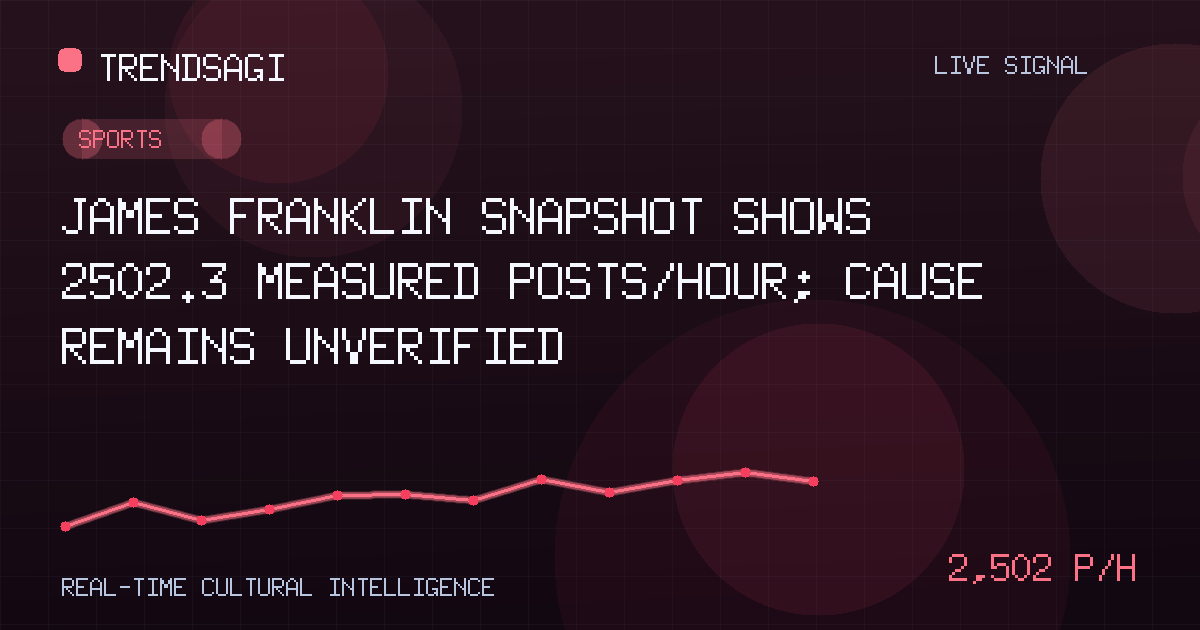
The stored James Franklin signal recorded a measured snapshot rate of 2502.3 posts/hour at 2026-10-03T01:56:37Z; the reason for the activity remains unverified. The figure was calculated over an exact 902-second window using 3 stored observations. It documents posting activity associated with the topic label during that interval, but it does not identify what triggered the activity.
The latest snapshot contained 1014 posts. That is a stored volume, not a rate. The 2502.3 figure is a measured snapshot rate expressed as posts per hour, not a live or current count, forecast, reach estimate, engagement measure, or count of unique people. For this signal, no verified public context establishes why the topic was moving.
| Metric | Value |
|---|---|
| Observation time | 2026-10-03T01:56:37Z |
| Measured posts/hour | 2502.3 posts/hour |
| Snapshot volume | 1014 posts |
| Calculation basis | Exact 902-second window using 3 stored observations |
Why this topic may be moving
The cause remains unclear. The record supplies the topic label James Franklin and the category Sports, but it provides no event description or identity details. Those fields do not establish which person the posts concern, whether they concern one person at all, or whether a sports development caused the activity.
Possible explanations to test—not findings to report—include:
- A sports result, roster change, injury, disciplinary development, award, or media appearance involving someone with that name.
- A clip, quotation, or interpersonal exchange that circulated through fan, news, or commentary communities.
- A scheduled release or live appearance that produced a synchronized reaction.
- A different person with the same name entering the monitored conversation.
- A repost wave, duplicated content, or automated repetition increasing post volume without a corresponding rise in original discussion.
The measured snapshot rate alone cannot separate those possibilities. The decisive work is to inspect representative posts, resolve the named person, and look for an event timestamp that matches the measured window.
Editorial takeaway: A measured posting rate can identify where investigation is needed, but it cannot establish the event, identity, sentiment, or cause behind the activity.
Why it matters
For editors, this signal should trigger verification rather than a causal headline. Publishing that James Franklin was moving because of a particular event would go beyond the available record. A reporter who first resolves the identity and finds time-aligned reporting or official material can turn the alert into a factual story; without that work, the defensible conclusion is limited to the measured posting activity.
For sports organizations, media teams, and monitoring specialists, the label’s ambiguity is an operational risk. Queries based only on a name can mix separate subjects. Future monitoring should attach verified identifiers, such as the person’s role and organization, and should preserve separate topic streams until the references converge. Readers should also distinguish conversation about a person from direct participation by that person.
The measurement is useful for triage, but not for sizing importance. There is no supplied baseline showing what is normal for this topic, so the record cannot establish how unusual the rate is or whether it persisted. It also does not reveal sentiment, audience geography, source reliability, or organic versus automated behavior.
What to watch next
- Resolve the identity. Read a representative cross-section of posts, not just the most reposted item, and note how users identify the relevant James Franklin. Look for consistent references to a role, team, league, organization, or location, then verify those identifiers against authoritative public material.
- Find the alleged event. Search post text for game references, names, quotations, dates, screenshots, and phrases that imply a result, announcement, or controversy. Check whether independent credible reports or an official sports source place that event at or near 2026-10-03T01:56:37Z.
- Establish chronology. Identify the earliest substantive item and distinguish it from reactions, screenshots, and reposts. A credible event preceding the 902-second measurement window is stronger context than an unsourced explanation appearing afterward.
- Test originality and concentration. Separate original posts from copies and quote-posts; inspect duplicate wording, repeated media, and tightly clustered timestamps. Heavy repetition without varied references would point toward redistribution rather than broad independent reaction.
- Recheck persistence. Compare the next scheduled observations using the same collection method and window definition. Consecutive activity would support a sustained conversation; a rapid return to the prior pattern would characterize this as a short-lived burst.
- Watch for convergent evidence. A decision-ready update would combine one clearly identified person, one corroborated event, publication times consistent with the measured interval, and multiple independent sources. Conflicting identities or several unrelated event threads would instead require the topic to be split.
Methodology and limitations
All figures here come from the stored signal observed at 2026-10-03T01:56:37Z. The latest snapshot volume is 1014 posts. The measured snapshot rate is 2502.3 posts/hour, calculated over an exact 902-second window from 3 stored observations. The stored category is Sports, while the signal description contains no supporting event narrative.
No verified external explanation was established, so this briefing does not assign a cause. The collection method, query scope, baseline, and sampling rules are not provided. Consequently, completeness and comparability cannot be assessed. Posts may include repeated material or multiple posts from the same account; the available figures do not establish unique authors, authentic activity, or independent reach.
Most importantly, 1014 is snapshot volume and 2502.3 is a measured historical posts-per-hour rate. Neither is a live rate, forecast, audience total, engagement count, sentiment score, or proof of causation. The signal is best used as a time-stamped investigation lead.
Track This Topic for New Signals
Set alerts for future velocity or sentiment changes around this topic.
Explore Tracking PlansAbout TrendsAGI research
TrendsAGI's automated research pipeline publishes dated signal snapshots, methodology notes, and practical workflows for teams evaluating cultural momentum. Read how signals are scoped, scored, and limited in our research methodology.


