1393-second window · 3 observations · Measured Aug 28, 2026, 8:28 PM UTC · Provider: go_recent_snapshot_v2
Jackson Hole Posts Hit 378 With Measured 312.7 Posts/Hour Rate on Aug 28, 2026
Jackson Hole posts hit 378 at 2026-08-28 20:28 UTC; measured rate 312.7 posts/hour. Trigger unconfirmed. Read what to watch next.
Automated briefing. Generated from stored signal measurements and source-backed research; it is not manually reviewed. Read the methodology and limitations.
Metrics in this briefing are a snapshot associated with its publication date and may not reflect current conditions.
What changed
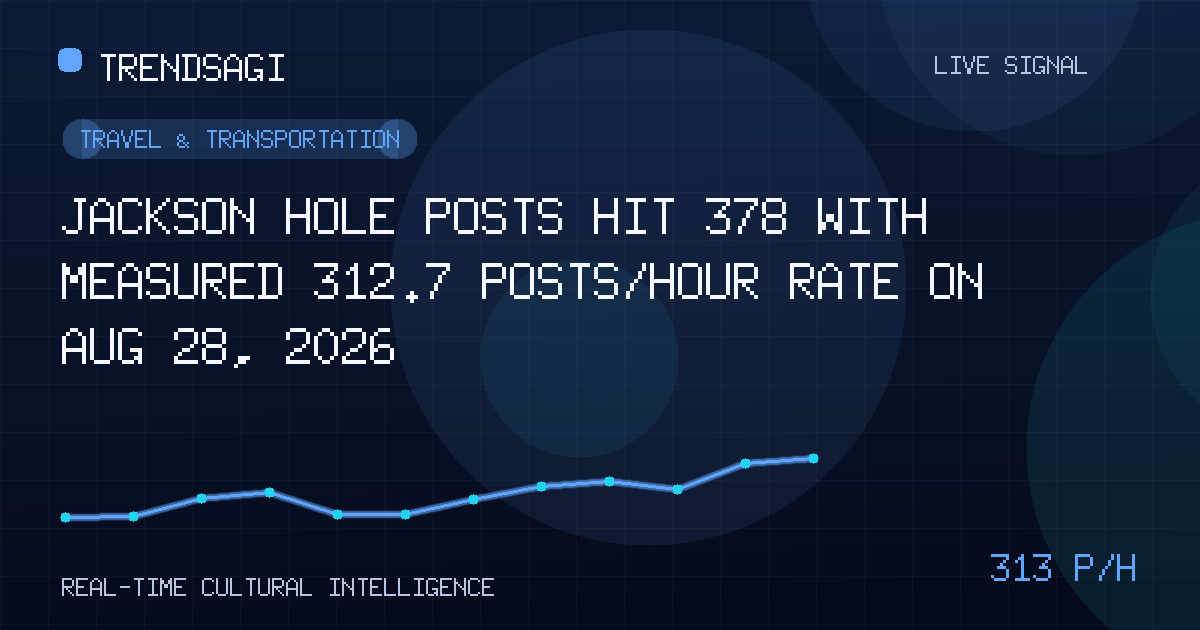
Jackson Hole is moving fast in the measured snapshot. At 2026-08-28T20:28:19Z, the topic had 378 posts, and the measured snapshot rate was 312.7 posts/hour over a 1,393-second window. This is a point-in-time measure of post volume, not a live rate or engagement estimate.
The cause of the increase is not confirmed by the signal. The dataset supplies no event metadata, no article links, and no topic classification beyond "Other," so the spike could reflect a scheduled policy conference, a market-moving comment, or unrelated coverage of the Jackson Hole region. The late-August timing is consistent with the period when central-bank attention historically centers on the Jackson Hole Economic Symposium, but this briefing does not verify that connection.
| Metric | Value |
|---|---|
| Observation time (UTC) | 2026-08-28 20:28:19 |
| Measured snapshot rate | 312.7 posts/hour |
| Snapshot volume | 378 posts |
Why this topic may be moving
Jackson Hole is more than a place name in financial news; it is a shorthand for a gathering where central bankers and economists discuss monetary policy. A surge in posts during the last week of August is a pattern that repeats in most years as market participants scan speeches for signals on interest rates, inflation, and employment. However, the stored signal cannot confirm that this is happening now.
Possible explanations for the measured acceleration include:
- A scheduled or unscheduled speech by a Federal Reserve or other central-bank official.
- Market analysts reacting to new economic data or a policy statement released around the same time.
- News coverage of the symposium agenda, participant arrivals, or an interview from the venue.
- A viral or widely shared post that uses "Jackson Hole" in a non-economic context, such as travel, wildfire smoke, or regional news.
Because the stored category is "Other," the system did not classify the content as finance, government, travel, or breaking news. The description field is empty. This means the topic label alone is not enough to identify a single cause.
The measured rate tells us that Jackson Hole was being talked about at increasing velocity in the minutes around the observation time; it does not tell us who was talking, why, or whether the discussion was positive, negative, or neutral.
Why it matters
The importance of this signal depends on what is actually driving the conversation. For fixed-income and currency markets, Jackson Hole has a history of moving asset prices when policymakers use the venue to hint at changes in monetary policy. A sharp rise in posts can be an early cue that the market is watching a particular speaker or phrase.
For communications or policy teams, a sudden cluster of posts is a signal to check whether a comment is being quoted accurately or spun in a way that could affect expectations. The signal cannot tell you whether the coverage is bullish, bearish, or neutral.
For researchers and analysts, the value is in the shape of the spike. The measured rate is high relative to the total volume: 378 posts at final snapshot with a 312.7 posts/hour rate implies the posts were heavily concentrated in a short window. That concentration is more consistent with a discrete trigger than with a slow, steady topic trend.
What to watch next
To turn this snapshot into actionable information, check the following in order:
- Sample the posts behind the volume. Read at least 20-30 actual posts to see whether the conversation is about monetary policy, an event, or something local.
- Identify the first large post or source. One influential account can create a short-lived spike; a broader move across many sources is more credible as a market-relevant trend.
- Check whether the rate persists. If the 312.7 posts/hour rate is followed by another hour at a similar or higher level, something ongoing is likely driving the topic. If volume falls to near zero quickly, it was a one-off mention.
- Watch for connection to specific economic terms, such as "rate cut," "inflation target," or "policy uncertainty," in the same posts.
- Look for a second wave after U.S. market hours, when commentary and analysis pieces tend to publish.
Specific watch signals include a new speech or statement from a Fed official, a sharp move in Treasury yields or the U.S. dollar around the same timestamp, and a shift in the dominant sources from news organizations to individual market participants.
Methodology and limitations
This briefing uses three stored observations captured over an exact 1,393-second window ending at 2026-08-28T20:28:19Z. Snapshot volume is 378 posts. The measured snapshot rate is 312.7 posts/hour. The rate is calculated by the system from the change in post counts across those observations; it is not an extrapolated forecast and does not represent unique users, reach, or engagement.
The signal can establish that Jackson Hole conversation accelerated sharply at a specific moment. It cannot establish why, who is talking, whether the posts are genuine or coordinated, or how the current level compares with prior years. No external verification was performed for this briefing, and no publisher attribution is included. The cause of the topic movement remains unconfirmed.
Track This Topic for New Signals
Set alerts for future velocity or sentiment changes around this topic.
Explore Tracking PlansAbout TrendsAGI research
TrendsAGI's automated research pipeline publishes dated signal snapshots, methodology notes, and practical workflows for teams evaluating cultural momentum. Read how signals are scoped, scored, and limited in our research methodology.