2702-second window · 3 observations · Measured Oct 4, 2026, 4:11 AM UTC · Provider: go_recent_snapshot_v2
Jackson Chourio snapshot: 385 posts and a measured 357.0 posts/hour rate
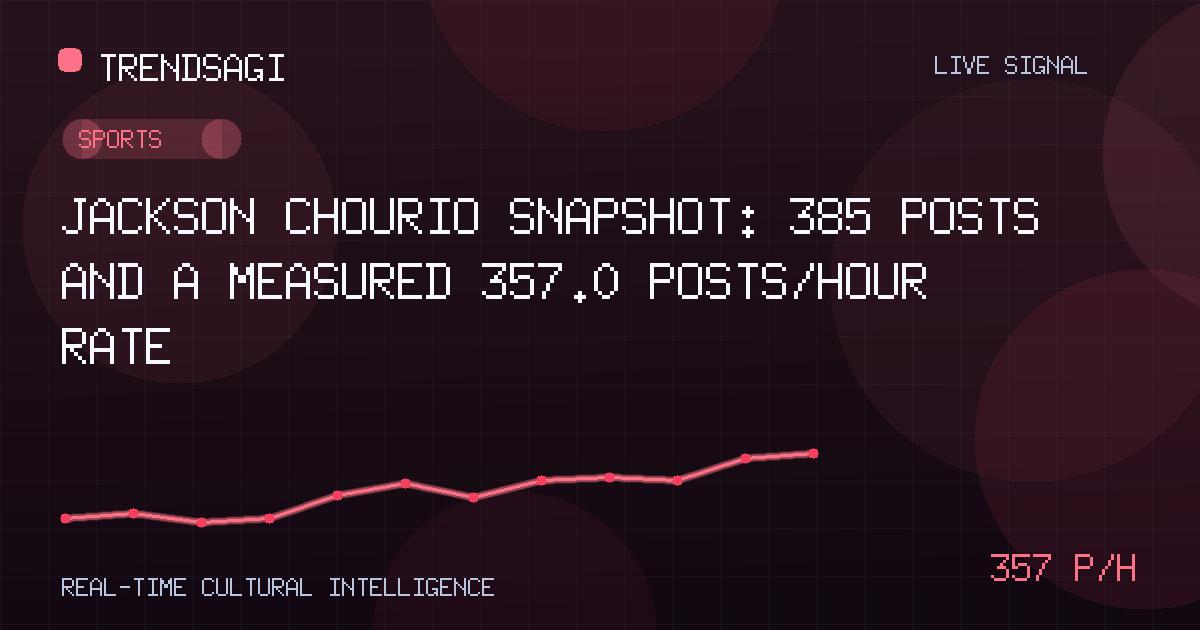
The Jackson Chourio label has 385 posts in the latest snapshot and a measured 357.0 posts/hour rate; the catalyst remains unverified.
Automated briefing. Generated from stored signal measurements and source-backed research; it is not manually reviewed. Read the methodology and limitations.
Metrics in this briefing are a snapshot associated with its publication date and may not reflect current conditions.
What changed
The latest snapshot for the sports topic labeled Jackson Chourio contains 385 posts and a measured snapshot rate of 357.0 posts/hour. The direct answer is that the label saw concentrated posting activity at the observed moment, but no verified public context establishes why it was moving. The available evidence does not tie the burst to a particular announcement, result, injury, transaction, or other event.
The measured change was recorded at 2026-10-04T04:11:00Z over an exact 2702-second window using 3 stored observations. The 357.0 posts/hour figure is a retrospective, measured snapshot rate—not a live or current rate, forecast, reach figure, engagement count, or count of unique people. Snapshot volume and velocity are different: 385 is the size of the latest snapshot, while 357.0 describes posting change within its defined window.
| Observation time | Measured snapshot rate | Snapshot volume |
|---|---|---|
| 2026-10-04T04:11:00Z | 357.0 posts/hour | 385 posts |
Together, the figures make the signal worth monitoring, but they do not show whether activity is above the topic's normal baseline. No comparison period is supplied, so the defensible conclusion is not that Jackson Chourio is more important than usual; it is that the stored sample captured a fast cluster of posts at that time.
Why this topic may be moving
The cause remains unclear. The stored signal has no supporting description, and no verified public item has been established as the trigger. Several mechanisms could generate this pattern, but they are hypotheses to test rather than findings:
- Event-driven attention: A sports development may have prompted immediate reaction. Nothing verified currently identifies a specific game, result, injury, roster move, award, or announcement as the cause.
- Amplified reaction: A widely shared item may have caused many accounts to respond to the same underlying story. That would make the activity meaningful as attention while leaving the original development still unconfirmed here.
- Repetition or coordinated posting: Repeated wording or reposting can increase post volume without representing independent events or people. The supplied measurements do not test that possibility.
- Mixed local and national pickup: One account's post may be repeated by larger followings, producing a fast rise without broad original reporting. Source diversity cannot be assessed from the current signal.
None of these possibilities should be promoted to a cause until the underlying posts and their chronology are examined.
A high post count can mark attention, but without a verified catalyst it cannot establish what happened, why attention rose, or whether the signal is durable.
Why it matters
The value of this signal is prioritization, not explanation. It identifies a short interval in which monitoring and verification deserve attention.
- Fans and followers: They now have an alert to check, but not enough evidence to know whether a confirmed development occurred or how consequential it is.
- Editors and reporters: They can use the window to locate the earliest substantive posts, identify the first credible source, and avoid amplifying an unexplained cascade.
- Social and trend analysts: They can compare rate, persistence, source mix, and account diversity rather than treating raw volume as importance.
- Teams, brands, and commercial teams: They should not translate post velocity into audience sentiment, purchasing intent, or brand impact without separate evidence.
The most important distinction is between attention and information. A burst can be large because people are reacting, repeating, or misunderstanding; the current record cannot discriminate among those cases.
What to watch next
The next useful step is to move from volume to causal verification, in this order:
- Inspect the burst itself. Review a representative slice of posts around the exact snapshot time, record their timestamps, and find the earliest item that appears to start the cluster.
- Locate the primary source. Search for the underlying report or announcement, compare its publication time with the first wave of posts, and attribute a catalyst only after a credible source confirms it.
- Separate post types. Mark original reporting, quotations, reactions, reposts, and duplicate wording. This reveals whether the count reflects many developments or many responses to one.
- Measure persistence. Add another observation using the same collection method and window length. A continuing rate indicates a sustained signal; a sharp fall suggests the snapshot caught a short burst.
- Establish a baseline. Compare this window with earlier, equally defined windows for the same label. That comparison is necessary before calling the activity unusually high.
Concrete signals to watch
- A named, timestamped catalyst appears in credible public reporting or an official announcement.
- Multiple independent publishers discuss distinct facts rather than repeating one post.
- The measured snapshot rate remains similar in the next window instead of dropping quickly.
- Post text and sources diversify, supporting broader discussion rather than a single-source cascade.
- The same wording, link, or claim recurs across accounts, which would point to amplification rather than independent confirmation.
No numerical threshold is warranted yet. The immediate goal is corroboration and a clearer account of how the activity developed.
Methodology and limitations
The snapshot contains 385 posts. The measured rate is 357.0 posts/hour across an exact 2702-second window based on 3 stored observations, with the measurement recorded at 2026-10-04T04:11:00Z. The figure counts posts in the sampled signal; it is not a count of unique people, impressions, clicks, or interactions.
The signal does not provide the full post set, original account identities, duplicate rates, engagement, sentiment, geography, publisher mix, or a prior baseline. A rate based on 3 observations can also be sensitive to where the window begins and ends. Consequently, the signal can establish observed posting velocity and a point-in-time snapshot, but not who participated, why activity rose, whether sentiment was positive, or whether the movement will continue.
Because no external catalyst is verified, this briefing does not assign one. The practical conclusion is simple: Jackson Chourio merits a targeted verification pass, while 357.0 posts/hour should remain a measured historical snapshot rather than a live trend claim.
Track This Topic for New Signals
Set alerts for future velocity or sentiment changes around this topic.
Explore Tracking PlansAbout TrendsAGI research
TrendsAGI's automated research pipeline publishes dated signal snapshots, methodology notes, and practical workflows for teams evaluating cultural momentum. Read how signals are scoped, scored, and limited in our research methodology.


