899-second window · 3 observations · Measured Sep 30, 2026, 2:26 AM UTC · Provider: go_recent_snapshot_v2
Jackie Young snapshot shows 853.2 posts/hour; public trigger remains unverified
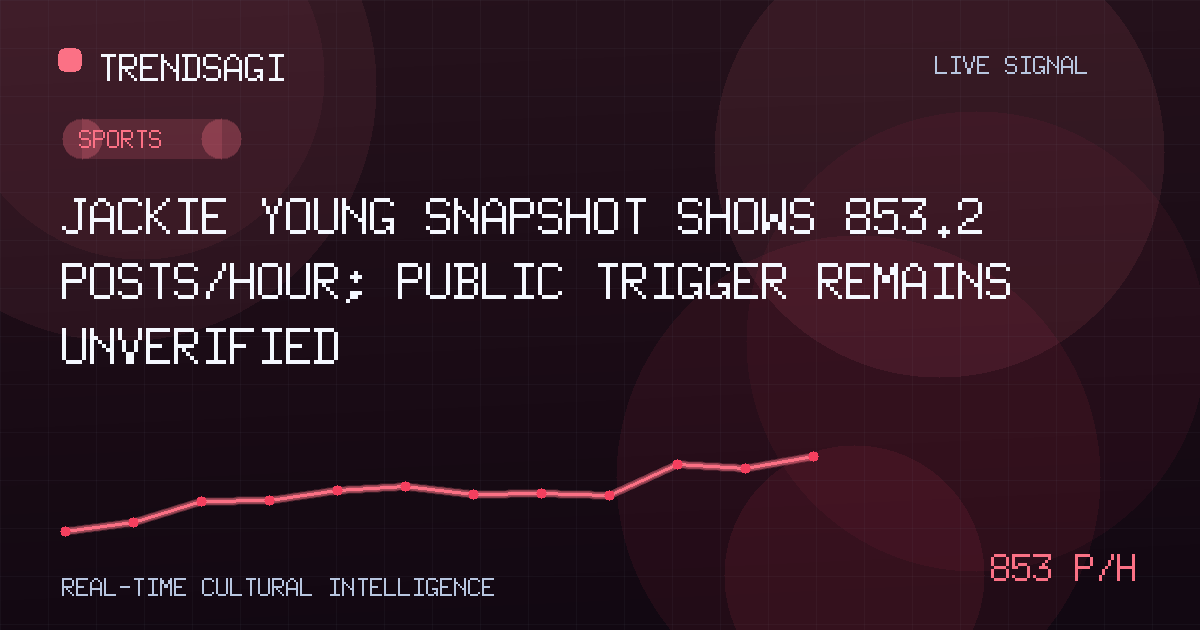
Jackie Young's stored signal shows a measured 853.2 posts/hour snapshot rate over 899 seconds and 818 snapshot posts; the trigger is unverified.
Automated briefing. Generated from stored signal measurements and source-backed research; it is not manually reviewed. Read the methodology and limitations.
Metrics in this briefing are a snapshot associated with its publication date and may not reflect current conditions.
What changed
The stored Jackie Young signal shows a measured snapshot rate of 853.2 posts/hour over an exact 899-second window using 3 stored observations. That is evidence of a short-window change in posts captured around the topic at the measured time. It does not identify the trigger, and no specific public event has been verified as the cause.
At 2026-09-30T02:26:35Z, the latest snapshot contained 818 posts. Snapshot volume is the size of the stored collection at that observation, not a speed of activity. The rate and volume are separate measures and should not be substituted for one another. The stored category is Sports, but it does not supply a team, league, role, or event that would safely resolve which Jackie Young the posts concern.
| Measure | Stored value |
|---|---|
| Observation time | 2026-09-30T02:26:35Z |
| Measured snapshot rate | 853.2 posts/hour |
| Measurement basis | Exact 899-second window using 3 stored observations |
| Latest snapshot volume | 818 posts |
Why this topic may be moving
There is no verified, attributable public explanation for this particular movement. The topic label and Sports category establish what is being monitored, not why it moved. Because the signal does not pair the name with a team, league, school, role, or dated announcement, even the relevant public context remains unresolved.
Several mechanisms could produce this pattern, but they are hypotheses rather than findings:
- A time-specific sports result, availability update, roster move, or other competition event could have created a news burst.
- An official statement from an identified team, league, school, or person could have prompted reaction.
- A viral clip, exchange, or controversy could have driven repeated posts without a major formal announcement.
- Attention could have diffused from a larger event, search result, recommendation system, or creator network.
- If the name maps to more than one subject, activity about different people could be blended under one label.
None of these possibilities should be reported as the cause until a dated primary item or attributable publisher report aligns with the measured window. Repetition alone is not confirmation: the same claim can be copied across many posts, while multiple independent reports can provide better evidence that a real event occurred.
The measured rate establishes that the monitored collection changed within a short window; it does not establish who generated the posts, whether they were original, or what happened in the wider world.
Why it matters
This matters because a fast post count can look conclusive even when identity and cause are unresolved. The useful decision is not whether to publish every high-volume topic, but whether there is enough verified information to explain it accurately.
- Reporters and editors should separate a confirmed event from an unexplained social spike and avoid putting an unsupported trigger in a headline or alert.
- Fan-facing community teams should determine whether the conversation concerns their subject before drafting a response or amplifying a claim.
- Trend analysts should preserve the distinction between volume and rate, then add a baseline, author-level checks, and repeated snapshots.
- Readers and decision-makers need to know that a post count can reflect copies and conversation density, not distinct participants.
The central risk is entity confusion. If unrelated people or subtopics share the name, combining their activity could create a trend that never existed as a single conversation. The briefing therefore reports the movement while withholding a causal story.
What to watch next
The next checks should move from quantity to identity, provenance, breadth, and persistence:
- Resolve the entity. Determine whether the label points to a specific person and, if so, the team, league, school, role, or event associated with that person at the observation time.
- Align the timeline. Compare the onset of the measured activity with dated posts, official pages, game records, and attributable reporting; discard context that predates the window or refers to a different subject.
- Verify a trigger. Seek a primary statement or direct report, then check whether independent reputable publishers describe the same event at the same time.
- Test distribution. Count distinct original authors separately from reposts, quotes, reactions, and likely duplicate media; a concentrated source is a different signal from broad participation.
- Check persistence. Add later snapshots and a longer comparison window. This measurement can describe its own 899-second interval, but only repeated observations can show whether the burst holds, fades, or recurs.
- Inspect the content. Identify the claim being repeated, its earliest traceable source, whether it is fact, rumor, reaction, or criticism, and how sentiment changes as more posts appear.
- Watch for response. A statement, correction, result update, or clarification from an identified party would be a stronger signal than another wave of unattributed reposts.
Concrete watch signals are converging timestamps, multiple independent sources, broader author participation, a verifiable originating post, and subsequent snapshots that preserve the movement. If those checks do not resolve the entity or cause, the responsible description remains a measured snapshot rate with an unknown trigger.
Methodology and limitations
The reported rate is 853.2 posts/hour, measured at 2026-09-30T02:26:35Z from 3 stored observations across an exact 899-second window. It is a measured snapshot rate, not a live or current rate, a forecast, reach, engagement, or unique-person count.
The latest snapshot volume is 818 posts. That value describes the stored collection at the observation time; it is not posts per hour and does not show how many authors, accounts, or people were active. The rate and volume also cannot establish sentiment, importance, authenticity, or whether the underlying development was favorable, adverse, or neutral.
The record does not provide raw post text, author identities, baseline activity, engagement data, geographic distribution, or verified event context. Those omissions prevent causal attribution and make entity resolution essential. This briefing can establish the timing, stated rate, window, observation count, and snapshot volume; it cannot establish what happened or who was talking. External explanations are therefore omitted rather than guessed.
Track This Topic for New Signals
Set alerts for future velocity or sentiment changes around this topic.
Explore Tracking PlansAbout TrendsAGI research
TrendsAGI's automated research pipeline publishes dated signal snapshots, methodology notes, and practical workflows for teams evaluating cultural momentum. Read how signals are scoped, scored, and limited in our research methodology.


