902-second window · 2 observations · Measured Oct 6, 2026, 9:56 AM UTC · Provider: go_recent_snapshot_v2
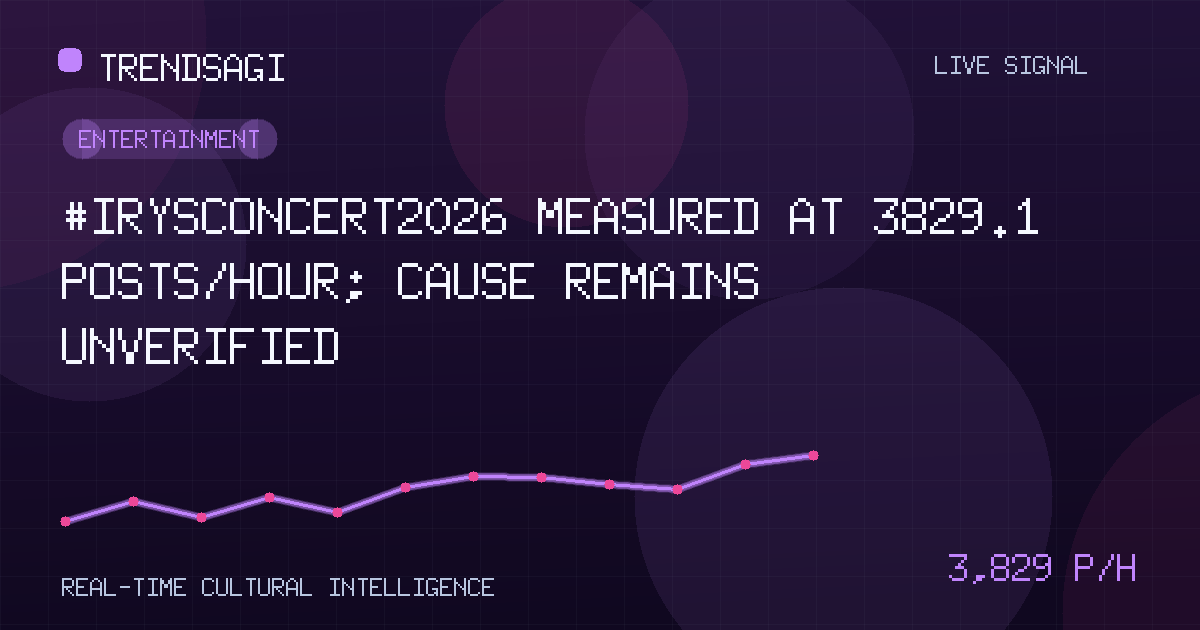
#IRySConcert2026 measured at 3829.1 posts/hour; cause remains unverified
#IRySConcert2026 logged 3829.1 posts/hour over 902 seconds; review the spike, its limits, and the checks needed to explain it.
Automated briefing. Generated from stored signal measurements and source-backed research; it is not manually reviewed. Read the methodology and limitations.
Metrics in this briefing are a snapshot associated with its publication date and may not reflect current conditions.
What changed
#IRySConcert2026 is showing a rapid, measured rise in posts, while the trigger behind that rise remains unverified. The stored entertainment-category signal establishes increased posting activity around the hashtag at the latest observation. It does not establish that an announcement, ticket release, performance, or controversy caused the change.
The measured snapshot rate was 3829.1 posts/hour across an exact 902-second window using 2 stored observations, measured at 2026-10-06T09:56:10Z. The latest snapshot volume was 1945 posts. The rate is tied to that historical window, not a live or current rate; the volume is a snapshot count, not a second rate.
| Observation time | 2026-10-06T09:56:10Z |
|---|---|
| Measured snapshot rate | 3829.1 posts/hour |
| Snapshot volume | 1945 posts |
These figures answer different questions. The rate describes how quickly the observed post count changed; the volume describes the size of the latest stored snapshot. Neither figure is a measure of unique people, engagement, reach, ticket demand, or event size.
Why this topic may be moving
A cause cannot responsibly be assigned from the stored material alone. No public catalyst has been verified in the material supporting this briefing, and the hashtag itself indicates only the subject used by contributors. Several mechanisms could produce a burst, but each needs confirmation before it can be reported as the reason.
- An official artist, organizer, venue, or ticketing update could have prompted replies; no such update is verified here.
- A ticket release, availability change, access problem, or sellout claim could have driven discussion; none is established by the signal.
- Performance clips, fan coordination, promotional reposting, or a participant's disclosure could have accelerated the hashtag.
- News coverage, criticism, misinformation, or a moderation decision could have created attention without representing broad public interest.
- Duplicate, automated, or coordinated posts could contribute to the measured count, so volume alone cannot establish an organic audience.
The useful story is not merely that the hashtag is loud; it is that the stored record shows a rapid rise in posting while the trigger remains unconfirmed. Any stronger narrative would outrun the evidence.
Until a timestamped public development can be linked to the rise, the most defensible description is a sharp change in posting activity with an unknown cause. That distinction matters because a plausible story can still be false, premature, or based on a different event.
Why it matters
The immediate value is verification, not amplification. Several groups have a practical reason to examine the signal:
- Artist and promoter teams can check whether the activity corresponds to a confirmed announcement or operational issue before responding. High posting speed may justify attention, but it does not show sentiment or information quality.
- Ticketing, venue, and event teams can compare the observation time with official system notices and customer-support themes. The signal cannot show sales, attendance, capacity, or geographic demand.
- Journalists and analysts can use the timestamp as a narrow prompt for reporting while avoiding unsupported causal language. A spike is a reason to investigate, not evidence of what happened.
- Fans and prospective attendees should seek confirmed logistics from the responsible parties. Conversation volume is not confirmation of a date, venue, ticket status, or access arrangement.
For all of these audiences, the key risk is conflation: treating a fast post count as a large or verified event. The signal can flag a moment worth checking; it cannot replace primary evidence.
What to watch next
Useful follow-up would test both persistence and cause:
- Take another comparable snapshot. Record the exact observation time, post count, measurement window, and collection method. A continued rise would suggest the burst was not confined to one interval; a reversal would show why duration matters.
- Check primary event sources. Look for timestamped updates from the artist, organizer, venue, or official ticketing provider, and compare their publication time with 2026-10-06T09:56:10Z. This can establish sequence without assuming causation.
- Verify ticket claims directly. Treat screenshots and reposts as leads, not proof. Confirm any sale, availability, access, refund, or sellout statement through the official provider.
- Sample what is inside the spike. Separate original posts from duplicates and reactions, and assess whether activity appears automated, coordinated, or geographically concentrated. Those checks help distinguish event response from collection mechanics.
- Attribute reporting to its publisher. If reputable coverage explains a development, note who published it and when. A publisher's report can verify a reported fact, but one article still may not explain the full volume.
- Track practical confirmations. Watch for an official schedule, venue information, access guidance, or cancellation notice. These are concrete signals readers can use; speculation about an unannounced cause is not.
The next credible explanation should meet a simple test: a verifiable source, a clear timestamp, and a demonstrable link to the increase. Even then, the source may explain only part of the movement without proving that every post was a spontaneous reaction.
Methodology and limitations
This briefing uses the canonical stored signal: an observation at 2026-10-06T09:56:10Z, a latest snapshot volume of 1945 posts, and a measured change rate of 3829.1 posts/hour across an exact 902-second window based on 2 stored observations. The stored category is entertainment. Because no external catalyst was verified, no specific announcement or event claim is presented as fact.
The main limitation is the small observation base. Two stored points establish the reported change in this window but cannot show whether the pattern is typical, how long it lasts, or whether it later reverses. Hashtag-based measurement may also include reposts, spam, bots, or unrelated uses. It does not reveal sentiment, authenticity, language, location, or unique participants. The 3829.1 posts/hour figure is therefore a measured snapshot rate only; 1945 posts is a stored volume only. The reliable conclusion is that activity rose sharply around #IRySConcert2026 in the measured window, while the reason remains an open question requiring primary verification.
Track This Topic for New Signals
Set alerts for future velocity or sentiment changes around this topic.
Explore Tracking PlansAbout TrendsAGI research
TrendsAGI's automated research pipeline publishes dated signal snapshots, methodology notes, and practical workflows for teams evaluating cultural momentum. Read how signals are scoped, scored, and limited in our research methodology.


