898-second window · 3 observations · Measured Sep 27, 2026, 10:06 AM UTC · Provider: go_recent_snapshot_v2
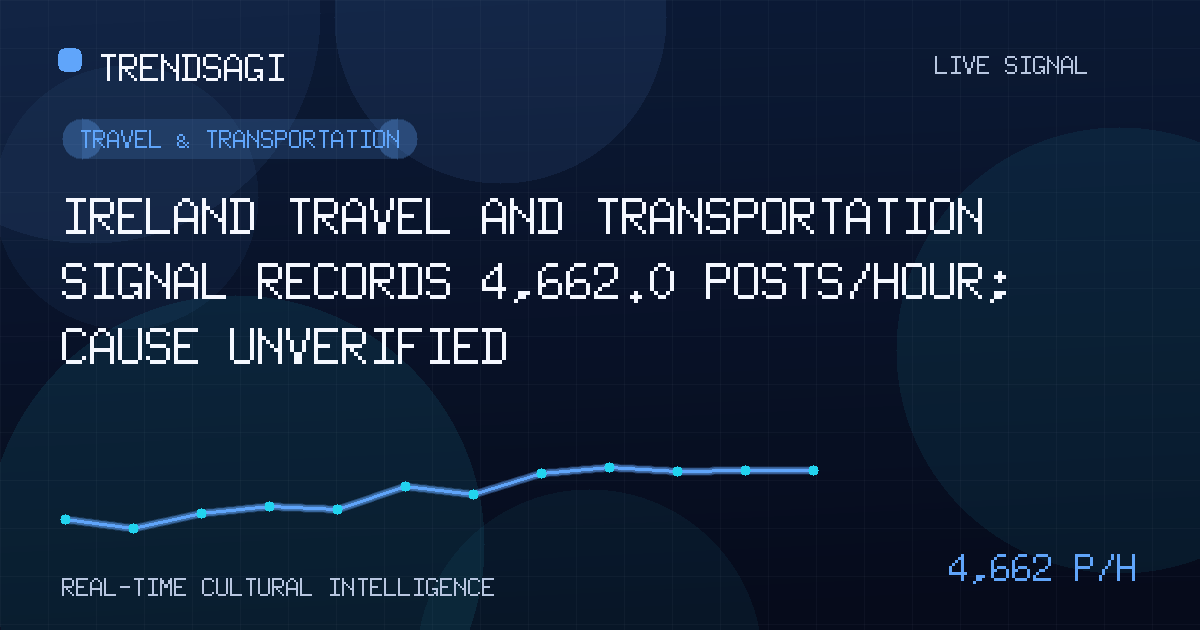
Ireland travel and transportation signal records 4,662.0 posts/hour; cause unverified
Ireland’s stored travel signal shows 1,945 posts and a measured 4,662.0 posts/hour; it indicates activity worth verifying, not a confirmed cause.
Automated briefing. Generated from stored signal measurements and source-backed research; it is not manually reviewed. Read the methodology and limitations.
Metrics in this briefing are a snapshot associated with its publication date and may not reflect current conditions.
What changed
The stored Ireland signal in the Travel & Transportation category recorded 4,662.0 posts/hour for the snapshot observed at 2026-09-27T10:06:57Z. The direct finding is fast short-window activity; the cause remains unverified because no specific public catalyst has been established.
The measured snapshot rate came from 3 stored observations across an exact 898-second window. The latest snapshot contained 1,945 posts. These are separate measures: the rate describes change within the measured window, while snapshot volume describes the collection at its latest observation. Neither is a live or current rate, forecast, reach, engagement, or unique-person count.
| Metric | Stored value |
|---|---|
| Observation time | 2026-09-27T10:06:57Z |
| Measured snapshot rate | 4,662.0 posts/hour |
| Measurement basis | 898 seconds; 3 stored observations |
| Snapshot volume | 1,945 posts |
Why this topic may be moving
The category shows where the signal was classified, not why it moved. Travel and transportation discussions can include destination information, transport operations, policy, itineraries, service issues, and cultural stories with a mobility angle. The stored description contains no event, source, or narrative that identifies a catalyst, so each possible explanation remains a hypothesis.
- Event clustering: Determine whether many posts cite the same timely event, announcement, or service issue, and whether their timestamps cluster around it.
- Repetition: Separate original posts from quotations, reposts, promotions, and coordinated-looking distribution; volume alone does not show the breadth of participation.
- Geographic meaning: Check whether Ireland is a destination, origin, nationality, organization, incidental mention, or something else. The topic label alone does not establish Irish travel relevance.
- Semantic mix: Code a sample for transport, tourism, policy, news, complaints, humor, and other themes. A mixed sample would not support a single-cause account.
A timestamp-bounded Google Search can check for contemporaneous reporting and official notices, while direct sampling can show what posters actually cite. A candidate should be treated as the explanation only when its timing and content connect it to the observed cluster. Without that connection, the cause remains unclear.
The measured snapshot rate establishes that the sampled conversation moved quickly during the stored window; it does not identify the catalyst, sentiment, reach, or real-world consequence.
Why it matters
The immediate value is editorial triage. A fast unexplained rate identifies where monitoring may be most useful, but it does not justify a causal headline or a claim that a particular event is driving public behavior.
- Travel editors and tourism teams: Check whether sampled posts contain actionable destination, itinerary, policy, or service information before escalating the topic.
- Transport operators: If operational content is confirmed, compare claims with authorized channels and identify the locations, routes, or services named in the sample.
- Communications and reputation teams: Treat the rate as a prompt for review, not proof of a crisis, campaign, or public reaction.
- Analysts: Preserve the measurement window, metric definitions, and collection scope so later comparisons use the same basis.
For these readers, the signal is best used to prioritize verification and operational checks. Its value comes from what closer inspection may reveal, not from assigning a cause before the evidence supports one.
What to watch next
The priority is to turn an unexplained rate into a testable account through better content, timing, and source checks.
- Check persistence: Compare complete windows immediately before and after the stored interval. Persistence would strengthen the case for a developing topic; disappearance would leave open that it was a short burst.
- Establish chronology: Find the earliest posts and candidate public items. A purported cause published after the cluster cannot explain its onset.
- Classify the content: Review a time-stratified sample by event, source type, language, and geography. Determine whether one theme accounts for the activity or many unrelated themes do.
- Check source integrity: Look for duplicated wording, quotation chains, account histories, and coordinated timing, but do not label activity automated without evidence.
- Test actionability: Determine whether posts name specific services, locations, routes, policies, or traveler decisions, and whether those details recur.
- Confirm metric definitions: Keep snapshot volume separate from the measured rate; neither should be used to derive the other without documentation.
Concrete watch signals include:
- The measured rate remains high in adjacent complete windows.
- One verified event or issue accounts for a growing share of sampled posts.
- Distinct primary-source posts increase while duplicate reposts decline.
- A timestamp-aligned public catalyst emerges from credible reporting or official notices.
- Sampled content more clearly concerns travel or transportation within Ireland.
These are confirmation tests, not predictions. Until they resolve the uncertainty, the defensible description is fast, unexplained short-window activity rather than a confirmed event-driven trend.
Methodology and limitations
The rate was measured from 3 stored observations over the exact 898-second window and anchored at 2026-09-27T10:06:57Z. It should be read only as a measured snapshot rate. The 1,945 posts are latest snapshot volume, not an hourly rate, forecast, reach, engagement, or unique-person count.
The signal does not provide a historical baseline, platform mix, collection coverage, language mix, geographic distribution, account verification, duplicate handling, sentiment, or evidence that activity persisted beyond the window. The observations cannot establish seasonality or a durable shift, and category assignment may not describe every item accurately.
No public causal claim is included because no specific, timestamp-aligned catalyst was verified. Readers should therefore treat the observation as a prompt for corroboration, not as evidence of a particular event or an enduring change in Irish travel behavior.
Track This Topic for New Signals
Set alerts for future velocity or sentiment changes around this topic.
Explore Tracking PlansAbout TrendsAGI research
TrendsAGI's automated research pipeline publishes dated signal snapshots, methodology notes, and practical workflows for teams evaluating cultural momentum. Read how signals are scoped, scored, and limited in our research methodology.