901-second window · 3 observations · Measured Sep 29, 2026, 11:06 AM UTC · Provider: go_recent_snapshot_v2
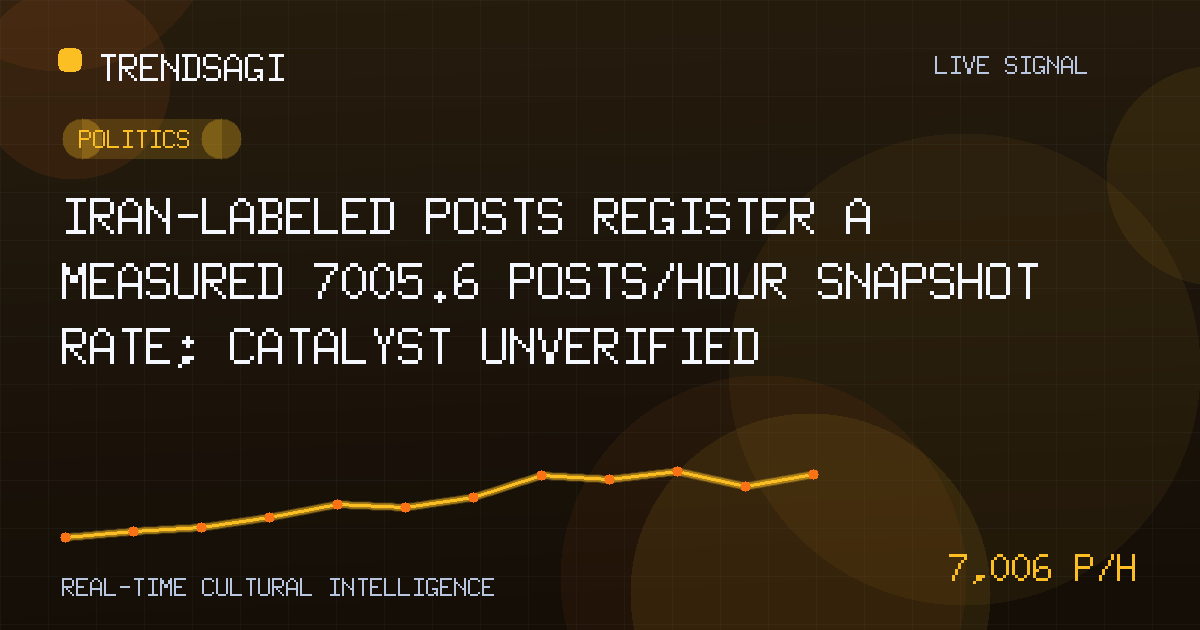
Iran-labeled posts register a measured 7005.6 posts/hour snapshot rate; catalyst unverified
Iran-labeled posts measured 7005.6 posts/hour over 901 seconds, with 3600 posts in the latest snapshot; cause unclear, next checks explained.
Automated briefing. Generated from stored signal measurements and source-backed research; it is not manually reviewed. Read the methodology and limitations.
Metrics in this briefing are a snapshot associated with its publication date and may not reflect current conditions.
What changed
The monitored Iran topic registered a measured snapshot rate of 7005.6 posts/hour for the observed change. The figure covers an exact 901-second window based on 3 stored observations, measured at 2026-09-29T11:06:30Z; the latest snapshot volume was 3600 posts.
The cause remains unclear. No public fact has been verified that ties the movement to a specific event, statement, or platform development, so the defensible conclusion is increased Iran-labeled activity in the monitored stream at that timestamp—not that a particular story caused it.
| Observation time | 2026-09-29T11:06:30Z |
|---|---|
| Measured snapshot rate | 7005.6 posts/hour |
| Snapshot volume | 3600 posts |
Why this topic may be moving
The series is categorized as Politics, but it carries no event-level explanation. Iran is a broad label: a mention may concern events, people, institutions, culture, or incidental keyword use unless the underlying posts demonstrate otherwise. The summary does not show that classification.
A real-world development and a measurement effect can produce the same visible symptom: more posts assigned to the label. Repetition of one source, a collection boundary, or imperfect topic matching could also distort the pattern. These are hypotheses to test, not findings. A causal headline requires timestamped public evidence, not volume alone.
The defensible finding is that the monitored Iran-labeled stream changed at a measured rate of 7005.6 posts/hour during this window. The triggering event, the people behind the posts, their motives, and the broader significance remain unresolved.
Accordingly, this briefing records what moved and where verification is needed, but it does not assign blame, motive, or political meaning that the signal does not contain.
What the signal can—and cannot—establish
It establishes only narrow facts about the monitored series. The observation was recorded at 2026-09-29T11:06:30Z; the supplied rate is 7005.6 posts/hour across an exact 901-second window using 3 observations; and the latest snapshot volume was 3600 posts. Together, these values identify a time-bound increase in captured item count and justify closer inspection.
- The rate is a change measurement, not the size of the latest snapshot. It should be read as the supplied time-stamped result, not a live or current total.
- The 3600 figure describes latest snapshot volume. It does not mean 3600 people, views, engagements, or additions during the 901-second window.
- The label and Politics category describe classification, not sentiment, policy position, or author nationality.
The signal does not provide a historical baseline, so it cannot show whether this rate is unusual for the topic. It also cannot establish original versus reposted content, sentiment, factual accuracy, coordination, geography, language mix, or unique authors. It is not a measure of total Iran-related conversation across the internet. A measured increase in this collection may matter as a monitoring alert while still saying little about representative public opinion.
Why it matters
Newsrooms and editors need the signal because the increase can justify checking for a verified development, but publishing a causal frame before verification would turn a volume change into an unsupported news claim. Regional analysts and researchers can use the timestamp as an anchor for building an event timeline and a cleaner time series.
Public affairs, policy, and diaspora or community teams should treat the label as a prompt to examine which questions and communities are active, not as evidence of consensus. Trust and safety teams may also need to check whether apparent momentum is being amplified by duplicate content or automated posting. None of those interpretations should be assumed from the aggregate alone.
What to watch next
The immediate priority is to determine whether this is a real information event, a concentrated source effect, or a collection artifact.
- Collect adjacent snapshots. Compare subsequent windows in the same series, keep the measured rate separate from snapshot volume, and determine whether the movement persists, reverses, or appears confined to this observation.
- Audit collection. Check topic-matching rules, deduplication, any volume cap, language and geographic coverage, and time-zone boundaries. Establish whether 3600 posts are all available items or only the captured set.
- Inspect source structure. Review early-posting accounts, domains, original material versus quotes and reposts, repeated text, and concentration by source. Repetition can inflate apparent momentum; it does not by itself prove coordination.
- Build a public timeline. Use a Google Search verification pass around the exact UTC observation, then inspect any linked primary record and independent reporting. A later article may document an aftermath, but it cannot alone prove what caused earlier posts.
- Code relevance and content. Separate posts meaningfully about Iran from incidental uses, and classify subject matter, factual claims, and sentiment. This tests whether the broad label and Politics category accurately represent the captured material.
- Test portability. Check whether a comparable pattern appears on other platforms under transparent collection definitions rather than assuming one monitored stream represents all public discussion.
Concrete signals that would strengthen a real-event interpretation include a verifiable primary record aligned with the window, several independent originators, source diversity, and persistence across later snapshots and platforms. Signals that would weaken it include widespread duplicate text, topic-label mismatches, a collection cap, no timestamped public event, or disappearance in adjacent observations.
Methodology and limitations
The rate of 7005.6 posts/hour is the supplied measured snapshot result for an exact 901-second window using 3 stored observations at 2026-09-29T11:06:30Z. It is not a live or current rate, forecast, reach, engagement, or unique-person count. The 3600 figure is latest snapshot volume only; it should not be relabeled as a rate or assumed to be cumulative without documentation.
All conclusions are bounded to the collection method and timestamp. The summary provides no underlying post text, account counts, geography or language mix, platform coverage, historical baseline, or verified external catalyst. Those omissions prevent causal attribution and an assessment of representativeness. The signal can trigger verification; it cannot complete it.
Track This Topic for New Signals
Set alerts for future velocity or sentiment changes around this topic.
Explore Tracking PlansAbout TrendsAGI research
TrendsAGI's automated research pipeline publishes dated signal snapshots, methodology notes, and practical workflows for teams evaluating cultural momentum. Read how signals are scoped, scored, and limited in our research methodology.