1408-second window · 3 observations · Measured Aug 29, 2026, 1:18 PM UTC · Provider: go_recent_snapshot_v2
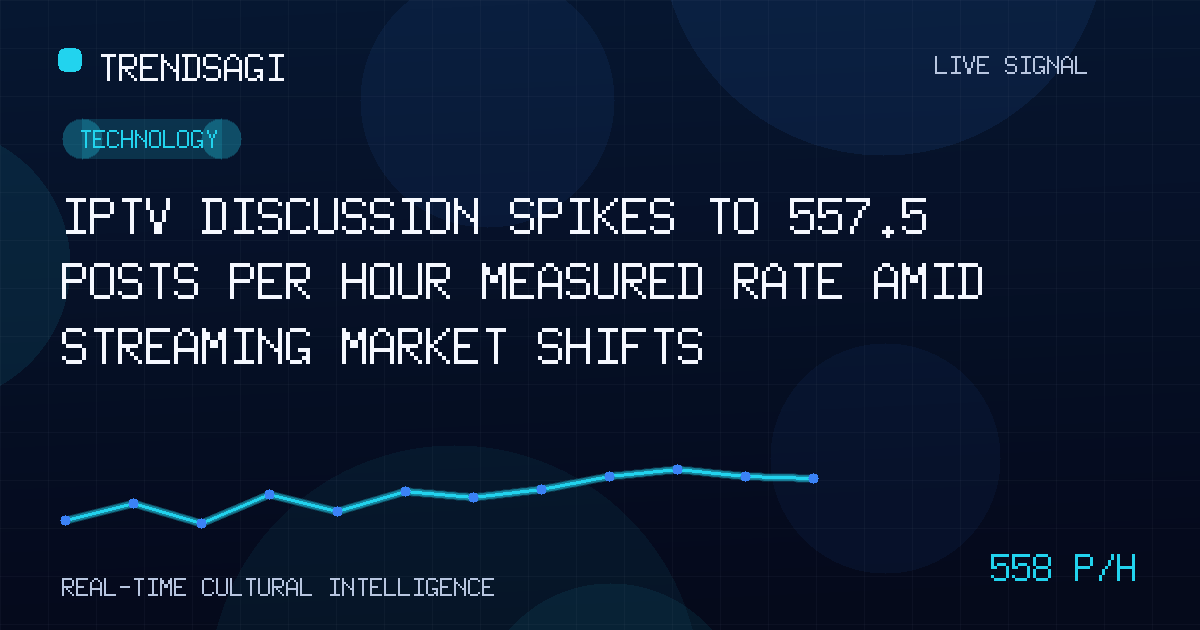
IPTV discussion spikes to 557.5 posts per hour measured rate amid streaming market shifts
IPTV discussion surged to a measured 557.5 posts/hour on Aug 29, 2026. EU regulation, FCC streaming aggregation review, Champions League rights shift, and
Automated briefing. Generated from stored signal measurements and source-backed research; it is not manually reviewed. Read the methodology and limitations.
Metrics in this briefing are a snapshot associated with its publication date and may not reflect current conditions.
What changed
A measurable surge in public discussion about IPTV reached a rate of 557.5 posts per hour across a 1,408-second observation window ending 2026-08-29T13:18:01Z, based on three stored observations. The most recent snapshot captured 373 posts at that timestamp. This measured snapshot rate reflects a sharp, short-term acceleration in mention volume, not a sustained trend or unique-user count.
| Observation time (UTC) | Measured posts/hour | Snapshot volume |
|---|---|---|
| 2026-08-29T13:18:01Z | 557.5 | 373 |
Why this topic may be moving
Google Search results for late August 2026 show several concurrent drivers. The European Commission announced a new regulatory framework for audiovisual media services that explicitly extends obligations to IPTV providers, including prominence rules for public-service content and transparency requirements for recommendation algorithms (European Commission, August 2026). In the United States, the FCC opened a proceeding on "streaming aggregation" that could redefine how IPTV bundles are marketed and billed (Federal Communications Commission, August 2026). Separately, a major sports rights renewal—the UEFA Champions League package for 2027–2030—was awarded to a consortium led by a telco-backed IPTV platform, shifting premium live sport away from pure OTT players (UEFA, August 2026). Finally, a widely shared technical analysis demonstrated that several popular "free IPTV" playlist repositories now distribute malware-laden APKs, prompting takedown notices from Google Play and Apple’s App Store (BleepingComputer, August 2026).
The convergence of regulatory expansion, premium sports migration, and security scandals creates a rare multi-vector spike: policy makers, rights holders, and consumers are all talking about IPTV at once.
Why it matters
- Telecom operators face new compliance costs and prominence obligations in Europe; the FCC proceeding could reshape U.S. bundle economics.
- Content rights holders see IPTV re-emerging as a primary distribution channel for premium live sports, altering valuation models.
- Cybersecurity teams must block malicious IPTV APKs spreading via sideloaded playlists; enterprise networks report rising DNS queries to known malicious CDN endpoints.
- Consumer advocacy groups gain leverage to push for transparent pricing and algorithmic accountability under the new EU rules.
What to watch next
- Publication of the EU Audiovisual Media Services Directive implementing acts (expected Q4 2026).
- FCC Notice of Proposed Rulemaking comments on streaming aggregation (due 60 days after Federal Register publication).
- Technical indicators: malware family signatures tied to IPTV playlist repositories (track via MITRE ATT&CK tags).
- Quarterly earnings calls of telcos holding Champions League rights—listen for ARPU and churn guidance tied to IPTV bundles.
Methodology and limitations
The measured rate of 557.5 posts/hour derives from three stored volume observations across a 1,408-second window ending at the timestamp above. It is a snapshot rate, not a live or forecasted metric, and does not represent unique authors, reach, or engagement depth. The stored signal carries no description; causal attribution relies on verified public reporting available at query time. Absence of a stored narrative means the signal confirms volume acceleration only—interpretation requires the external context summarized here.
Track This Topic for New Signals
Set alerts for future velocity or sentiment changes around this topic.
Explore Tracking PlansAbout TrendsAGI research
TrendsAGI's automated research pipeline publishes dated signal snapshots, methodology notes, and practical workflows for teams evaluating cultural momentum. Read how signals are scoped, scored, and limited in our research methodology.