903-second window · 3 observations · Measured Oct 3, 2026, 8:40 PM UTC · Provider: go_recent_snapshot_v2
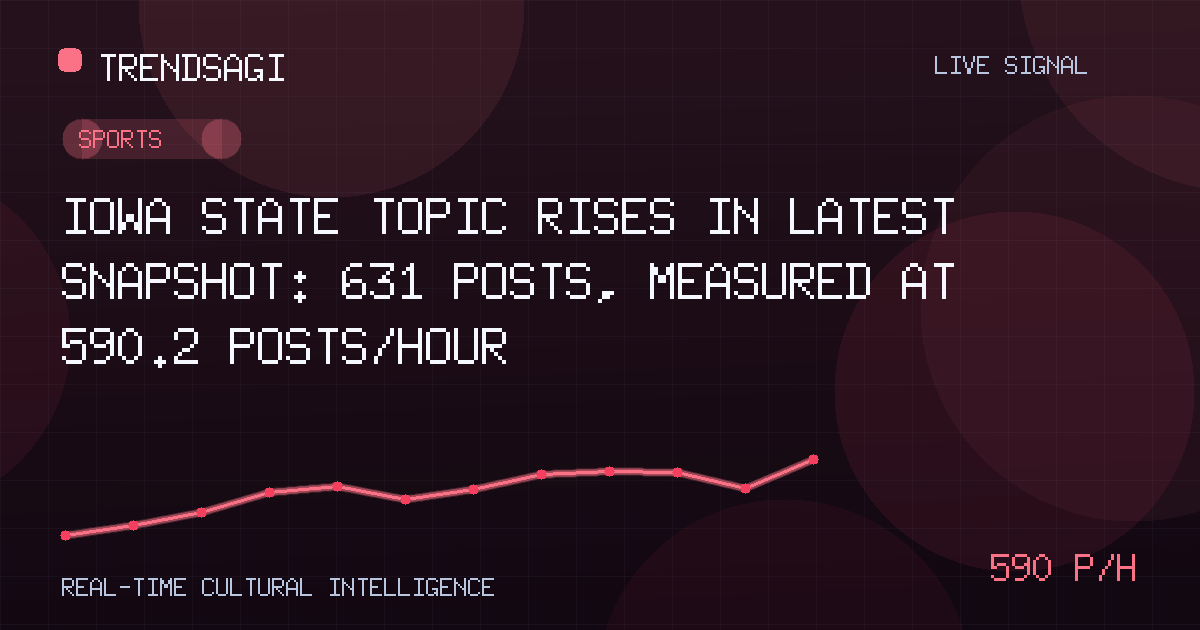
Iowa State topic rises in latest snapshot: 631 posts, measured at 590.2 posts/hour
Iowa State shows 631 posts in the latest snapshot and a measured 590.2 posts/hour over 903 seconds; the reason for the rise remains unverified.
Automated briefing. Generated from stored signal measurements and source-backed research; it is not manually reviewed. Read the methodology and limitations.
Metrics in this briefing are a snapshot associated with its publication date and may not reflect current conditions.
What changed
The Iowa State topic registered a sharp short-window rise in the stored Sports signal, but the available record does not establish why. The latest stored snapshot contains 631 posts at 2026-10-03T20:40:38Z. That makes the change a monitoring alert, not yet a verified account of a game, roster development, announcement, or controversy.
The stored sequence measured 590.2 posts/hour over an exact 903-second window using 3 stored observations. This is a measured snapshot rate, not a live or current rate, forecast, reach, engagement, or count of unique people. It shows that post accumulation accelerated within the observed interval; it does not show that the same pace continued after the snapshot.
| Observation time | 2026-10-03T20:40:38Z |
|---|---|
| Measured snapshot rate | 590.2 posts/hour |
| Snapshot volume | 631 posts |
Why this topic may be moving
No verified public context in the supplied record ties the timestamp to a particular external event. The topic label is broad, and the stored category is Sports, but neither field identifies the people, teams, or story embedded in the posts. Several mechanisms could produce a concentration, and they should be treated as hypotheses rather than explanations.
- Event reaction: A game result, selection, injury update, recruiting report, or controversy could prompt rapid response. None of those events is verified here.
- Scheduled attention: A live event, press conference, program announcement, or media segment can create simultaneous posting. The timestamp alone does not confirm any of them.
- Amplification: A creator, media account, community, or repeated link may push the same subject across the conversation, making topic volume appear broader than the original discussion.
- Label noise: Iowa State may refer to different teams, people, places, or unrelated uses of the name. Category metadata does not prove that every captured post concerns athletics.
The key distinction is between a topic spike and an event spike. A defensible event attribution would require contemporaneous posts that repeatedly name the same subject and a verified public source whose timing fits the observed window. One matching headline or several repeated posts would still be weak evidence. Until the underlying posts are inspected and external context is verified, the cause remains unclear.
Why it matters
This signal is useful to fans checking reactions, journalists looking for a story, athletic communicators monitoring conversation, or community teams trying to distinguish a substantive event from label noise. The immediate takeaway is to inspect the spike quickly. The 631 posts show how much material was present in this snapshot; they do not show how many people saw it, how many contributed, or whether the sentiment was positive, negative, or neutral.
The 590.2 posts/hour figure is best used as a prioritization metric. It says the stored observations captured a fast change over 903 seconds, directing attention to the interval immediately before and after the snapshot. It should not be used as an audience estimate or compared with another platform unless collection methods are equivalent. Raw volume alone could confuse duplication with reach, or a fleeting burst with sustained interest.
A measured snapshot rate can justify closer monitoring, but it cannot tell readers what happened or why. Event attribution requires matching post content and timestamps to verified public context.
What the signal can and cannot establish
The measured sequence establishes that the latest stored snapshot contained 631 posts and that the supplied observations registered 590.2 posts/hour over the exact 903-second window. Those are precise descriptions of this dataset, and they support the conclusion that attention increased within the captured sequence.
The signal cannot establish the trigger, sentiment, platform, geography, organic versus automated participation, original versus copied posts, or total public interest. It also lacks a historical baseline, so it cannot show how unusual the pace is relative to a normal Iowa State day. Without post-level terms and named entities, even the specific sports context behind the activity cannot be reconstructed reliably.
What to watch next
Several concrete checks can determine whether this was a real event burst or monitoring noise.
- Check persistence with the same method. Preserve the collection definition and timestamp. Look for whether later observation windows remain elevated, slow, or reverse. Sustained elevation across comparable windows would support continuing attention; a single burst would support a shorter-lived spike.
- Inspect event fingerprints. Review posts around the measured window for repeated names, teams, opponents, score language, venue references, and terms such as injury, recruit, result, or announcement. Repetition can reveal the subject, but a term is not evidence until its context is checked.
- Match claims to verified sources. Check whether a primary statement from Iowa State Athletics, a credible news report, or another attributable source appeared at a compatible time. A verified source can explain the subject; social repetition alone cannot.
- Measure composition. Separate original posts from quotes or reposts, and examine account types, relevant communities, geography, and sentiment. This shows whether the captured items represent broad participation or concentrated amplification.
- Watch for correction or second-wave behavior. A verified update, response, result change, or clarification may alter both volume and sentiment. Follow the same interval forward rather than assuming the first burst is the full story.
Methodology and limitations
This briefing uses the canonical observation at 2026-10-03T20:40:38Z, its snapshot volume of 631 posts, and the supplied change measurement of 590.2 posts/hour across an exact 903-second window based on 3 stored observations. The rate is described as a measured snapshot rate because it belongs to that observation sequence. It is not a live measure at publication time.
No verified public context is included in the canonical record, so no external event is named as the cause. The empty signal description, broad topic label, and Sports category do not provide enough detail to disambiguate the subject. The record also supplies no platform mix, query definition, collection coverage, historical comparison, account-level data, or engagement data. It is therefore a precise summary of the supplied spike, not a complete measure of public interest.
An update should retain the exact observation time, distinguish snapshot volume from the measured snapshot rate, inspect the underlying post sample, and attribute any external cause only to a verified public source. That approach would show not only that Iowa State moved, but also whether the movement was broad, sustained, and tied to a confirmed development.
Track This Topic for New Signals
Set alerts for future velocity or sentiment changes around this topic.
Explore Tracking PlansAbout TrendsAGI research
TrendsAGI's automated research pipeline publishes dated signal snapshots, methodology notes, and practical workflows for teams evaluating cultural momentum. Read how signals are scoped, scored, and limited in our research methodology.


