899-second window · 3 observations · Measured Oct 8, 2026, 7:39 PM UTC · Provider: go_recent_snapshot_v2
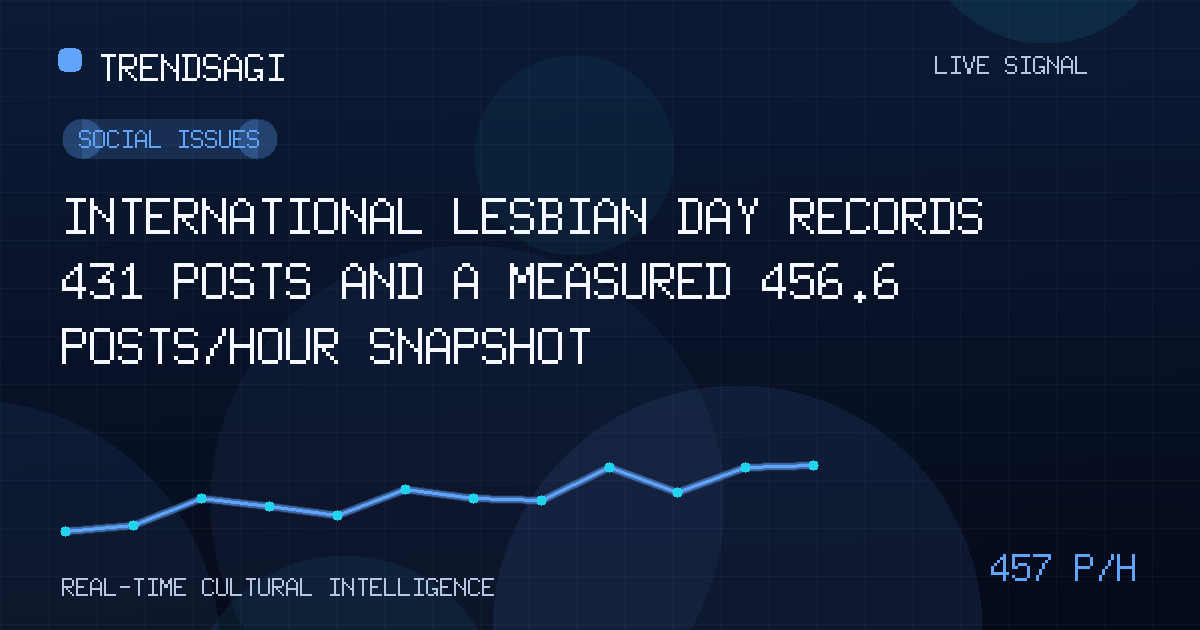
International Lesbian Day records 431 posts and a measured 456.6 posts/hour snapshot
International Lesbian Day shows 431 posts and a measured 456.6 posts/hour snapshot; here is what is known, unknown, and worth checking next.
Automated briefing. Generated from stored signal measurements and source-backed research; it is not manually reviewed. Read the methodology and limitations.
Metrics in this briefing are a snapshot associated with its publication date and may not reflect current conditions.
What changed
International Lesbian Day was moving in the monitored corpus at the latest snapshot, which contained 431 posts. Based on 3 stored observations in an exact 899-second window, measured at 2026-10-08T19:39:13Z, the topic’s measured snapshot rate was 456.6 posts/hour.
The rate confirms concentrated posting activity during that window, but it is not a live or current rate, forecast, reach estimate, engagement measure, or count of unique people. No prior baseline is supplied, so the signal cannot show how large the movement was relative to normal activity or whether it continued. Why the topic was moving remains unverified because no external trigger has been confirmed.
| Observation time | 2026-10-08T19:39:13Z |
|---|---|
| Measured snapshot rate | 456.6 posts/hour |
| Latest snapshot volume | 431 posts |
Why this topic may be moving
The stored signal contains no description or verified public context establishing a cause. That means it would be premature to attribute the cluster to a news event, campaign, public statement, or seasonal observance. Each explanation should remain a hypothesis until original public material and its publication time are confirmed.
The topic label makes a calendar-related explanation plausible enough to test, but not confirmed. Other possibilities include newly published reporting, a community campaign, renewed discussion around public remarks, or coordinated recirculation. These possibilities would leave different traces in the posts, which is why they should not be treated as interchangeable.
- Calendar concentration: Compare the observation time with any confirmed date-linked observance and determine whether discussion begins before, during, or after it.
- News or a public statement: Identify the first credible report or original statement and compare its verified publication time with the earliest relevant posts.
- Organizing or mobilization: Check whether posts point to a specific action, event, message, or resource rather than repeating general commentary.
- Platform circulation: Look for repeated wording, common links, synchronized timing, or bursts from a limited set of accounts. Those patterns cannot be determined from the supplied totals.
The strongest supported conclusion is that the monitored corpus recorded a short-window cluster of posts—not that a particular event caused it, that sentiment was uniform, or that the movement would last.
Why it matters
For LGBTQ+ organizations, editors, communications teams, community researchers, and platform moderators, the useful question is not simply “How many posts?” It is whether the cluster reflects broad participation, a repeated campaign, a response to news, or a narrow group amplifying material. Each possibility calls for a different editorial or operational response.
- Community organizations can use the window to locate recurring questions and messages, while avoiding the assumption that posting volume equals audience demand or social consensus.
- Journalists and editors should verify an external trigger before describing the activity as a reaction to a particular event or statement.
- Moderators and safety teams should inspect the posts themselves for harassment, threats, unwanted targeting, or coordinated misinformation. Volume alone cannot diagnose any of those outcomes.
- Researchers should retain the timestamps, collection method, and sampling scope so this snapshot can be compared with future observations rather than treated as a complete historical total.
The 431-post snapshot volume and the 456.6 posts/hour measured snapshot rate describe different aspects of the signal. Neither establishes how many people participated, whether the posts were original, or whether the activity was organic, automated, or coordinated.
What to watch next
The most useful next step is to extend the time series on both sides of the observation. Adjacent windows can show whether this was an isolated cluster, a recurring calendar pattern, or part of a sustained conversation. Comparisons should use the same platform coverage, geography, language settings, and collection rules.
- Check persistence: Retrieve earlier and later observations under the same method. Look for continued activity after 2026-10-08T19:39:13Z, rather than treating a second isolated peak as proof of a lasting trend.
- Inspect composition: Review the actual posts and classify distinct reporting, first-person discussion, organizing calls, routine observance, repeated wording, and harmful content. Keep original posts separate from quotes and reposts.
- Verify the trigger: Use public search to find the earliest credible item associated with the topic, then open the publisher’s page to confirm its content and publication time. A search snippet alone is not sufficient verification.
- Measure concentration: Count distinct post texts and originating accounts, then compare them with the total. This cannot prove authentic human activity, but it can reveal whether a small set of posts accounts for substantial repetition.
- Compare benchmarks: Place the topic beside comparable social-issue topics over the same window and against its own prior observations. Without that context, “fast” has no defensible magnitude.
Concrete watch signals include a verified publication that predates the cluster, continued high-rate posting under the same collection method, a rising share of original material rather than repeated text, participation beyond a small recurring account set, or a clear change in moderation needs. If none of those appears, the defensible conclusion remains a short observed burst with an unclear cause.
Methodology and limitations
The measured snapshot rate of 456.6 posts/hour was supplied from 3 stored observations over an exact 899-second window. The 431 figure is the latest snapshot volume; it is neither the numerator of that rate nor a count of people. No platform mix, sampling frame, geographic scope, language coverage, account-level data, sentiment result, or deduplication method is provided.
The signal can establish that the monitored corpus contained a measurable concentration of posts at the stated time. It cannot establish reach, unique participants, sentiment, organic versus automated behavior, factual accuracy, causal motivation, or longer-term direction. Three observations support reporting the supplied measurement, but they do not establish seasonality or persistence. Broader conclusions should wait for adjacent snapshots and independently verified public context.
Track This Topic for New Signals
Set alerts for future velocity or sentiment changes around this topic.
Explore Tracking PlansAbout TrendsAGI research
TrendsAGI's automated research pipeline publishes dated signal snapshots, methodology notes, and practical workflows for teams evaluating cultural momentum. Read how signals are scoped, scored, and limited in our research methodology.