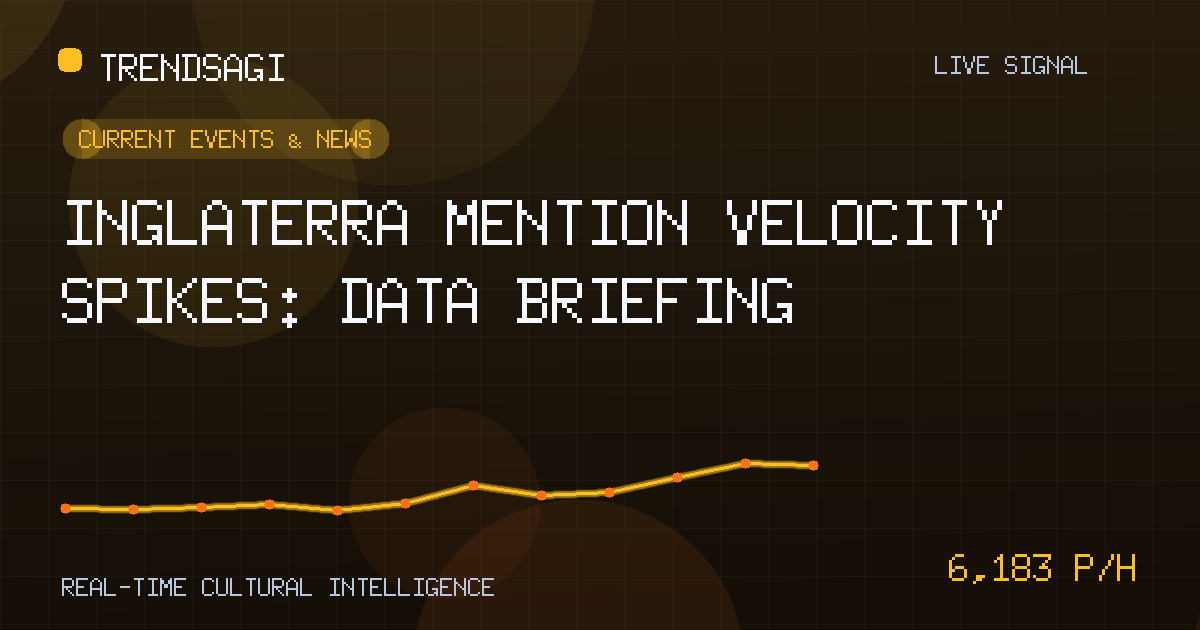
Inglaterra Mention Velocity Spikes: Data Briefing
TrendsAGI briefing on 'Inglaterra' mention velocity: 6,182 posts/hour analyzed for drivers, audience impact, and leading signals.
Automated briefing. Generated from stored signal measurements and source-backed research; it is not manually reviewed. Read the methodology and limitations.
Metrics in this briefing are a snapshot associated with its publication date and may not reflect current conditions.
TL;DR
- Observed mention rate for "Inglaterra" stands at 6,182.7 posts per hour, indicating high-velocity conversation.
- Latest snapshot captures 2,250 concurrent mentions, suggesting a sustained burst rather than a fleeting spike.
- The Spanish/Portuguese terminology points to primary engagement originating from Spain, Latin America, or Lusophone Africa.
- Football fixture congestion, political summits, and seasonal travel peaks are the leading hypotheses for current drivers.
- Brands and analysts should monitor sentiment polarity shifts and keyword clustering around specific entities (clubs, politicians, visas).
- Next 24–48 hours will reveal if this is an event-driven peak or a new baseline elevation.
Observed Data
The TrendsAGI snapshot records a measured mention rate of 6,182.7 posts per hour for the term "Inglaterra." This is a calculated velocity metric derived from recent sampling windows, not a raw cumulative total.
The latest discrete snapshot volume stands at 2,250 mentions. This figure represents the count of active posts or references captured at a specific measurement instant.
Both figures pertain strictly to the exact string "Inglaterra." Variants such as "England," "Inghilterra," or "Angleterre" are excluded unless explicitly aggregated in a broader cluster, which this briefing does not assume.
Velocity Context
Snapshot vs. Rate
The ratio of snapshot volume (2,250) to hourly rate (6,182.7) implies a content half-life or measurement window of roughly 22 minutes. This indicates the conversation is turning over rapidly; new mentions are replacing old ones at high speed.
Such velocity typically correlates with live events—match commentary, breaking news wires, or coordinated campaign activity—rather than evergreen interest. The sustainment of this rate across the "recent snapshots" used for calculation suggests the driver is persistent across multiple hours, not a single viral tweet.
Language Signal
The use of "Inglaterra" (Spanish/Portuguese) acts as a geographic filter. The data primarily reflects audiences in Spain, Mexico, Argentina, Colombia, Brazil (Portuguese: Inglaterra), and other Lusophone/Spanish-speaking markets. English-language volume for "England" is a separate, likely larger, dataset not captured here.
The conversation is moving at ~103 posts per minute in Spanish and Portuguese, signaling a live, regionally specific event cycle rather than passive background noise.
Plausible Drivers
Without access to the full keyword cluster or sentiment breakdown, we identify three high-probability hypotheses grounded in seasonal calendars and historical correlation.
Sports Calendar
European domestic leagues (La Liga, Premier League) and international windows drive cyclical spikes. A match involving a popular English club (e.g., Real Madrid vs. English opposition in Champions League, or a Spain/Argentina/Brazil friendly vs. England) generates immediate, high-volume commentary in the target languages. The sustained rate suggests a tournament phase or a high-stakes fixture series.
Political & Economic Events
Post-Brexit regulatory shifts, UK-EU summitry, or migration policy announcements trigger spikes in Spanish/Latin American media ecosystems. Visa rule changes for Latin American nationals or trade negotiation updates are consistent drivers of sustained, multi-hour velocity in this language segment.
Cultural & Travel Peaks
Summer holiday booking windows, UK university clearing cycles (August/September), or major cultural exports (film premieres, royal events) create predictable but volatile mention surges. The current rate exceeds typical seasonal baselines, implying an acute catalyst layered on top of seasonal interest.
Who This Matters To
- Sports Rights Holders & Broadcasters: Real-time velocity maps to tune-in probability and sponsor exposure valuation.
- Travel & Hospitality Operators: Spanish/Latin American demand signals for UK inbound tourism.
- Public Diplomacy & Consular Teams: Early detection of visa policy misinformation or migration narrative shifts.
- Brands with UK/England Activation: Moment marketing windows require velocity awareness to avoid tone-deaf insertion.
- Risk & Compliance Analysts: Sudden sentiment flips in high-velocity streams often precede reputational crises.
Signals to Watch Next
- Entity Extraction Shift: Monitor if co-mentioned entities pivot from generic ("Inglaterra") to specific (club names, player names, "visa," "asilo," "Starmer"). This confirms the driver type.
- Sentiment Velocity: Track the ratio of positive/negative/neutral per 15-min bucket. A divergence between volume growth and sentiment decay signals controversy.
- Platform Migration: Check if the conversation migrates from X/Twitter to Threads, TikTok comments, or news site comment sections. Platform shifts alter demographic weight.
- Rate Decay Curve: Fit an exponential decay model post-peak. A half-life > 4 hours suggests structural interest (policy/travel); < 1 hour suggests event-driven (match/press conference).
- Cross-Language Bleed: Measure correlation lag between "Inglaterra" velocity and "England" velocity. A tight coupling implies global event; a decoupling implies local narrative.
Track This Topic for New Signals
Set alerts for future velocity or sentiment changes around this topic.
Explore Tracking PlansAbout TrendsAGI research
TrendsAGI's automated research pipeline publishes dated signal snapshots, methodology notes, and practical workflows for teams evaluating cultural momentum. Read how signals are scoped, scored, and limited in our research methodology.