898-second window · 2 observations · Measured Oct 1, 2026, 6:37 AM UTC · Provider: go_recent_snapshot_v2
Independence Day signal shows 4488.1 posts/hour measured change; cause unverified
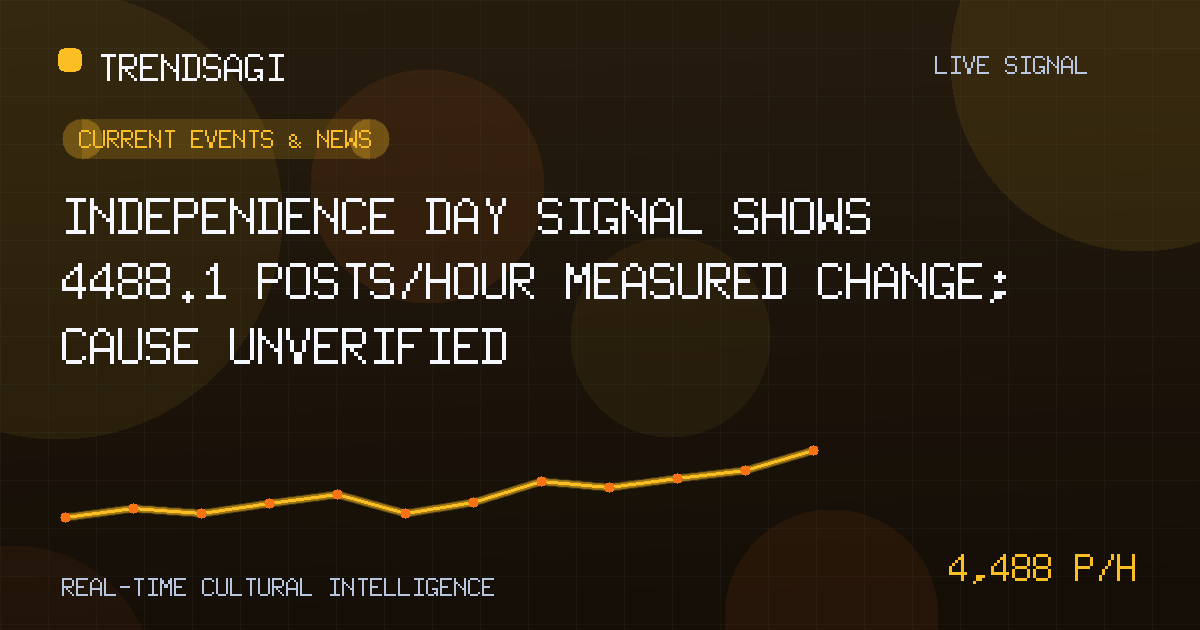
The Independence Day signal contained 4000 posts in the latest snapshot and showed a measured 4488.1 posts/hour change, but its cause remains unverified.
Automated briefing. Generated from stored signal measurements and source-backed research; it is not manually reviewed. Read the methodology and limitations.
Metrics in this briefing are a snapshot associated with its publication date and may not reflect current conditions.
What changed
The stored “Independence Day” signal registered a measured increase, but the available record does not identify a verified event or publisher as the cause. The defensible conclusion is a fast-moving sampled discussion, not a confirmed news development.
Across an exact 898-second window between 2 stored observations, the measured change rate was 4488.1 posts/hour. The latest snapshot, observed at 2026-10-01T06:37:11Z, contained 4000 posts. This is a measured snapshot rate, not a live or current rate, forecast, reach figure, engagement total, or unique-person count.
| Observation time | Measured snapshot rate | Latest snapshot volume |
|---|---|---|
| 2026-10-01T06:37:11Z | 4488.1 posts/hour | 4000 posts |
Why this topic may be moving
No external driver is verified in the material available for this briefing. The stored category is Current Events & News, and the signal description is blank. The category, observation date, and topic label are metadata; they are not evidence of a trigger.
A measured spike establishes rapid movement in the sampled stream; a real-world explanation requires corroborated actors, actions, and sources.
Several mechanisms could produce the pattern, but none is verified:
- Calendar association. A recurring or date-linked use of the phrase may be activating, but the record names no country or observance.
- News response. A new announcement or incident could be driving discussion, but no such event has been verified.
- Amplification. Repeated text, coordinated reposting, or multiple reactions could lift the count without equivalent original activity.
- Label ambiguity. The phrase may be being applied to different subjects that have not been separated in the stored topic.
The causal description therefore remains unresolved. A headline naming a country, organization, or event would go beyond the evidence and should wait for source confirmation.
What the signal can and cannot establish
It is useful to separate what the series shows from what observers may be tempted to infer.
It can establish:
- The count associated with this label increased at the supplied rate within the defined window.
- The latest collection contained 4000 posts, establishing the size of that snapshot.
- The increase was visible within this monitoring series rather than being only an unsupported forecast.
It cannot establish:
- What caused the increase or whether one real-world event explains it.
- How many distinct people were active, or the discussion's reach.
- Whether posts were original, authentic, duplicated, coordinated, or automated.
- Which geography, language, organization, or event the label represents.
- Whether sentiment was positive, negative, or representative of a wider population.
- Whether the increase will persist beyond the short measured window.
With only 2 observations, the series also cannot show the full trajectory, timing of the peak, or normal baseline for this label.
Why it matters
For newsrooms and fact-checkers, the distinction prevents a monitoring spike from being converted into an unsupported causal headline. The rate justifies checking, but it does not establish what happened. A neutral report can accurately say that posts in a monitored sample increased while clearly labeling the cause as unknown.
For communications, research, and platform teams, the topic is a monitoring priority because the measured change warrants attention, but prioritization should depend on persistence and source quality. A transient keyword burst calls for classification and duplicate review; a sustained event calls for rapid verification and updating.
Readers also benefit from the distinction. Attention is a measure of activity in a dataset, not proof that a claim is true, important to a particular community, or new.
What to watch next
The next useful step is to turn an undifferentiated topic label into a sourced account of what changed.
- Persistence. Compare the next equal-length observation windows. Repeatedly similar measurements would support a continuing topic; a quick reversal would indicate a short burst.
- Referent clarity. Look for named locations, institutions, people, and events. Greater specificity would help determine which “Independence Day” is being discussed; generic or unrelated uses should be separated.
- Source chain. Identify the earliest substantive posts and the accounts that subsequently amplified them. This can show whether discussion follows an announcement, a reaction post, or a recurring phrase.
- Content novelty. Check whether new information is spreading or the same text is recurring. Duplicate clusters and synchronized posting can change the interpretation of a raw post count.
- Public corroboration. Check for a dated statement or credible reporting that links the phrase to a specific development. Until then, the cause should remain explicitly unverified.
- Diffusion and decay. Track whether discussion broadens across communities and languages or quickly fades. A sustained, diversified conversation is different from a concentrated eruption.
The strongest confirming watch signal would be convergence: persistent measurement, specific entities, identifiable original sources, and public corroboration. Without that convergence, report only the observed movement.
Methodology and limitations
The figures are reported exactly as supplied. The 4488.1 posts/hour figure is a measured snapshot change rate over an exact 898-second window using 2 stored observations, with the latest timestamp recorded as 2026-10-01T06:37:11Z. The 4000-post figure is the latest snapshot volume, not a rate. The earlier observation's component values are not included here, so the calculation is not independently reconstructed.
The signal is an aggregate topic series. No raw-post sample, collection geography, language mix, account-level metadata, duplication controls, bot controls, or engagement data are provided. Those omissions prevent conclusions about authenticity, independence, public interest, or representativeness. The short window also makes the result sensitive to a burst around the observations.
No external cause is verified here, so none is asserted. Any later causal update should cite the relevant public evidence and distinguish the event itself from the platform activity surrounding it.
Track This Topic for New Signals
Set alerts for future velocity or sentiment changes around this topic.
Explore Tracking PlansAbout TrendsAGI research
TrendsAGI's automated research pipeline publishes dated signal snapshots, methodology notes, and practical workflows for teams evaluating cultural momentum. Read how signals are scoped, scored, and limited in our research methodology.


