899-second window · 3 observations · Measured Oct 1, 2026, 4:22 AM UTC · Provider: go_recent_snapshot_v2
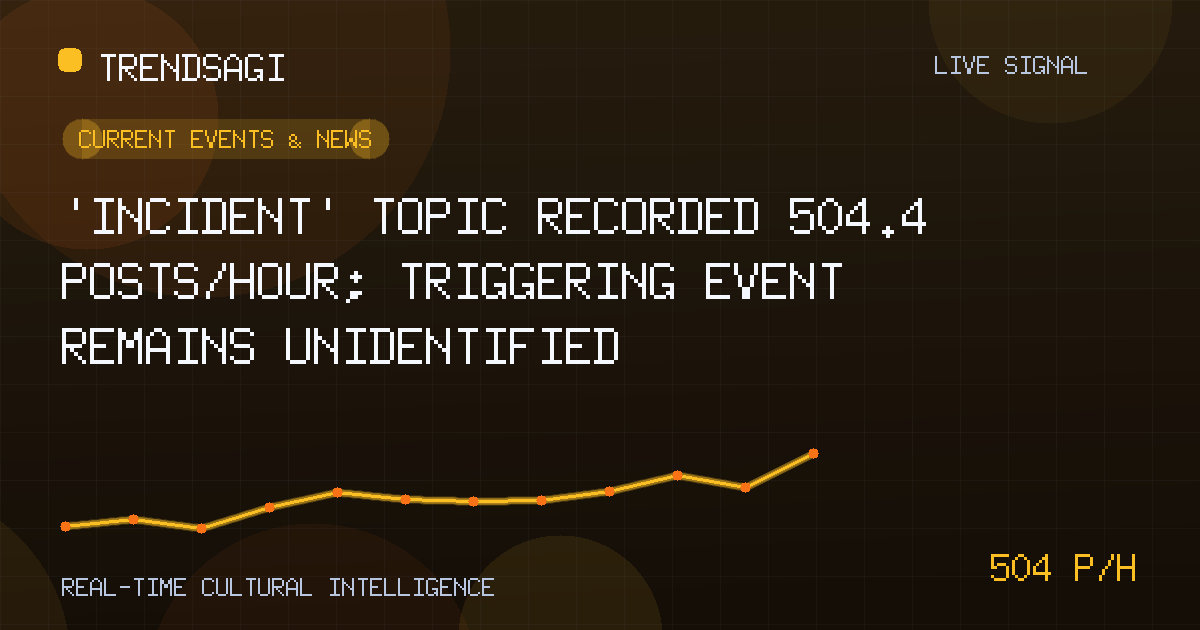
‘Incident’ topic recorded 504.4 posts/hour; triggering event remains unidentified
The “Incident” topic recorded 504.4 posts/hour and a 900-post snapshot; editors explain what is verified and what to check next.
Automated briefing. Generated from stored signal measurements and source-backed research; it is not manually reviewed. Read the methodology and limitations.
Metrics in this briefing are a snapshot associated with its publication date and may not reflect current conditions.
What changed
The defensible takeaway is that the broad “Incident” label showed concentrated post activity at the stored snapshot: the measured snapshot rate was 504.4 posts/hour, and the latest snapshot contained 900 posts. The signal does not identify the incident behind that activity, so it supports monitoring and verification—not a claim that a particular event is real, breaking, or important.
The 504.4 posts/hour figure is a measured snapshot rate based on 3 stored observations over an exact 899-second window measured at 2026-10-01T04:22:08Z. It is not a live or current rate, forecast, reach or engagement figure, or count of unique people. The 900 posts represent snapshot volume. With no event name, location, source set, or verified trigger in the stored record, the cause of the movement remains unclear.
| Observation time | 2026-10-01T04:22:08Z |
|---|---|
| Measured snapshot rate | 504.4 posts/hour |
| Latest snapshot volume | 900 posts |
Why this topic may be moving
No verified trigger is present in the stored signal, and its description is empty. The label “Incident” and stored category “Current Events & News” identify how the material was classified, not which event—or events—the posts concern. Without an attributable report or named source, no particular development can responsibly be presented as the cause.
Several explanations remain possible and should be treated as verification targets rather than findings:
- Event-linked attention: A new report, official response, or clarification could have prompted discussion, but no such development has been verified in the available record.
- Label collision: The generic term “Incident” may be collecting posts about unrelated subjects, making the aggregate misleading if treated as one event.
- Reposting activity: A widely shared source could be producing repeated excerpts without a corresponding increase in distinct reporting.
- Automated or coordinated behavior: Repetition, account bursts, or copied text could be influencing the observed volume.
The signal establishes a bounded rate of labeled post activity, not the identity, truth, severity, or public impact of an incident.
What the signal can—and cannot—establish
The signal is useful as a prompt for investigation. It establishes that the monitoring system recorded 504.4 posts/hour for the broad topic label during the stated window and held 900 posts in its latest snapshot. It also provides a precise observation time against which collection records can be audited.
It does not establish:
- which incident, location, organization, or people the posts concern;
- whether the underlying claims are accurate, current, or officially confirmed;
- how severe the alleged event is or whether it affects the public;
- the number of unique authors, accounts, or people exposed to the posts;
- reach, engagement, sentiment, or organic participation;
- whether the activity will persist beyond the measurement window;
- which explanation is responsible for the observed movement.
Why it matters
A fast-moving label can create pressure to publish before the underlying subject has been resolved. That is especially risky when the label is generic: an editor may connect two unrelated conversations and present the combined activity as evidence of a single developing event.
- News editors should resolve the subject and source chronology before using the signal to select or frame a headline.
- Communications and public-safety teams should distinguish measurable discussion volume from confirmed operational facts before responding.
- Trust and safety teams should examine copying, account behavior, and possible label contamination before assessing coordination or misinformation risk.
- Researchers need query-level samples and collection details before generalizing from this snapshot to wider public opinion.
- Readers should treat the rate as evidence of posting activity, not independent confirmation that an incident occurred or is significant.
What to watch next
The immediate priority is to convert the broad trend label into a verifiable event record. Useful checks include:
- Identify the subject: Review a representative sample for dominant named entities, locations, recurring descriptions, and references that can distinguish separate incidents.
- Reconstruct chronology: Find the earliest attributable posts, trace their cited sources, and compare publication times with the snapshot observation time.
- Verify externally: Look for an attributable report from a reliable publisher and any statement from the relevant official body. Attribute every confirmed fact to its publisher and omit claims that cannot be corroborated.
- Test repetition: Look for identical text, duplicated media, rapid account posting, or reposting networks that could inflate apparent activity.
- Check persistence: Compare later stored snapshots using the same topic definition and measurement method. Do not infer a sustained trend from this bounded observation alone.
- Watch for resolution signals: A confirmed event identity, official response, correction, location, or follow-up report would materially change the interpretation even if posting activity changed little.
Methodology and limitations
This briefing uses the canonical stored observation: 3 data points across the exact 899-second window measured at 2026-10-01T04:22:08Z. The reported 504.4 posts/hour value is treated as a measured snapshot rate, while 900 posts is treated separately as latest snapshot volume. The figures measure different concepts and should not be substituted for one another.
No baseline, comparison topic, collection query, geographic scope, language mix, platform coverage, or deduplication method is supplied. As a result, the signal cannot show how unusual the rate is relative to normal activity or other topics. Snapshot posts may also include repetition and should not be read as a unique-person count.
The empty signal description and broad label are the central limitations. No verified public context in the supplied record identifies a triggering event, so the movement cannot yet be attributed to a specific news development. The appropriate conclusion is therefore narrow but actionable: post activity was measured, the cause is unresolved, and verification should precede escalation, publication, or operational response.
Track This Topic for New Signals
Set alerts for future velocity or sentiment changes around this topic.
Explore Tracking PlansAbout TrendsAGI research
TrendsAGI's automated research pipeline publishes dated signal snapshots, methodology notes, and practical workflows for teams evaluating cultural momentum. Read how signals are scoped, scored, and limited in our research methodology.