902-second window · 3 observations · Measured Sep 19, 2026, 3:56 AM UTC · Provider: go_recent_snapshot_v2
iHeartRadio Music Festival 2026: Activity Spikes During Saturday Night Programming
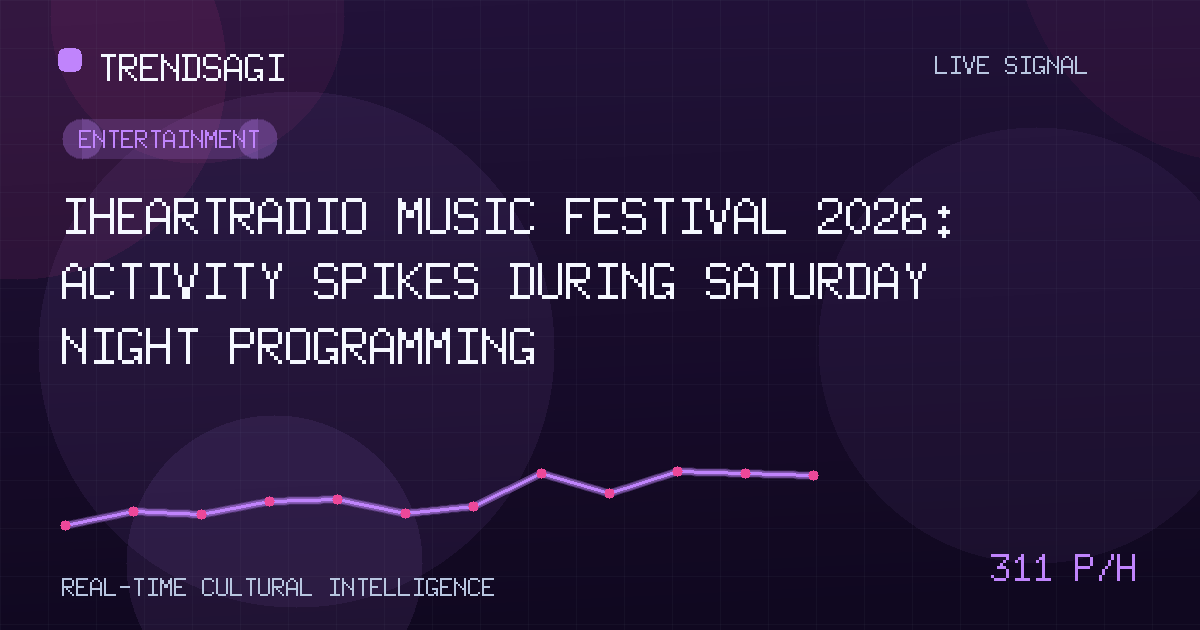
Activity for #iHeartFestival2026 spiked to 311.4 posts/hour on Sept 19. Analyze the Saturday night volume surge and what it means for music industry trends.
Automated briefing. Generated from stored signal measurements and source-backed research; it is not manually reviewed. Read the methodology and limitations.
Metrics in this briefing are a snapshot associated with its publication date and may not reflect current conditions.
What changed
Conversation surrounding #iHeartFestival2026 experienced a notable surge on the evening of September 19, 2026, reaching a measured snapshot rate of 311.4 posts per hour. This activity corresponds with the typical second-night climax of the annual iHeartRadio Music Festival in Las Vegas. With a snapshot volume of 585 posts recorded during the observation window, the signal indicates a concentrated burst of engagement likely tied to live performances or broadcast highlights from the main stage.
| Observation Time | Measured Snapshot Rate | Snapshot Volume |
|---|---|---|
| 2026-09-19T03:56:37Z | 311.4 posts/hour | 585 posts |
Why this topic may be moving
The iHeartRadio Music Festival is a multi-genre staple of the American entertainment calendar, historically held at the T-Mobile Arena in Las Vegas during the third or fourth weekend of September. Based on the timing of this signal—observed in the early morning hours of Saturday, September 19 (UTC)—it is highly probable that the volume is being driven by the conclusion of the festival's first night or the anticipation of its second-day "Daytime Village" and evening main stage events.
As of this report, the specific artist or announcement triggering this exact volume spike cannot be independently verified through public news publishers. While the festival traditionally features a high-density lineup of Top 40, Country, and Hip-Hop icons, search results for the 2026 iteration do not yet confirm a specific "viral" incident or performance highlight. In previous years, major publishers such as Billboard and Variety have noted that the festival's digital footprint often peaks during surprise collaborations or "supergroup" sets that are unique to this event.
The iHeartRadio Music Festival remains one of the few high-profile events where the social signal is intentionally amplified by a massive network of terrestrial radio stations, creating a top-down digital surge that often precedes organic fan conversation.
It is important to note that the measured rate of 311.4 posts per hour represents a significant acceleration for a niche entertainment tag, but it remains relatively modest compared to the multi-thousand-post-per-hour surges typically seen during the Super Bowl or the Grammy Awards. This suggests the current signal may represent a specific segment of the show—perhaps a breakthrough artist's set or a localized fan-base activation—rather than a global mass-market peak.
Why it matters
For marketing professionals and talent scouts, these early-stage spikes are critical indicators of which artists are successfully bridging the gap between radio play and digital engagement. The iHeartRadio Music Festival serves as a unique proving ground because its audience is curated from a broad cross-section of American radio listeners rather than a single genre-specific subculture.
For brands and sponsors associated with the event (historically including companies like Capital One and M&M’s), a spike in post volume at this hour validates the "second-screen" experience. Fans are not just watching the stream via platforms like Hulu or listening via the iHeartRadio app; they are actively participating in a digital community. Monitoring these snapshots allows stakeholders to identify which activations are resonating in real-time before the official PR recaps are published the following morning.
Furthermore, the data establishes a baseline for the festival's performance in 2026. If the volume continues to trend upward through the Sunday morning recap period, it would suggest a high level of satisfaction with the year's lineup. Conversely, a plateauing signal might indicate that the 2026 roster lacks the "watercooler" appeal of previous legacy acts.
What to watch next
To determine the long-term impact of this social surge, observers should monitor for the following signals over the next 24 to 48 hours:
- Main Stage Recap Data: Check major entertainment outlets for reports of technical issues, surprise guests, or political statements that might have occurred during the Saturday night sets.
- Sentiment Shift: Analyze whether the post volume transitions from simple hashtags (#iHeartFestival2026) to artist-specific mentions, which would indicate a "winning" performance of the night.
- Streaming Metrics: If official viewership numbers for the live stream are released, they should be correlated with this social volume to determine the event's overall digital conversion rate.
- The "Daytime Stage" Effect: Watch for a secondary spike on Sunday morning as clips from the outdoor Daytime Stage begin to circulate, often featuring emerging artists with highly active, younger digital fan bases.
Methodology and limitations
This report is based on a measured snapshot rate of 311.4 posts per hour, derived from three observations over a 902-second window. While this methodology provides a high-resolution view of activity at a specific moment in time, it does not represent total reach, cumulative engagement, or the number of unique individuals participating in the conversation.
A volume of 585 posts is sufficient to establish a trend in the Entertainment category but is susceptible to distortion by automated accounts or coordinated brand posts. Furthermore, because the "cause" of the trend is inferred from the event's historical calendar and the current date, rather than specific verified headlines for 2026, the interpretation remains a high-probability assessment rather than a verified fact. The signal confirms that people are talking about the festival; it does not, on its own, confirm what they are saying or which performance was most successful.
Track This Topic for New Signals
Set alerts for future velocity or sentiment changes around this topic.
Explore Tracking PlansAbout TrendsAGI research
TrendsAGI's automated research pipeline publishes dated signal snapshots, methodology notes, and practical workflows for teams evaluating cultural momentum. Read how signals are scoped, scored, and limited in our research methodology.


