888-second window · 3 observations · Measured Oct 10, 2026, 5:26 AM UTC · Provider: go_recent_snapshot_v2
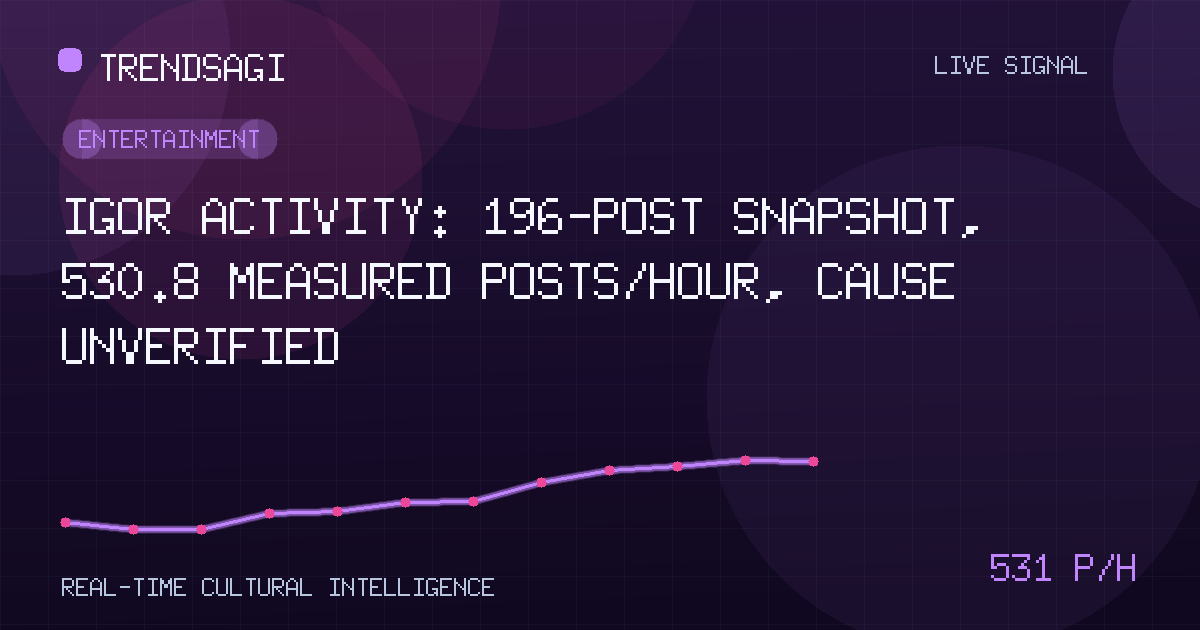
Igor activity: 196-post snapshot, 530.8 measured posts/hour, cause unverified
Igor’s stored snapshot shows 196 posts and a measured 530.8 posts/hour, but the label’s identity and the cause of the activity remain unverified.
Automated briefing. Generated from stored signal measurements and source-backed research; it is not manually reviewed. Read the methodology and limitations.
Metrics in this briefing are a snapshot associated with its publication date and may not reflect current conditions.
What changed
The stored record shows a rapid cluster of activity labeled “Igor,” but it does not identify what the label denotes or establish why the cluster formed. The latest stored snapshot contains 196 posts. That figure is snapshot volume—not a rate, reach, engagement total, or count of unique people—and it is not proof of a broader entertainment event.
The measured snapshot rate is 530.8 posts/hour over an exact 888-second window using 3 stored observations, measured at 2026-10-10T05:26:34Z. This is a historical, measured snapshot rate rather than a live or current rate, forecast, or audience estimate. The figures make “Igor” worth monitoring, while the missing referent and cause make the signal unsuitable for a confident trend explanation.
| Observation time | Measured snapshot rate | Snapshot volume |
|---|---|---|
| 2026-10-10T05:26:34Z | 530.8 posts/hour | 196 posts |
Why this topic may be moving
The cause remains unclear. The stored category is “Entertainment,” but the signal description is blank, and no verified public context in the record ties “Igor” to a named event, work, person, character, announcement, or controversy. Category membership does not resolve the entity or explain the mechanism.
Because “Igor” is only a label here, several different mechanisms could produce the same posting burst. A person, fictional character, work, controversy, announcement, fandom phrase, or unrelated name collision could be involved; none is verified by the signal. It would therefore be premature to attribute the movement to an entertainment release, appearance, or news event.
Verified public context would need to identify the entity, connect it to an event, and show that event in the clustered posts. The available record supplies none of those links, so the defensible answer is that activity is moving quickly but its cause is still unverified.
What the signal establishes
The useful conclusion is narrow but actionable: posts assigned to this label formed a fast-moving cluster in the stored sample that merits entity and catalyst checks.
- Observed volume: The latest stored snapshot records 196 posts under the supplied label.
- Measured velocity: The rate was 530.8 posts/hour over the exact 888-second window using 3 stored observations.
- Stored classification: The signal is categorized as Entertainment, although its description supplies no identifying context.
These observations establish the size, speed, timestamp, and category of the recorded cluster. They do not establish what happened, who participated, or whether the activity had cultural significance beyond the collected posts.
What the signal cannot establish
- Identity: It cannot show whether the posts concern the same person, character, work, or other use of “Igor.”
- Causation: It cannot identify an event, announcement, release, controversy, or other catalyst behind the burst.
- Audience scale: It cannot convert 196 posts or 530.8 posts/hour into unique participants, impressions, or engagement.
- Conversation quality: It cannot establish sentiment, geography, source diversity, or whether copying or coordinated amplification influenced the total.
- Persistence: It cannot show whether the activity continued, intensified, faded, or disappeared after the measured window.
A fast topic label is a monitoring signal, not an explanation. Here, the editorial opportunity is to resolve the entity and catalyst; treating the raw count as a finished story could amplify a name collision or an unrelated burst.
Why it matters
Entertainment and news editors should care because a measured rate of 530.8 posts/hour can indicate a story worth verifying. It should not, by itself, become a headline. Without representative post text or verified context, assigning the label to a particular person or franchise could misdirect coverage and waste audience attention.
Fandom editors, audience researchers, and media-monitoring teams also have a reason to investigate. The key questions are whether independently identifiable participants are discussing a shared subject, whether credible public information is driving the activity, and whether the apparent volume reflects a meaningful conversation rather than repeated material or a label collision.
What to watch next
- Resolve the entity. Inspect representative posts for names, mentions, quoted context, linked profiles, and recurring co-occurring terms. Determine whether they point to one referent or several unrelated ones.
- Find a verified catalyst. Look for a public statement, official announcement, release, appearance, episode, controversy, or credible reporting that is temporally and substantively connected to the posts—not merely adjacent to the observation.
- Test persistence. Gather subsequent timestamped snapshots and compare both volume and measured rate. The current figures should not be extended beyond the supplied window without new observations.
- Examine composition. Check the mix of source accounts, original versus duplicated material, geography, platform, and audience overlap. This helps distinguish broad discussion from repetition or possible amplification.
- Assess editorial significance. Look for credible sourcing, independent participation, and useful new information. Raw post volume alone does not show impact.
The clearest escalation signal would be a verified referent followed by additional observations showing consistent discussion of that same subject and a credible public catalyst. The clearest reason to de-escalate would be subsequent snapshots showing the activity fading or sampled posts resolving to unrelated uses. Until then, “Igor” is a fast but unexplained entertainment-labeled signal.
Methodology and limitations
This briefing uses the stored observation set. Its timestamp is 2026-10-10T05:26:34Z; the latest snapshot volume is 196 posts; and the measured change rate is 530.8 posts/hour over an exact 888-second window using 3 stored observations. The posts/hour figure is reported as a measured snapshot rate, not a live or current rate.
The record does not provide a normal baseline, full time series, post text, account or source breakdown, geography, engagement, or verified external context. As a result, it cannot establish typicality, persistence, breadth, sentiment, or causation. Snapshot volume and posts/hour are separate statistics, and the sampling mechanics needed to reconcile them are not supplied. No external cause is asserted because no specific public explanation could be verified.
Track This Topic for New Signals
Set alerts for future velocity or sentiment changes around this topic.
Explore Tracking PlansAbout TrendsAGI research
TrendsAGI's automated research pipeline publishes dated signal snapshots, methodology notes, and practical workflows for teams evaluating cultural momentum. Read how signals are scoped, scored, and limited in our research methodology.


