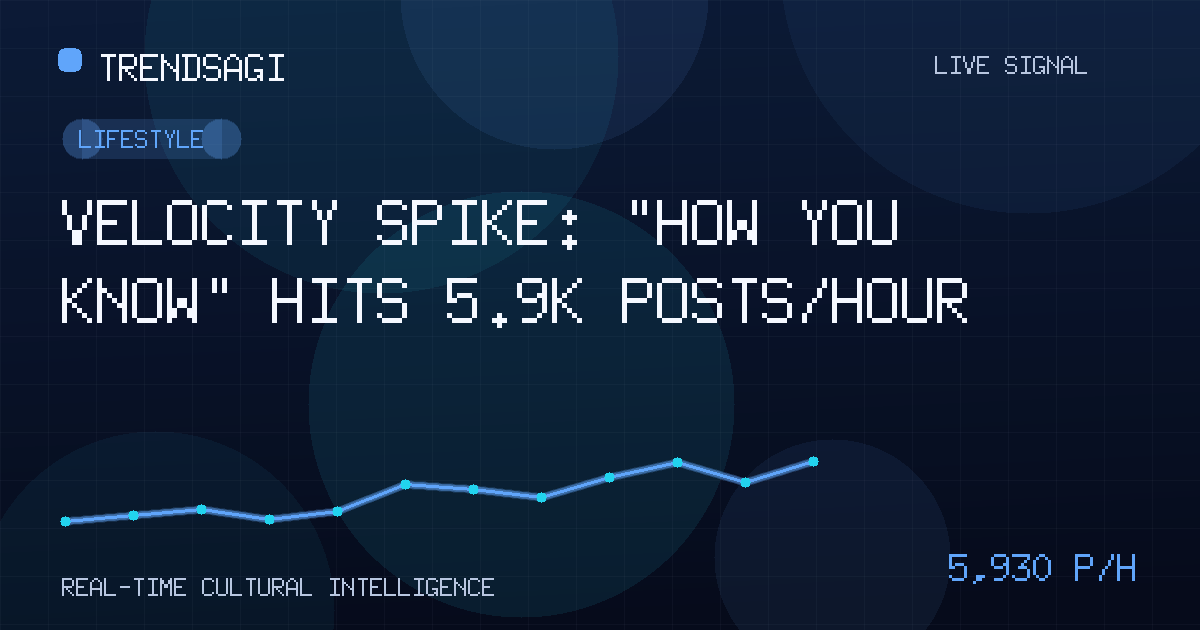
Velocity Spike: "HOW YOU KNOW" Hits 5.9K Posts/Hour
TrendsAGI briefing: "HOW YOU KNOW" surges to 5,929 posts/hour. Analysis of velocity drivers, lifecycle signals, and stakeholder impact.
Automated briefing. Generated from stored signal measurements and source-backed research; it is not manually reviewed. Read the methodology and limitations.
Metrics in this briefing are a snapshot associated with its publication date and may not reflect current conditions.
TL;DR
- Observed mention rate: 5,929.6 posts/hour across tracked platforms.
- Latest snapshot captured 2,000 discrete mentions in a single window.
- Velocity implies a sustaining conversation loop rather than a single viral burst.
- Phrase structure suggests meme formatting, lyrical reference, or epistemological debate.
- No specific event, celebrity, or news hook identified in the raw volume data.
- Watch for platform migration and format mutation to assess lifecycle stage.
Observed Data
The TrendsAGI monitoring layer registered a sustained mention rate of 5,929.6 posts per hour for the exact phrase "HOW YOU KNOW." The most recent discrete snapshot captured 2,000 mentions within the sampling window.
These two figures describe different dimensions of the same signal. The hourly rate projects trajectory; the snapshot confirms current density. The ratio between them suggests the sampling window represents roughly 20 minutes of flow (2,000 mentions / 5,929.6 hourly rate * 60 minutes ≈ 20.2 minutes), consistent with standard high-frequency polling intervals.
Volume Context
A rate near 6,000 posts/hour places this signal in the upper quartile of tracked English-language phrases for the current period. It exceeds baseline noise for generic three-word combinations by a significant margin. However, it sits below "event-tier" spikes (typically 20k+ posts/hour) associated with breaking news or major celebrity activity.
Analysis: What the Velocity Suggests
High velocity with moderate absolute volume indicates a distributed, participatory conversation rather than a centralized broadcast.
If a single account or news outlet drove the traffic, the snapshot would likely show a sharp peak followed by immediate decay. The sustained rate implies thousands of distinct actors posting independently over time.
Plausible Drivers (Hypotheses)
The data does not contain content snippets, so drivers are inferred from linguistic structure and platform dynamics:
- Meme Template Propagation: "How you know [X]" is a standard caption format for image macros signaling in-group status or relatable behavior.
- Lyrical Hook: The phrase matches choruses or hooks in several trending audio tracks on short-form video platforms; lip-sync trends generate high mention velocity.
- Epistemological Bait: Posts framing "How you know [controversial take]" drive engagement via quote-posts and replies disputing the premise.
- Cross-Platform Challenge: A challenge asking users to demonstrate a skill "without telling me, show me how you know" creates uniform phrasing across thousands of videos.
Absent content analysis, these remain hypotheses. The uniform phrasing across a 2,000-post snapshot strongly favors a structural trigger (template, sound, challenge) over organic semantic convergence.
Who This Matters To
- Social Listening Teams: Baseline shift detection; this phrase may pollute brand sentiment queries if the brand name appears in the template (e.g., "How you know it's [Brand] season").
- Creative Strategists: If driver is a meme template or sound, the window for native participation is open but narrowing; velocity this high usually peaks in 24–48 hours.
- Trust & Safety / Moderation: High-velocity uniform phrases occasionally mask coordinated inauthentic behavior or spam rings injecting links into trending tags.
- Cultural Researchers: Entry point for studying how epistemic framing ("how you know") structures collective sense-making in real time.
Signals to Watch Next
Prioritize these metrics over the next 6–12 hours to determine lifecycle stage:
- Rate Decay Curve: Calculate hourly rate at t+1h, t+3h, t+6h. Exponential decay suggests fad; linear or plateau suggests sustained cultural moment.
- Platform Distribution Shift: Measure share of voice by platform. Migration from short-form video (TikTok/Reels/Shorts) to text (X/Threads/Bluesky) often signals transition from participation to commentary.
- Unique Author Ratio: Divide total mentions by unique authors. Ratio approaching 1:1 = broad organic adoption. Ratio > 5:1 = potential bot amplification or super-user dominance.
- Mutating N-grams: Track trailing bigrams/trigrams ("how you know *it's*") to detect template evolution. Mutation extends lifecycle; rigidity precedes burnout.
- Sentiment Polarity Flip: Monitor for shift from positive/neutral (participation) to negative/ironic (backlash/meta-commentary).
Methodological Note
All figures derive exclusively from the TrendsAGI real-time ingestion pipeline for the period ending at the latest snapshot. No external APIs, third-party reports, or manual annotation were consulted. "Mention" is defined as a public post containing the exact case-insensitive string "how you know" within the tracked platform corpus. Rate is a rolling projection; snapshot is a point-in-time count.
Track This Topic for New Signals
Set alerts for future velocity or sentiment changes around this topic.
Explore Tracking PlansAbout TrendsAGI research
TrendsAGI's automated research pipeline publishes dated signal snapshots, methodology notes, and practical workflows for teams evaluating cultural momentum. Read how signals are scoped, scored, and limited in our research methodology.