889-second window · 3 observations · Measured Sep 27, 2026, 8:56 AM UTC · Provider: go_recent_snapshot_v2
Hinges snapshot shows 107 posts and 222.7 posts/hour; cause remains unverified
The latest Hinges snapshot contained 107 posts and a measured 222.7 posts/hour rate; the cause is unverified, and these checks show how to interpret it.
Automated briefing. Generated from stored signal measurements and source-backed research; it is not manually reviewed. Read the methodology and limitations.
Metrics in this briefing are a snapshot associated with its publication date and may not reflect current conditions.
What changed
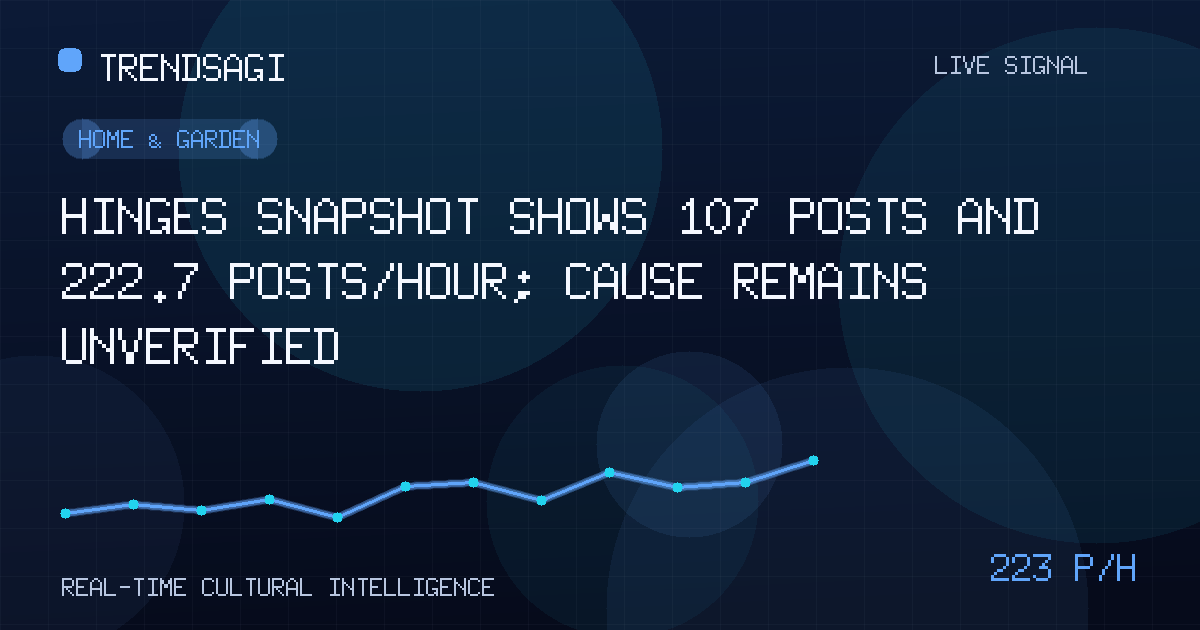
Posts matching the label “Hinges” numbered 107 in the latest stored snapshot, observed at 2026-09-27T08:56:42Z. The measured change rate was 222.7 posts/hour. The direct conclusion is limited: labeled activity moved during the observed window, but the cause remains unclear and no specific catalyst has been verified.
The 222.7 posts/hour figure is a measured snapshot rate for an exact 889-second window associated with that observation time, based on 3 stored observations. It is not a live or current rate, forecast, reach, engagement, or unique-person count. The 107 posts are the latest snapshot volume, a separate count rather than a rate.
| Metric | Reported value |
|---|---|
| Observation time | 2026-09-27T08:56:42Z |
| Measured snapshot rate | 222.7 posts/hour |
| Latest snapshot volume | 107 posts |
The two figures should not be substituted for one another or used to create additional estimates. The supplied record does not establish that one can be derived from the other, and it provides no basis for projecting how many labeled posts will follow.
Why this topic may be moving
No specific external catalyst has been verified, and the stored signal contains no description connecting the movement to a news event, product, repair problem, or seasonal need. Several non-exclusive possibilities therefore deserve testing:
- Literal hardware use. Posts may concern cabinet, door, or gate hinges, installation, repair, or buying decisions. That would represent home-improvement interest, but the label alone does not confirm this interpretation.
- Semantic collision. “Hinges” can also be used figuratively or as a name, label, handle, or phrase. If unrelated meanings are mixed, the aggregate rate can overstate interest in physical hardware.
- Event-led discussion. A public event could have introduced a shared hinge-related term. That remains a hypothesis until contemporaneous reporting and post text establish the connection.
- Distribution effect. Repetition, reposting, or one source generating many labeled items could lift the count without broad adoption. Unique-author data would be needed to distinguish that possibility.
None can be presented as the reason from volume alone. A topic can move because people are discussing a thing, because a word is being reused, or because content is being redistributed.
A measured rise in labeled posts is a reason to investigate meaning and timing, not proof of a shared cause.
What the signal can—and cannot—establish
The signal establishes that the collection recorded 107 labeled posts at the specified time and that the supplied method measured 222.7 posts/hour for the stated window from 3 observations. That is enough to prioritize investigation.
- It does not show what “Hinges” meant in each post.
- It does not establish unique authors, original versus copied posts, or organic spread.
- It does not reveal sentiment, geography, audience size, or engagement.
- It does not show whether the movement persisted after the observation window.
Most importantly, a measured change rate describes the collected stream; it does not identify a cause. The topic should not yet be described as rising demand for physical hinges, a repair surge, or a broader cultural trend.
Why it matters
For a home-and-garden category team, the label may point to an opportunity, but only if a content audit confirms literal hardware intent. Product teams should avoid inventory or merchandising decisions based on 107 labeled posts alone.
- For publishers and editors: Ambiguous labels can direct readers toward irrelevant stories and distort content planning.
- For community managers: A spike may warrant monitoring, but not a campaign or resource allocation until the subject and audience are clear.
- For trend analysts: The rate is a trigger for verification, not a causal finding or forecast.
The practical distinction is between a signal worth checking and a trend safe to act on. This record is the former.
What to watch next
The next verification pass should be concrete:
- Audit the 107 posts. Record the exact matched phrase, surrounding text, format, and whether each use is literal, figurative, a name, or an unrelated collision.
- Check chronology. Note the earliest appearance, repeated wording, cited sources, and repost patterns; separate original content from duplication where possible.
- Test external context. Look for contemporaneous, independent public reporting that names the same term. If no credible match exists, retain the unknown rather than inventing a catalyst.
- Keep comparisons like-for-like. Use the same label, collection method, and window length before and after; display snapshot volume separately from measured posts/hour.
- Segment the evidence. If metadata permits, compare source, language, geography, and subject cluster to see whether one source or one use dominates.
- Recheck subsequent snapshots. Look for persistence, decay, or a shift from one dominant meaning to several coherent clusters; do not assume the observed burst will continue.
Evidence would strengthen if later windows show a comparable measured posts/hour rate, the posts converge on an identifiable subject, and independent public sources corroborate a catalyst. It would weaken if meanings remain fragmented, duplicated content is widespread, or activity does not carry into subsequent observation windows.
Methodology and limitations
This briefing uses the supplied observation at 2026-09-27T08:56:42Z. It repeats the reported 107-post snapshot and 222.7 posts/hour measured rate rather than recomputing them. The rate comes from an exact 889-second window based on 3 stored observations.
The record does not disclose the query, collection coverage, sampling approach, deduplication, or consistency of topic labeling. It also supplies no post-level evidence, so semantic conclusions cannot be checked here.
The external explanation remains unverified. The supported conclusion is measurable movement in labeled posts with an unclear cause—not evidence of product demand, public sentiment, or an enduring trend. The appropriate next step is content validation and independent corroboration.
Track This Topic for New Signals
Set alerts for future velocity or sentiment changes around this topic.
Explore Tracking PlansAbout TrendsAGI research
TrendsAGI's automated research pipeline publishes dated signal snapshots, methodology notes, and practical workflows for teams evaluating cultural momentum. Read how signals are scoped, scored, and limited in our research methodology.