1659-second window · 3 observations · Measured Oct 7, 2026, 1:09 PM UTC · Provider: go_recent_snapshot_v2
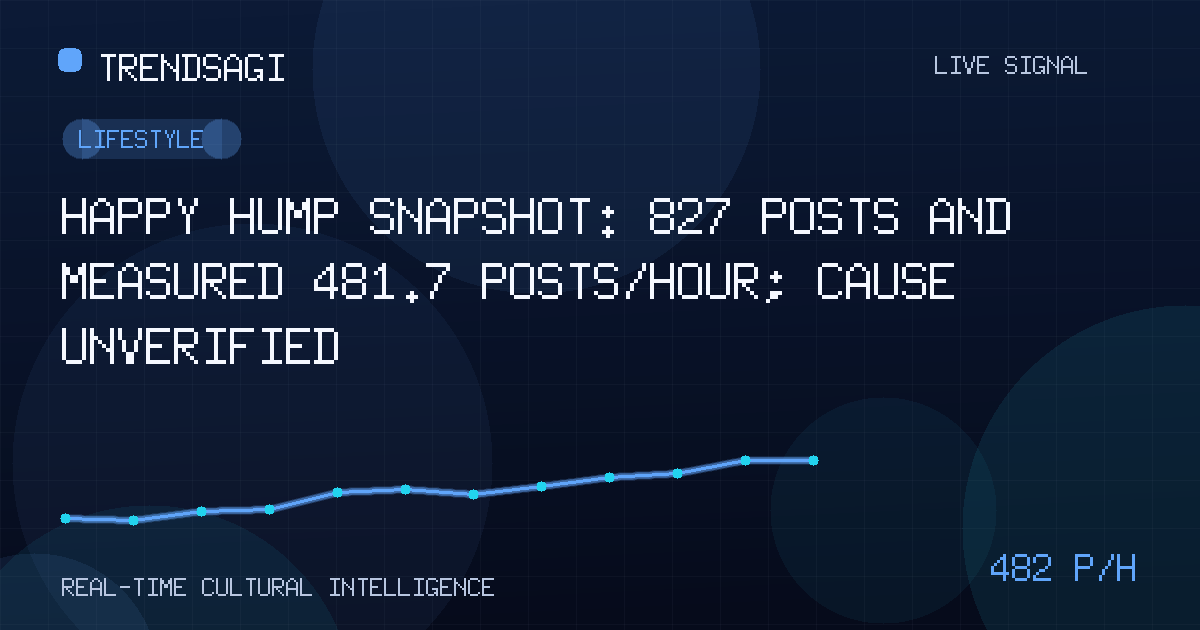
Happy Hump snapshot: 827 posts and measured 481.7 posts/hour; cause unverified
Happy Hump logged 827 posts and a measured 481.7 posts/hour snapshot; the cause remains unverified, with practical checks for editors and analysts.
Automated briefing. Generated from stored signal measurements and source-backed research; it is not manually reviewed. Read the methodology and limitations.
Metrics in this briefing are a snapshot associated with its publication date and may not reflect current conditions.
What changed
Answer: The stored Lifestyle signal for “Happy Hump” logged 827 posts at 2026-10-07T13:09:21Z. It also recorded a positive measured change in posting activity, but the available evidence does not establish why the topic moved. Without a cited post, event, named account, or verified public report, the defensible description is an unexplained measured rise in recorded posts, not a confirmed trend with an identified cause.
The measured snapshot rate was 481.7 posts/hour across an exact 1659-second window using 3 stored observations. This is a retrospective indicator for those records, not a live rate, forecast, reach estimate, engagement result, or count of unique people.
| Measure | Stored value |
|---|---|
| Observation time | 2026-10-07T13:09:21Z |
| Measured snapshot rate | 481.7 posts/hour |
| Latest snapshot volume | 827 posts |
Why this topic may be moving
No verified public catalyst accompanies the record. The stored signal description is empty, so there is no explanation to inspect, and the phrase itself remains ambiguous. “Happy Hump” could be ordinary wording, a label, a quotation, a brand or product reference, or repeated chatter; none of those readings is established here.
The safest conclusion is “activity changed, cause unverified.” A measured rate can reflect original publishing, concentrated amplification, repeated copies, or a change in what the collection captured. Those are testable alternatives, not findings. A causal explanation would need dated, inspectable evidence connected to the phrase and aligned with the timing of the observed change.
A measured snapshot rate shows that posting activity changed within the captured records; it does not identify the event, audience, or mechanism behind the change.
How to interpret the signal
The signal supports a narrow set of factual statements:
- The stored category is Lifestyle.
- The snapshot contains 827 posts at the stated UTC observation time.
- The supplied change measure is 481.7 posts/hour, based on 3 stored observations over the exact 1659-second window.
Snapshot volume and measured change rate answer different questions. Volume describes the captured count at the observation time; the rate describes change within the supplied measurement window. They should not be treated as interchangeable or combined to imply additional reach.
The signal does not establish:
- how many distinct people posted or saw the topic;
- which platforms, locations, languages, or communities were represented;
- whether posts were original, quotations, duplicates, or automated activity;
- the sentiment, purchase intent, or cultural meaning of the phrase;
- whether the measured movement persisted after the snapshot;
- or what event caused it.
The Lifestyle label is a stored classification, not proof that the content is benign, consumer-oriented, or safe.
Why it matters
For lifestyle and culture editors, this signal is a prompt to verify, not a ready-made story angle. Publishing a speculative cause would give a raw activity measure the authority of a reported event. The useful question is whether source material can connect the phrase to a specific, dated development.
Community, brand-safety, and social-listening teams should also care about ambiguity. A phrase-level spike can combine unrelated conversations, and a broad category can conceal context that changes the story. Analysts should preserve the topic as observed while testing whether the activity is broad or concentrated, organic or repetitive, and persistent or temporary.
What to watch next
Concrete checks and watch signals are:
- Comparable measurement: Collect later snapshots with the same cadence, coverage, and topic definition. Check whether the measured snapshot rate continues in the same direction or reverses; without a baseline, do not call the movement durable.
- Distribution: Count distinct source URLs, accounts, and platforms represented. Concentration on a single source suggests amplification, while wider distribution would provide stronger evidence that the phrase traveled.
- Duplication: Separate original posts from quotations, reposts, and near-duplicates. A rise made mostly of copied text has a different interpretation from a rise made of distinct posts.
- Origin and timing: Find the earliest substantive public items and map subsequent reposts. A credible catalyst should appear before, or at least align with, the measured change rather than be invented after seeing the spike.
- Meaning and drift: Review the actual post text for distinct uses of the phrase. Track whether authors are discussing the same entity or event, and whether the Lifestyle classification still fits.
- External corroboration: Look for a dated primary announcement or reputable reporting that directly explains the phrase and the timing. Corroboration should connect to the observed posts; a loosely related headline is not an explanation.
- Engagement quality: When reliable data becomes available, compare substantive replies, original contributions, and repeat authors with raw volume. None of those measures is present in the current signal.
Methodology and limitations
The stored record provides the observation time, latest snapshot volume, measured snapshot rate, exact window, observation count, and category. It does not provide the underlying posts, a historical baseline, the collection query, platform or geographic coverage, language settings, account identities, deduplication rules, or the rate formula. The rate therefore cannot be independently reconstructed from this brief.
The 827-post snapshot must not be called a rate, and the measured 481.7 posts/hour figure must not be extended into another period or described as current activity. The 3 observations do not by themselves show persistence. Until public evidence identifies a trigger, the accurate editorial label is an ambiguous Lifestyle topic with a measured change in recorded posting and no verified cause.
Track This Topic for New Signals
Set alerts for future velocity or sentiment changes around this topic.
Explore Tracking PlansAbout TrendsAGI research
TrendsAGI's automated research pipeline publishes dated signal snapshots, methodology notes, and practical workflows for teams evaluating cultural momentum. Read how signals are scoped, scored, and limited in our research methodology.


