15-minute window · 3 observations · Measured Oct 5, 2026, 1:52 PM UTC · Provider: go_recent_snapshot_v2
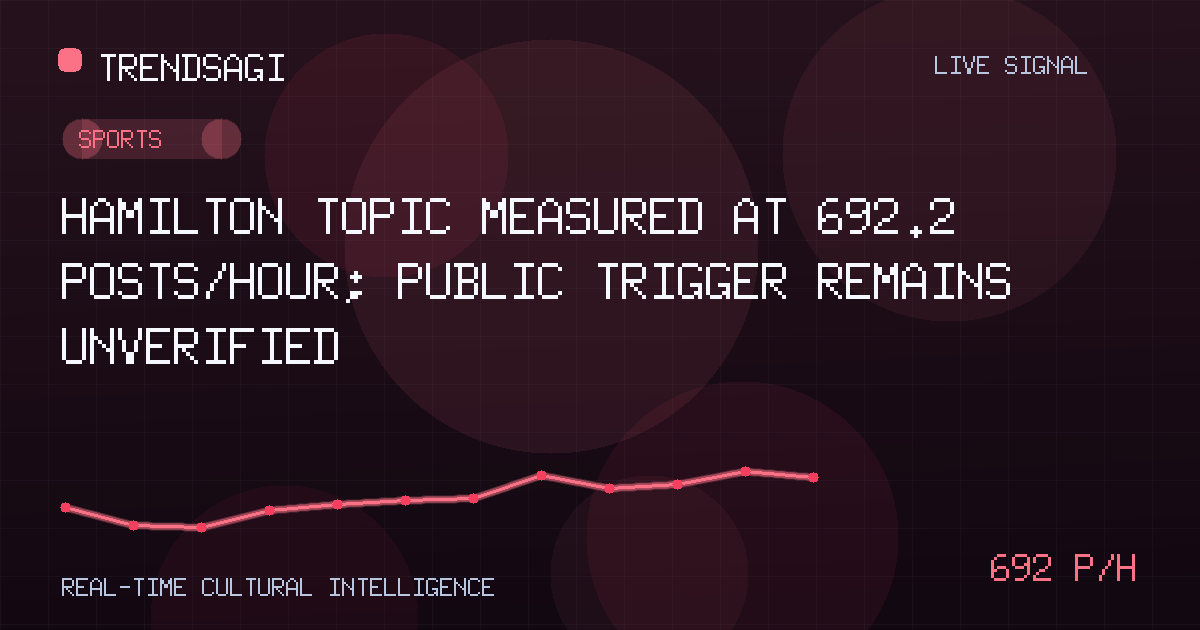
Hamilton topic measured at 692.2 posts/hour; public trigger remains unverified
Hamilton activity reached a measured 692.2 posts/hour in the latest sports snapshot; see what is confirmed, what is unresolved, and what to check next.
Automated briefing. Generated from stored signal measurements and source-backed research; it is not manually reviewed. Read the methodology and limitations.
Metrics in this briefing are a snapshot associated with its publication date and may not reflect current conditions.
What changed
The Hamilton topic registered a rapid burst in the monitored sports-category feed, but no verified public trigger is established and the label remains entity-ambiguous. The right editorial read is “recent activity requiring prompt verification,” not “confirmed breaking news” or proof of a sustained trend.
Across the exact 900-second window represented by three stored observations and ending at 2026-10-05T13:52:13Z, the measured snapshot rate was 692.2 posts/hour. The latest snapshot volume was 458 posts. Those are distinct measures: the snapshot volume is not a rate, reach, engagement total, forecast, or count of unique people.
| Observation time | Measured snapshot rate | Snapshot volume |
|---|---|---|
| 2026-10-05T13:52:13Z | 692.2 posts/hour | 458 posts |
The figures capture a short, changing interval. They do not show whether the burst continued after the observation, what each post said, or whether several meanings of Hamilton were pooled under the same label.
Why this topic may be moving
The stored category supplies a useful clue: Sports. That makes sports-related interpretations worth testing first, but it does not verify a particular athlete, team, competition, location, or event. A category label can be accurate at a broad level while the specific topic entity remains unresolved.
- A time-sensitive development could have triggered reaction, but no dated result, announcement, controversy, or other public event has been verified as the cause of this signal.
- Entity overlap could combine separate conversations. A surname, place name, organization, or other proper noun can share the label Hamilton and make aggregate activity look like one story.
- A secondary news cycle could be amplifying an initial post, although the sequence and independence of sources are not available in the supplied signal.
- Repeated or coordinated posting could contribute to the rise; repetition alone would not prove automation, manipulation, or inauthenticity.
Until the referent and timeline are checked, the cause remains unclear. The defensible conclusion is simply that activity accelerated around the Hamilton label during the measured interval.
A measured posting rate shows that a monitored topic is moving quickly. It does not, by itself, show what happened, why it happened, or whether the movement reflects broad public interest.
What the signal can—and cannot—establish
The signal is useful because it identifies topic-level acceleration with a precise observation time. It supports fast triage: editors can inspect what is being posted rather than assume the label alone explains the movement.
- It establishes the measured snapshot rate of 692.2 posts/hour for the stated window.
- It records a latest snapshot volume of 458 posts at the stated time.
- It confirms that the stored series changed quickly enough to warrant checking, even without a long-term baseline.
It does not establish which Hamilton is being discussed, the sentiment or factual accuracy of posts, the number of people involved, organic versus coordinated activity, the geographic or language mix, public importance, or persistence. A high posting rate measures motion in the monitored series, not the significance or truth of what is being said.
Why it matters
The immediate risk is misattribution. A broad label can invite a headline, summary, or response that treats unrelated posts as a single event. Verification is especially important when the category points toward sports but the exact subject is unknown.
- Sports editors and reporters should resolve the entity and seek a dated primary source before assigning a cause.
- Audience teams should sample the observed conversation rather than infer consensus from volume alone.
- Community moderators should examine repeated wording, account overlap, and misleading posts without assuming coordination from popularity.
- Researchers and decision-makers should compare this interval with normal activity before treating it as a baseline shift.
What to watch next
Verification should move from the broad label to specific evidence. A useful next pass would:
- Resolve the referent. Read a representative sample of recent posts and record which Hamilton they name or describe. Separate sports, place, organization, and unrelated uses before combining findings.
- Reconstruct the timeline. Identify the earliest visible item, subsequent reposts, and any dated public statement. The first substantiated event is more informative than the most frequent later reaction.
- Check the alleged trigger. Look for a relevant primary source and independent public reporting. If those do not converge on the same event, retain “cause unverified.”
- Establish a baseline. Compare the rate and snapshot volume with earlier comparable windows and adjacent captures. A short spike that immediately fades has a different interpretation from repeated elevation.
- Inspect content quality. Distinguish original reporting, quotations, reactions, questions, jokes, and recycled claims. Check whether high-volume posts add information or merely repeat an unsupported assertion.
- Recheck persistence. Observe the next exact 900-second window and later snapshots. Do not carry the measured rate forward as a live or current figure.
Concrete signals to watch
- Rapid convergence on one clearly identified Hamilton-related subject.
- A dated, independently verifiable public event that predates the acceleration.
- Independent pickup by multiple credible publishers rather than one repeated source.
- Continued elevation in the next comparable window, or a clear reversal in snapshot volume from 458.
- Clusters of near-identical posts, synchronized activity, or sudden changes in source mix that merit further review.
Methodology and limitations
This briefing uses the latest stored snapshot of 458 posts and the supplied change measurement derived from three observations across an exact 900-second window ending at 2026-10-05T13:52:13Z. The reported 692.2 posts/hour is a measured snapshot rate, not a live rate, forecast, reach figure, engagement measure, or unique-person count.
Precision in the timestamp and interval should not be mistaken for statistical representativeness. No baseline, platform distribution, sampling method, post text, account data, sentiment, geography, or verified public context is included here. The signal can flag acceleration, but attribution requires entity resolution, source checking, and a subsequent comparable observation.
Track This Topic for New Signals
Set alerts for future velocity or sentiment changes around this topic.
Explore Tracking PlansAbout TrendsAGI research
TrendsAGI's automated research pipeline publishes dated signal snapshots, methodology notes, and practical workflows for teams evaluating cultural momentum. Read how signals are scoped, scored, and limited in our research methodology.