902-second window · 3 observations · Measured Oct 2, 2026, 4:11 AM UTC · Provider: go_recent_snapshot_v2
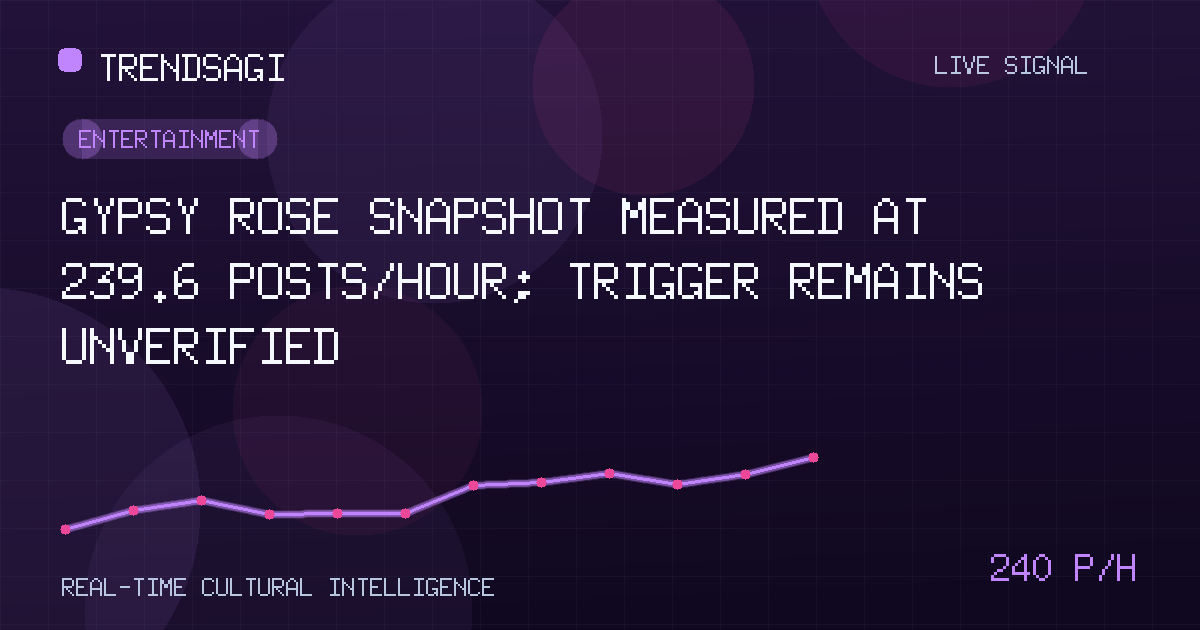
Gypsy Rose snapshot measured at 239.6 posts/hour; trigger remains unverified
A Gypsy Rose measured snapshot rate reached 239.6 posts/hour with 265 posts; review what changed, what is unverified, and what to check next.
Automated briefing. Generated from stored signal measurements and source-backed research; it is not manually reviewed. Read the methodology and limitations.
Metrics in this briefing are a snapshot associated with its publication date and may not reflect current conditions.
What changed
The direct answer is that Gypsy Rose was associated with a concentrated burst of posts, but the cause is still unclear. The available record does not verify a trigger. It would be premature to attribute the activity to a program release, interview, dispute, or platform event without time-matched confirmation. For now, the supported finding is a short-window change in posting activity within the stored Entertainment signal.
The measured snapshot rate was 239.6 posts/hour over an exact 902-second window using 3 stored observations, with the snapshot observed at 2026-10-02T04:11:29Z. The latest snapshot contained 265 posts. This is a historical measured snapshot rate—not a live or current rate, forecast, reach figure, engagement measure, or count of unique people.
| Observation time | 2026-10-02T04:11:29Z |
|---|---|
| Measured snapshot rate | 239.6 posts/hour |
| Measurement window | 902 seconds using 3 stored observations |
| Latest snapshot volume | 265 posts |
Why this topic may be moving
A change in volume and a cause are separate findings. The record establishes that the label was associated with concentrated posting activity during the measured window, but it does not identify the earliest substantive post, a verified news event, or the account that initiated the apparent wave. Without that sequence, assigning the movement to one event would be speculation.
- New media material: A clip, interview, episode-related post, or announcement could be tested as a trigger; none is verified here.
- Renewed discussion: Older footage or past remarks could be recirculated, producing many posts without a new underlying event.
- High-visibility participation: Posts by recognizable accounts may amplify an existing discussion, but no amplifying account is established in the supplied record.
- Collection effects: Quote posts, copies, duplicates, or changes in query coverage can raise post volume without a proportional rise in distinct participants.
The most useful next step is to align timestamps rather than search for a vague resemblance. If a verified public event predates the first wave and subsequent posts repeatedly reference it, the causal case becomes stronger. Until then, these hypotheses should guide checking, not headline writing.
The verified fact is the short-window change in posting activity; the explanation remains unconfirmed until a time-matched public record connects an event to the posts.
Why it matters
This matters less as a claim about Gypsy Rose than as an editorial and measurement signal. A fast burst can indicate a developing story, a recirculated clip, or a platform artifact. Each requires a different response: report a confirmed development, monitor an unfolding discussion, or wait for cleaner evidence.
- News editors need a verified trigger before treating the burst as a new event rather than recycled attention.
- Publicity and social teams may need to monitor whether discussion persists, but post volume alone does not reveal sentiment or effective reach.
- Media researchers need account-level and duplication checks before interpreting the rate as audience growth.
- Readers and fans should not mistake a dashboard peak for 265 unique individuals or proof that a specific allegation or narrative is true.
For the Entertainment category, the immediate editorial posture should be watch, not amplify: identify the verified event if one exists, and avoid converting an unexplained surge into a story by implication.
What the signal can establish
The signal can establish a historical concentration of posts associated with the label at the stated observation time. It also gives analysts a defined window to inspect. It cannot, on its own, explain the subject of those posts or establish who participated.
- Whether the measured rate persists in the next comparable 902-second window or recedes.
- Whether the latest snapshot volume is driven by original posts, quote posts, or repeated copies.
- Whether timestamps cluster around one event or several unrelated threads.
- Whether the accounts represent distinct people, organizations, or automated activity.
- Whether discussion is positive, negative, neutral, or mixed; volume does not encode sentiment.
The label also does not show that every post refers to the same person, work, or subtopic. Entity and context checks are therefore part of interpreting the measurement, not optional cleanup.
What to watch next
These checks would turn the snapshot into a more reliable trend read:
- Establish order: Review the earliest posts in the measured window and the comparable period immediately before it. Note the first apparent source, any quoted material, and whether later posts refer back to it.
- Separate originals from redistribution: Group exact duplicates, quote posts, screenshots, and videos. Compare post volume with the number of distinct authoring accounts.
- Verify a trigger: Look for a direct public statement or a reliable publisher report whose publication time falls before the first concentrated wave. Confirm the event itself, not merely a later summary of the discussion.
- Keep collection conditions stable: Use the same topic query and counting method for the next comparable 902-second window. A changed query would make the rate comparison misleading.
- Test persistence: Watch whether new posts continue without simply recycling the same source. Persistence, novelty, and participation are separate signals.
- Resolve the story before naming a cause: A useful update should identify the verified event, show the timestamp relationship, and explain what remains unknown. If no such record emerges, retain the no-verified-trigger finding.
Methodology and limitations
The stored observation was recorded at 2026-10-02T04:11:29Z. It reports 265 posts in the latest snapshot and a measured change rate of 239.6 posts/hour across an exact 902-second window using 3 stored observations. The rate was supplied with the signal and was not reconstructed here from raw post data. The record is categorized as Entertainment.
The 3 observations provide a short historical window but not a durable baseline, seasonality check, or forecast. Snapshot volume is a post count, while the measured snapshot rate summarizes change over the stated window; neither establishes unique people, reach, engagement, sentiment, authenticity, or continued activity after the observation. No external cause is attributed because a sufficiently verified, time-matched public explanation was not established. That is an evidence limitation, not proof that no triggering event occurred.
Track This Topic for New Signals
Set alerts for future velocity or sentiment changes around this topic.
Explore Tracking PlansAbout TrendsAGI research
TrendsAGI's automated research pipeline publishes dated signal snapshots, methodology notes, and practical workflows for teams evaluating cultural momentum. Read how signals are scoped, scored, and limited in our research methodology.