15-minute window · 3 observations · Measured Sep 25, 2026, 7:51 PM UTC · Provider: go_recent_snapshot_v2
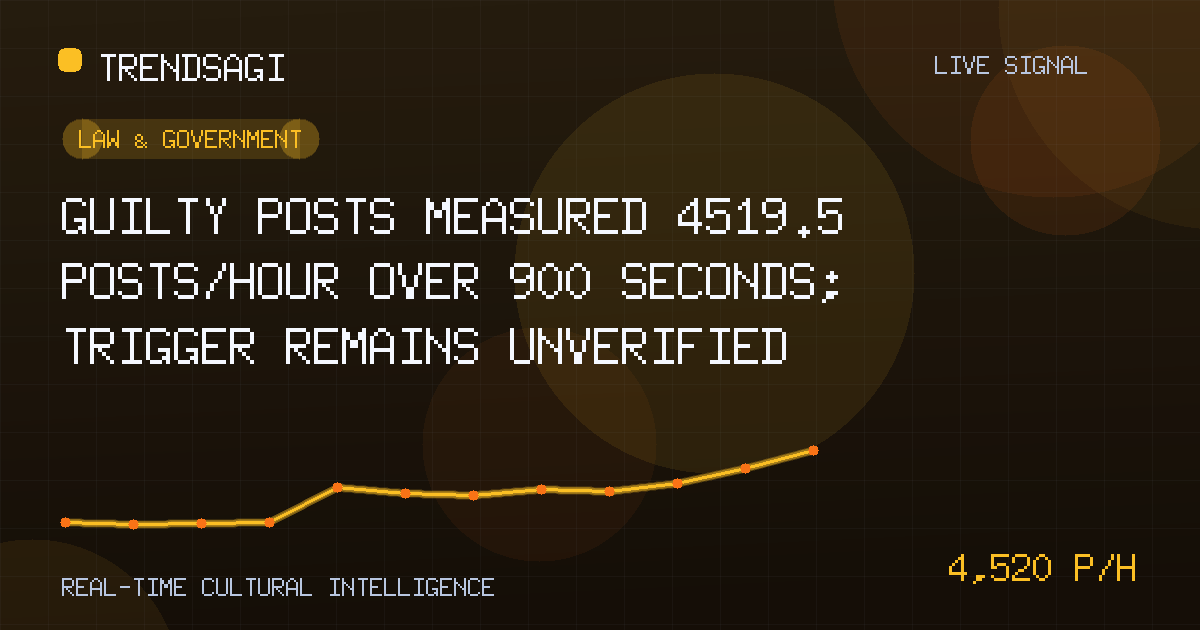
Guilty posts measured 4519.5 posts/hour over 900 seconds; trigger remains unverified
Guilty posts recorded 4519.5 posts/hour in the latest stored snapshot; the movement is measured, but its public trigger is unverified.
Automated briefing. Generated from stored signal measurements and source-backed research; it is not manually reviewed. Read the methodology and limitations.
Metrics in this briefing are a snapshot associated with its publication date and may not reflect current conditions.
What changed
The monitored Guilty topic shows a sharp measured increase in keyword-level activity. In the record observed at 2026-09-25T19:51:44Z, the measured snapshot rate was 4519.5 posts/hour over an exact 900-second window using 3 stored observations; the latest snapshot contained 3130 posts. The direct conclusion is that conversation around the stored label accelerated in this dataset. The reason for that acceleration is not verified.
| Observation time | Measured snapshot rate | Latest snapshot volume |
|---|---|---|
| 2026-09-25T19:51:44Z | 4519.5 posts/hour | 3130 posts |
The rate and the snapshot volume answer different questions. The 4519.5 posts/hour figure describes measured change during the stated window; 3130 posts describes the latest stored inventory. Neither number is a count of unique people, impressions, or engagement. Nor do the figures identify what “Guilty” meant in any given post, establish that every item concerned law, or show that a court reached a conclusion about a person.
Why this topic may be moving
No verified public context establishes a specific catalyst, so the cause remains unclear. Explanations to test—not conclusions—include:
- A developing legal event could prompt repeated discussion of a verdict, charge, sentence, or ruling.
- A headline or prominent post could be copied across accounts, producing volume without equivalent original discussion.
- Nonlegal or figurative uses of “guilty” could be caught by the same keyword.
- Coordinated or automated posting could amplify an existing reaction; repetition alone would not prove that mechanism.
- Platform recommendation or a broader conversation could increase exposure, but the stored figures do not report distribution.
Editorial read: A keyword spike establishes a change in posting activity, not the meaning, legitimacy, or cause of that activity.
What the signal can and cannot establish
What the signal can establish is narrow but relevant:
- At the recorded time, the stored system measured a rate of 4519.5 posts/hour using 3 observations across an exact 900-second window.
- The latest stored snapshot contained 3130 posts.
- The signal was assigned to Law & Government; that is a category label, not proof of legal content in each item.
What it cannot establish is equally important:
- Who caused the movement, or whether a specific event, institution, or individual triggered it.
- Whether posts were original, independent, or automated.
- How many unique people participated or saw the topic.
- The sentiment, claim accuracy, geographic spread, or language mix.
- Whether references to guilt concerned allegations, quotations, verdicts, or unrelated usage.
- Whether activity continued after the observation time or will continue.
- Whether keyword classification was accurate or representative.
Why it matters
For legal and government desks, the immediate risk is conflation. A burst around the word “guilty” is not evidence of a new ruling, a new charge, or a policy action. Editors should describe the conversation spike first and add an event explanation only after verification.
For courts, lawyers, and justice organizations, social volume should not be read as caseload, public approval, or legal significance. It may instead reflect repetition, ambiguous keyword use, or coverage of an event outside the monitored system.
For communications, trust, and safety teams, the spike is a prompt to inspect coordination and duplication. For general readers, it is a reminder that a trending word can look more conclusive than its underlying posts.
What to watch next
Useful follow-up should test persistence, context, provenance, and timing:
- Re-measure on the same basis. Use an exact 900-second window with 3 stored observations at a new timestamp, without changing the collection or counting method. A result that quickly returns to an earlier pattern would suggest a burst; a rate that remains high in subsequent same-basis windows would warrant a longer trend assessment.
- Audit the snapshot of 3130 posts. If the stored items are accessible, draw a reproducible sample and record each item’s context, format, apparent duplication, and whether it is original commentary, quotation, or repost. Retain the sampling design and exclusions so another analyst can repeat the check.
- Separate legal states and nonlegal usage. Distinguish references to a ruling, an allegation, a quoted word, and figurative language. Do not collapse them into one measure of “guilty” discussion; a reference to a verdict is not equivalent to unrelated usage.
- Cluster the burst by event. Group posts by named case, institution, jurisdiction, headline, and first appearance. Concentration around a specific timestamped event would make a catalyst more plausible; dispersion across many contexts would point toward broad keyword use or a platform effect.
- Check public-event timing. A catalyst should precede or align with the earliest relevant posts, not appear only after a reporter noticed the spike. A targeted Google Search check should look for an attributable, timestamped public record, but search results alone should not become the explanation.
- Test provenance and amplification. Compare exact and near-exact reposts, account histories, posting cadence, and cross-platform copies. These are investigation signals rather than proof; concentration and synchronized repetition need corroboration before automated or coordinated activity is asserted.
Methodology and limitations
The rate is a measured snapshot rate from the supplied record, not a live or current rate, forecast, reach, engagement, or unique-person count. It covers an exact 900-second window using 3 stored observations and is timestamped 2026-09-25T19:51:44Z. The latest snapshot volume is 3130 posts and is not interchangeable with the rate.
With 3 stored observations, the record supports the reported change within that window but not a longer trend line. The stored category is Law & Government, but the record supplies no event description. No verified public catalyst is available here, so this briefing does not attribute the movement to a ruling, campaign, celebrity case, or other actor.
The next update should preserve the same timestamping, window, observation count, volume definition, and sampling method, while adding deduplicated examples and verified event timing. Until those checks are available, confidence is high that the stored series recorded increased posting activity and low that its cause is known.
Track This Topic for New Signals
Set alerts for future velocity or sentiment changes around this topic.
Explore Tracking PlansAbout TrendsAGI research
TrendsAGI's automated research pipeline publishes dated signal snapshots, methodology notes, and practical workflows for teams evaluating cultural momentum. Read how signals are scoped, scored, and limited in our research methodology.