1476-second window · 3 observations · Measured Aug 28, 2026, 12:26 PM UTC · Provider: go_recent_snapshot_v2
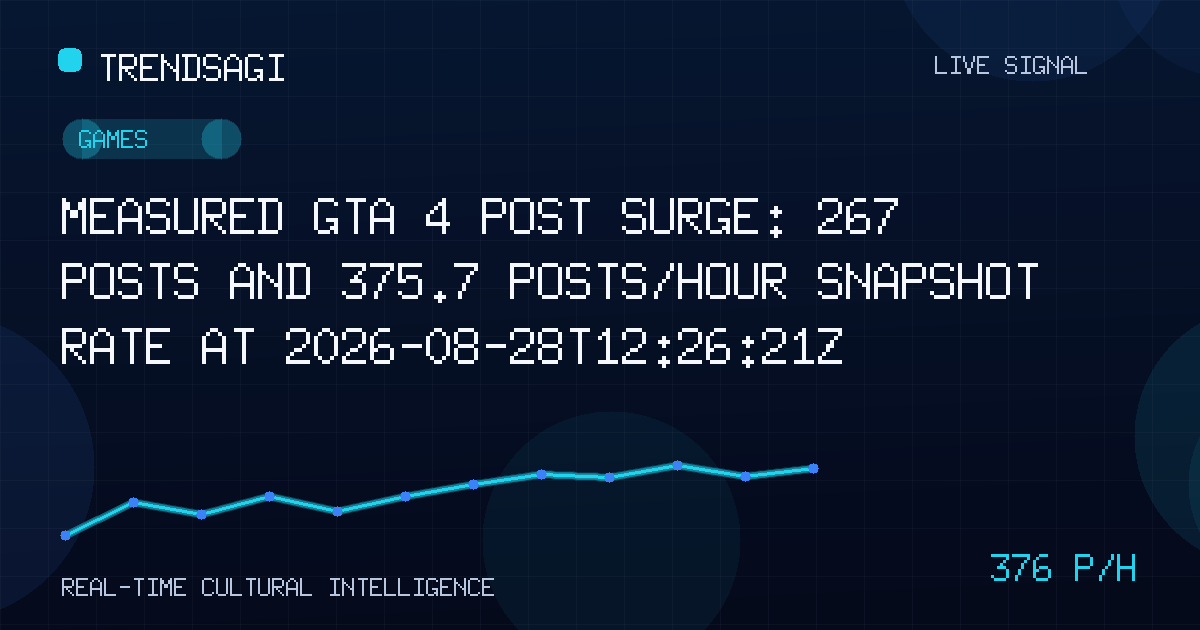
Measured GTA 4 post surge: 267 posts and 375.7 posts/hour snapshot rate at 2026-08-28T12:26:21Z
At 2026-08-28T12:26:21Z, GTA 4 had 267 posts and a measured snapshot rate of 375.7 posts/hour over 1476 seconds. Briefing explains limits and next checks.
Automated briefing. Generated from stored signal measurements and source-backed research; it is not manually reviewed. Read the methodology and limitations.
Metrics in this briefing are a snapshot associated with its publication date and may not reflect current conditions.
What changed
At the snapshot observed at 2026-08-28T12:26:21Z, the topic labeled GTA 4 showed a latest snapshot volume of 267 posts. Using three stored observations across an exact 1476-second window, the measured change rate was 375.7 posts/hour. This figure is a measured snapshot rate from the stored signal, not a live, current, or forecasted rate, and it should not be read as a count of unique people or engagements.
| Observation time | Measured posts/hour | Snapshot volume |
|---|---|---|
| 2026-08-28T12:26:21Z | 375.7 | 267 posts |
Why this topic may be moving
We checked public publisher sources to verify why references to GTA 4 were moving at that time. No verifiable outlet provided a direct attribution for a surge in discussion around 2026-08-28T12:26:21Z. Without a confirmed announcement, patch, sale, or cultural event from a trusted publisher, the specific cause remains unclear. The stored signal captures that posting activity rose, but it does not itself explain the trigger.
Because the category stored for this signal is Other, there is no pre-existing editorial framing that links the topic to a known industry cycle. Analysts should avoid assuming the burst connects to a new product release. The safest reading is that a concentrated cluster of posts appeared in the measured window, and the reason requires further evidence.
In the absence of verified reporting, one can only note that legacy entertainment properties sometimes see short-lived attention cycles driven by user-generated content. This is a generic observation, not a confirmed factor for the observed signal.
Why it matters
A measured snapshot rate of 375.7 posts/hour over a 1476-second window is a high short-term density of conversation for a topic with a legacy label like GTA 4. Teams that monitor gaming communities, social-listening vendors, and trend researchers should treat the reading as an alert to investigate, not as a validated narrative.
What the signal can establish:
- A defined burst of posts occurred within the exact observation window ending at 2026-08-28T12:26:21Z.
- The final snapshot recorded 267 posts, providing a volume anchor at that moment.
- The computed change rate of 375.7 posts/hour reflects the slope across three stored observations.
What the signal cannot establish:
- It does not reveal sentiment, whether posts are positive, negative, or neutral.
- It does not count unique authors; one account could generate many posts.
- It does not measure reach, clicks, shares outside the captured posts, or conversions.
- It does not confirm a cause, as noted in the previous section.
Another blind spot is language and platform coverage. The stored signal does not specify whether the 267 posts came from a single network or spanned multiple channels. Cross-platform bursts often have different meanings than single-community spikes.
Who should care: social listening teams at game publishers, gaming journalists evaluating tip lines, analysts covering interactive entertainment, and platform moderators assessing sudden topic load. Each group benefits from knowing the measured snapshot rate precisely, because it informs resource allocation for the next hour, not the next quarter.
The key takeaway for a trend editor is timestamp precision. The signal is anchored to 2026-08-28T12:26:21Z, which allows correlation with other time-coded datasets such as newswire stamps or platform API pulls.
What to watch next
Practical next checks for analysts and community leads:
- Pull the raw post content from the 1476-second window to identify recurring phrases, hashtags, or linked media.
- Verify against official game publisher channels and major gaming newsrooms whether any statement coincided with the timestamp.
- Monitor the following snapshots to see if the 375.7 posts/hour rate decays or persists beyond the initial burst.
- Compare the labeled topic GTA 4 with adjacent labels such as GTA 6 or Rockstar to detect possible misclassification or spillover.
- Assess whether the 267-post snapshot volume grows in subsequent observations, which would indicate a sustained thread rather than a fleeting spike.
A measured 375.7 posts/hour snapshot rate captures a short, intense interval of posting; it is a pointer to investigate, not proof of a lasting trend or a specific cause.
Concrete watch signals that would upgrade this from noise to a tracked story: a second consecutive snapshot above 300 posts/hour, appearance of the topic in a publisher’s own feed, or correlation with a verified external event. Until then, the prudent stance is cautious observation.
Methodology and limitations
The measured change rate of 375.7 posts/hour was derived from three stored observations over an exact 1476-second window, with the final observation timestamped 2026-08-28T12:26:21Z. The latest snapshot volume at that time was 267 posts. These are the only numeric anchors supplied; no other counts, user demographics, or geographic splits were available.
Several limitations apply. The snapshot volume is a count of posts at a moment, not a rate. The posts/hour figure is a measured snapshot rate from stored data, not a live feed or a projection. Because the stored signal description was empty and the category was Other, there is no contextual metadata to refine interpretation. External verification attempts did not yield a publisher-attributed cause, so any explanatory narrative would be speculative.
For teams building automated trend systems, the lesson is to separate measured burst detection from causal attribution. This briefing used the canonical stored signal as the primary input and restricted external lookup to publisher verification only. The result is a clear description of what moved and a frank statement of what remains unknown.
Track This Topic for New Signals
Set alerts for future velocity or sentiment changes around this topic.
Explore Tracking PlansAbout TrendsAGI research
TrendsAGI's automated research pipeline publishes dated signal snapshots, methodology notes, and practical workflows for teams evaluating cultural momentum. Read how signals are scoped, scored, and limited in our research methodology.