894-second window · 3 observations · Measured Oct 8, 2026, 2:56 AM UTC · Provider: go_recent_snapshot_v2
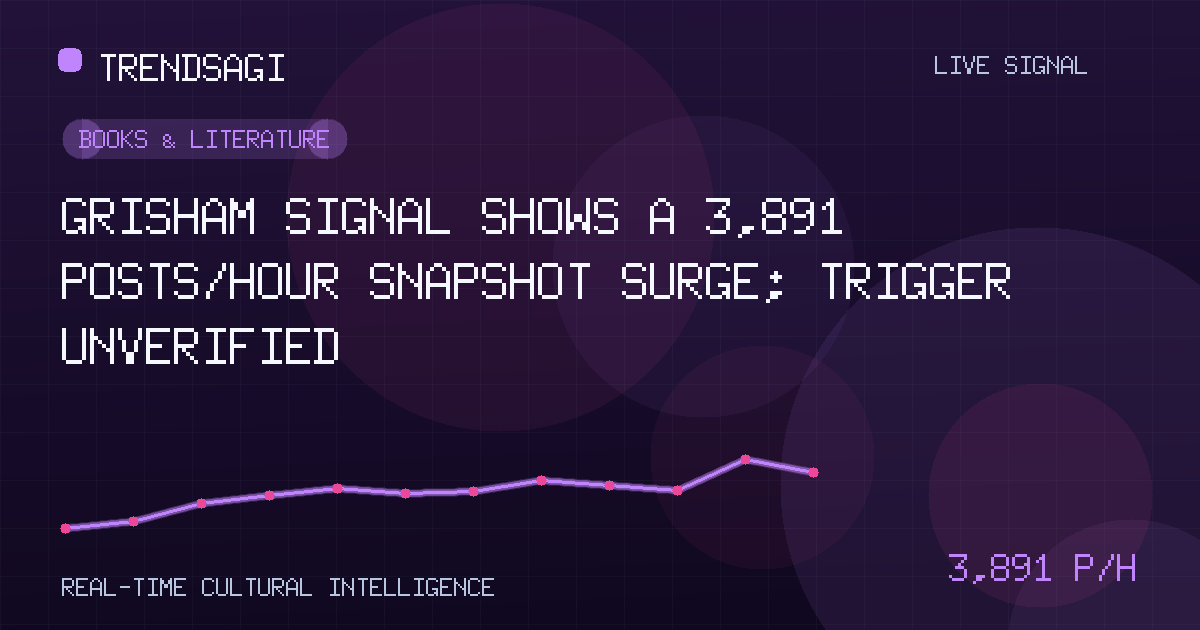
Grisham signal shows a 3,891 posts/hour snapshot surge; trigger unverified
The Grisham signal shows a measured 3,891 posts/hour snapshot surge, while the trigger remains unverified and requires post-level checks.
Automated briefing. Generated from stored signal measurements and source-backed research; it is not manually reviewed. Read the methodology and limitations.
Metrics in this briefing are a snapshot associated with its publication date and may not reflect current conditions.
What changed
The stored signal shows a concentrated rise in posts carrying the label “Grisham,” but it does not establish why the topic moved. The defensible conclusion is that attention accelerated around an ambiguous label classified under Books & Literature; no release, announcement, adaptation, controversy, or other public event can yet be tied to the increase.
The measured change is 3,891 posts/hour over an exact 894-second window using 3 stored observations, ending at 2026-10-08T02:56:24Z. The latest snapshot volume is 1,469 posts. The posts/hour figure is a measured snapshot rate, not a live or current rate, forecast, reach measure, engagement total, or count of unique people; the snapshot volume is a count, not a rate.
| Metric | Stored value |
|---|---|
| Observation time | 2026-10-08T02:56:24Z |
| Measured snapshot rate | 3,891 posts/hour |
| Latest snapshot volume | 1,469 posts |
Why this topic may be moving
The stored record does not identify a trigger, and no verified public event has been attached to this observation. Several mechanisms could produce a short burst with a similar shape, but none should be reported as the cause without additional evidence:
- A publishing or media event: An announcement, review, interview, campaign, or adaptation update could prompt many accounts to publish at once.
- A shared news source: Posts may be responding to one article or social post rather than arising independently.
- A name collision: The term may connect multiple people, places, products, or conversations that the monitoring system grouped under one label.
- Amplification or repetition: Reposting, automated activity, coordinated promotion, or a viral format may inflate the apparent movement without representing broad interest.
The first question is therefore semantic, not merely numerical: do the underlying posts concern the same subject, and do they express the same intent? A genuine public conversation should show recurring entities, titles, names, claims, or source links. If those elements differ, the aggregate spike may combine unrelated traffic rather than describe one cultural moment.
The useful finding is not simply that “Grisham” moved; it is that the movement is not yet attributable, so editorial coverage should describe a spike without inventing its cause.
Why it matters
For editors and media organizations, the signal identifies a point where rapid verification is more useful than immediate speculation. A short, high-rate movement can merit a story, but assigning it to an event before checking the underlying posts risks turning correlation into a false explanation.
Publishers, booksellers, literary creators, and librarians may want to examine the surrounding conversation because author-related attention can create timely opportunities for coverage or reader guidance. They should not treat the spike as evidence of demand, sales interest, or favorable sentiment until the posts are sampled and the apparent audience is characterized.
Readers and trend analysts also need caution. Snapshot volume can include repetition and does not reveal how many distinct people participated. Likewise, the measured rate describes movement in the collected observations, not the size or influence of the conversation. The practical value of this signal is its ability to direct attention, not yet its ability to explain the phenomenon.
What to watch next
- Inspect a representative post sample. Review posts around the observation time and record their timestamps, wording, linked destinations, language, and geography. Separate original comments from reposts, quotes, reactions, and automated-looking duplicates.
- Test whether the label is coherent. Identify the names, book titles, people, organizations, or claims that repeatedly accompany “Grisham.” A shared referent would support treating the movement as one topic; several unrelated referents would require segmentation.
- Find the earliest substantiating post. Determine when the central claim or announcement first appeared and whether its timestamp precedes the measured burst. Later summaries should not be mistaken for the original catalyst.
- Seek an independently verifiable catalyst. Check relevant official announcements and established reporting, then compare publication times and claims across independent sources. Any external fact used in coverage should remain explicitly attributed to its publisher.
- Check persistence against a normal baseline. Compare subsequent snapshots with activity in comparable periods and examine whether the burst continues, fades, or shifts to a narrower set of posts. A single short-window spike has a different meaning from sustained discussion.
- Watch for concrete corroboration. Repeated references to the same announcement, title, source, or event would strengthen the explanation. Continued disagreement over the label, broad copying of one phrase, or a concentration in one account would instead raise questions about amplification and coordination.
If no coherent public trigger emerges, the accurate editorial label is an unattributed increase in posts. That conclusion is more useful than attaching the movement to a plausible but unverified story.
Methodology and limitations
This briefing uses the supplied observation ending at 2026-10-08T02:56:24Z. The 3,891 posts/hour figure is a measured snapshot rate calculated over an exact 894-second window from 3 stored observations. The separate snapshot contains 1,469 posts. Because the rate and volume describe different measures, neither should be substituted for the other.
The short measurement window and limited observation set make the rate sensitive to changes between snapshots. It should not be extrapolated into a live total, longer-term pace, forecast, audience size, or trend persistence. The available record also does not specify the collection query, sampling method, geographic coverage, language mix, deduplication process, or baseline used for comparison.
Category assignment provides useful organization but does not guarantee that every post refers to literature or to one identifiable subject. Without a verified public event, post-level context, and a sustained baseline, the signal can establish that measured posting activity rose but cannot establish why. Any account of the cause should remain provisional until those checks are completed.
Track This Topic for New Signals
Set alerts for future velocity or sentiment changes around this topic.
Explore Tracking PlansAbout TrendsAGI research
TrendsAGI's automated research pipeline publishes dated signal snapshots, methodology notes, and practical workflows for teams evaluating cultural momentum. Read how signals are scoped, scored, and limited in our research methodology.