15-minute window · 3 observations · Measured Oct 6, 2026, 7:51 PM UTC · Provider: go_recent_snapshot_v2
Green Party signal measures 1251.8 posts/hour; cause remains unclear
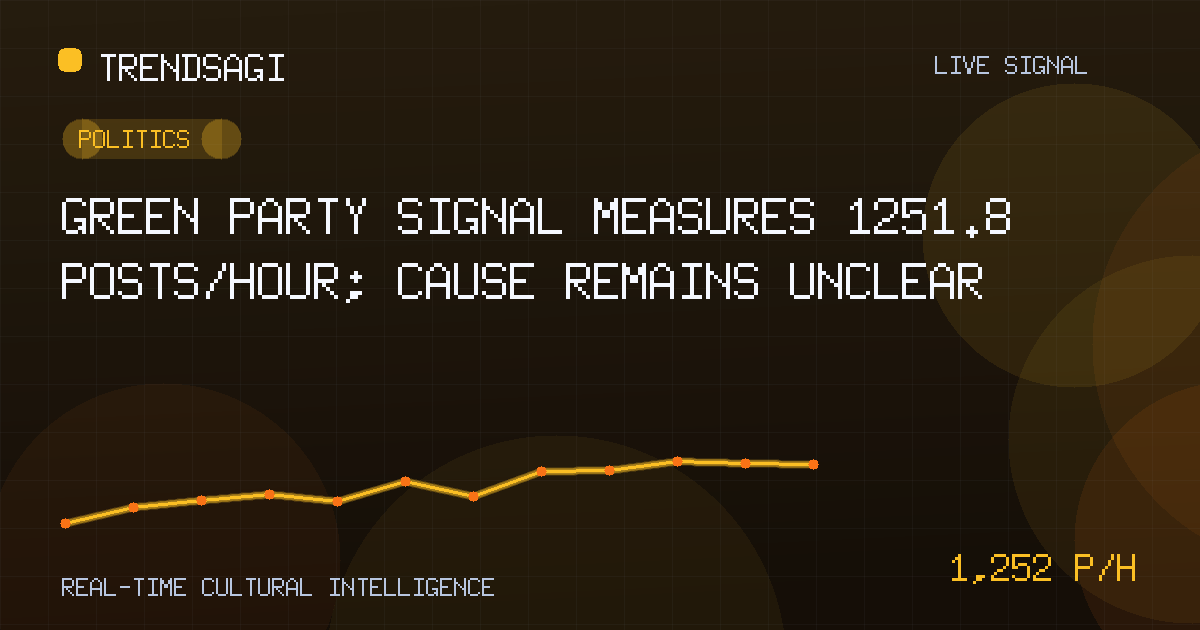
Green Party monitoring measured 1251.8 posts/hour and 626 posts; the cause is unclear, and these checks show what can—and cannot—be concluded.
Automated briefing. Generated from stored signal measurements and source-backed research; it is not manually reviewed. Read the methodology and limitations.
Metrics in this briefing are a snapshot associated with its publication date and may not reflect current conditions.
What changed
The Green Party monitoring signal recorded a measured snapshot rate of 1251.8 posts/hour in a short observation window, while the latest snapshot contained 626 posts. The direct conclusion is limited: the stored observations captured posts at that pace, but why the topic was moving is unclear, and no verified public context establishes a triggering event.
| Observation time | 2026-10-06T19:51:31Z |
|---|---|
| Measured snapshot rate | 1251.8 posts/hour |
| Latest snapshot volume | 626 posts |
The measured change comes from 3 stored observations across an exact 900-second window and was measured at 2026-10-06T19:51:31Z. This is a measured snapshot rate for that stored interval, not a live or current rate. The 626 figure is snapshot volume—not a rate, reach, engagement total, or unique-person count.
Why this topic may be moving
The stored category is Politics, but the signal has no supporting description and does not identify the countries, languages, accounts, posts, or public events involved. The Green Party label therefore needs disambiguation before any broader interpretation. Monitoring activity about a party in one country should not automatically be generalized to green politics or Green Party organizations elsewhere.
Several mechanisms could produce this pattern, but none is verified by the available record:
- A scheduled political event: campaigning, a debate, a vote, or another campaign deadline may have prompted discussion.
- A policy development: a newly reported environmental proposal, election commitment, or party position may have attracted reaction.
- An internal dispute: leadership news, candidate selection, funding, or disagreement within the party may have driven posting.
- External coverage: a news report, interview, speech, or viral clip may have made existing Green Party content more visible.
- Repetition or coordination: a campaign network, media story, automated account, or repeated message could contribute many posts without representing broad public interest.
- Label collision: unrelated uses of “Green Party,” including fiction, local organizations, or broader green-political discussion, may have inflated the count.
Without examining the underlying posts and their provenance, choosing among these explanations would be speculation. The defensible finding is therefore activity in the monitored collection, with no verified cause.
Why it matters
Journalists and editors should treat the signal as a reason to inspect the source material, not as evidence of a political breakthrough. Campaign communications teams may need to determine whether the activity concerns their organization, an electoral rival, or an unrelated use of the label. Researchers need the collection method and a longer baseline before comparing this interval with normal activity. Civic and environmental organizations should check whether discussion concerns a specific policy rather than assuming that every Green Party post is relevant to their issue.
A measured snapshot rate is a property of the observed data window, not a measure of public reach. It can justify closer investigation without validating the significance, authenticity, or cause of the activity.
The most consequential analytical error would be to equate 626 posts with 626 participants, or 1251.8 posts/hour with public attention, support, or influence. Duplicate content, quoted posts, automated activity, and multiple posts from the same account can all affect volume. Conversely, a smaller number of highly shared posts could matter more editorially than a larger stream of routine replies. None of those distinctions can be resolved from the supplied snapshot alone.
What to watch next
The next step is a provenance check that separates collection intensity from real-world significance.
- Validate the observation series. Review all 3 stored observations, their timestamps, collection boundaries, query or filter settings, and deduplication rules. Confirm how the 1251.8 posts/hour measured snapshot rate was produced without mixing it with the 626-post snapshot volume.
- Inspect the posts themselves. Identify dominant languages, countries, domains, hashtags, media attachments, and repeated wording. Distinguish original posts from quotations, reactions, reposts, and automated activity. Concentration is a clue requiring review, not automatic proof of manipulation.
- Look for a primary anchor. Check whether the activity points to a dated party statement, campaign event, official decision, election document, or other public record. Reputable reporting can then establish whether independent coverage followed the same event.
- Add a comparable baseline. Apply the same monitoring definition to earlier and later complete windows. Without that comparison, the signal cannot be described as unusually high, record-breaking, sustained, or fading.
- Separate volume from audience. Examine distinct accounts, original content, domains, and available engagement measures. These are verification targets and are not included in the current stored signal.
Concrete watch signals would include:
- Event confirmation: multiple independent posts converge on the same verifiable public act, with timestamps consistent with the observed window.
- Persistence: the measured snapshot rate remains elevated against a comparable baseline across subsequent complete windows.
- Concentration: much of the activity comes from a small set of accounts, domains, or identical messages, narrowing the likely explanation.
- Geographic clarity: language and location data show that the count is dominated by one identifiable party rather than several organizations sharing the label.
- Audience divergence: post volume increases without a corresponding rise in distinct accounts or substantive responses, which may indicate narrow or repetitive activity rather than wider discussion.
Methodology and limitations
This briefing uses the canonical Politics signal observed at 2026-10-06T19:51:31Z. It reproduces the supplied values: 3 observations, an exact 900-second measurement window, a measured snapshot rate of 1251.8 posts/hour, and latest snapshot volume of 626 posts. The volume and rate are intentionally presented as different measures.
The record does not provide a comparison period, collection universe, monitoring query, deduplication method, geographic scope, account totals, sentiment, engagement, audience data, or a verified external event. Consequently, it cannot establish why the topic moved, whether activity was authentic or coordinated, how many people participated, whether attention was broad, or whether the pattern continued after the observation time.
The accurate characterization is therefore narrow: the stored Green Party signal measured 1251.8 posts/hour over its defined window and contained 626 posts at the latest observation. Its cause and wider significance remain unresolved pending source inspection and contextual verification.
Track This Topic for New Signals
Set alerts for future velocity or sentiment changes around this topic.
Explore Tracking PlansAbout TrendsAGI research
TrendsAGI's automated research pipeline publishes dated signal snapshots, methodology notes, and practical workflows for teams evaluating cultural momentum. Read how signals are scoped, scored, and limited in our research methodology.


