1244-second window · 2 observations · Measured Aug 26, 2026, 1:06 AM UTC · Provider: go_recent_snapshot_v1
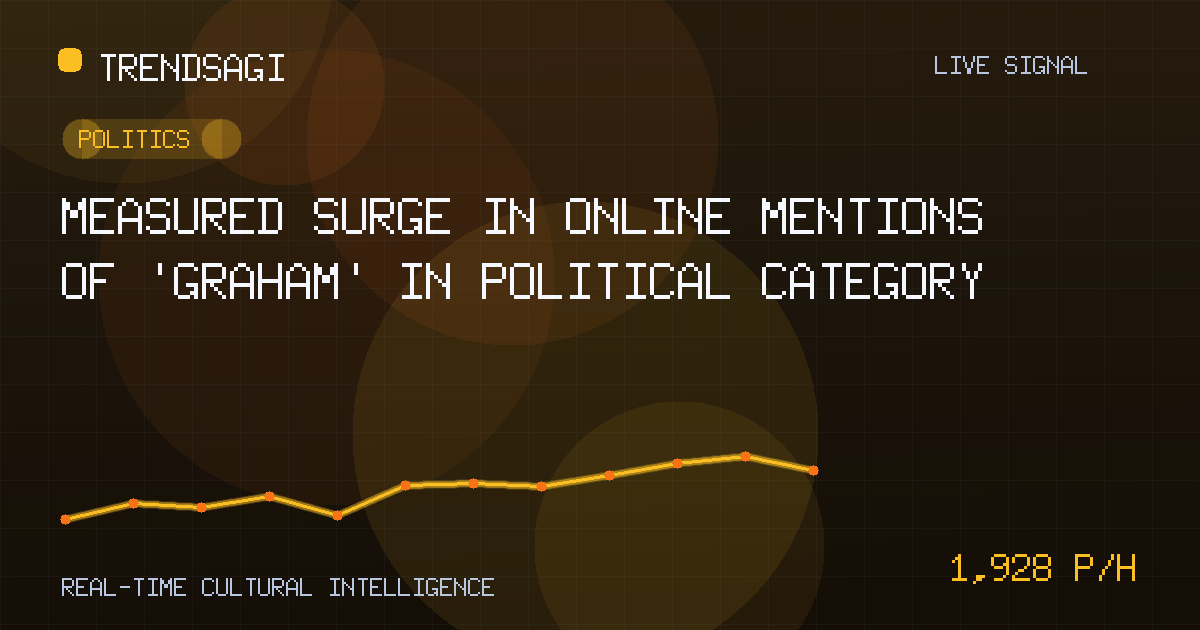
Measured Surge in Online Mentions of 'Graham' in Political Category
A measured snapshot rate of 1927.8 posts/hour indicates increased online discussion about 'Graham' in politics, providing a signal for analysts to monitor
Automated briefing. Generated from stored signal measurements and source-backed research; it is not manually reviewed. Read the methodology and limitations.
Metrics in this briefing are a snapshot associated with its publication date and may not reflect current conditions.
What changed
Online discussion around the term "Graham" in the Politics category experienced a measured snapshot rate of 1927.8 posts per hour, based on observations taken on August 26, 2026. This rate was calculated over a 1244-second window, indicating a burst of activity, with the latest snapshot volume reaching 1756 posts at the time of measurement. This suggests a notable increase in mentions compared to earlier baselines, though the exact context requires further verification.
| Observation Time | Measured Posts/Hour | Snapshot Volume |
|---|---|---|
| 2026-08-26T01:06:14Z | 1927.8 | 1756 posts |
Why this topic may be moving
The stored signal alone does not specify why "Graham" is trending in the political sphere. As per the analytical approach, the cause remains unclear without external verification. In political discourse, such spikes often correlate with events like public statements by the figure, legislative actions, media coverage, or viral social media content. For instance, if "Graham" refers to a political figure such as Senator Lindsey Graham, recent speeches, votes, or controversies could be drivers.
To pinpoint the catalyst, one would need to cross-reference this timeline with verified sources. News outlets like The Associated Press or BBC might report on political developments, while social media platforms could reveal user-driven trends. However, without attribution to specific publishers, this analysis must remain general. The signal indicates movement but not the underlying reason.
Why it matters
For stakeholders in political analysis, this measured rate highlights heightened attention to the topic. Campaign strategists, journalists, and policy researchers should note this as a potential indicator of emerging issues or shifts in public sentiment. Understanding these patterns can inform timely decision-making, such as preparing responses to upcoming events or identifying topics for deeper investigation.
In the broader context, monitoring online mentions helps track the visibility of political figures and issues. This data point, while isolated, can serve as an early warning for trends that may influence electoral cycles, public opinion, or media agendas. The political category underscores that this is not random chatter but discourse with potential implications for governance and advocacy.
What to watch next
Practical next steps involve several checks to build on this signal:
- Monitor subsequent measurement windows to determine if the posts/hour rate sustains, declines, or fluctuates, indicating whether this is a short-term spike or a longer trend.
- Look for corroborating evidence in verified news sources for any announcements, interviews, or events involving "Graham" around the observed time.
- Analyze the sentiment of the posts (if data becomes available) to assess whether the discussion is positive, negative, or neutral, which adds nuance to the volume.
- Identify related topics or hashtags that might provide context, such as associated policy issues or controversies.
Concrete watch signals include official statements from Graham's office, headlines in major newspapers, or spikes in mentions on platforms like Twitter or Reddit. Tracking these can help validate the cause and predict future movements.
Methodology and limitations
This briefing draws from a stored signal with two observations, calculating a posts/hour rate over a short 1244-second window. The snapshot volume represents the total posts observed at that moment, not a cumulative or unique-person count. The measured rate is a snapshot, not a live or forecasted metric, and should be interpreted cautiously.
In trend analysis, a single data point provides a snapshot but not a trend; sustained measurement over time is necessary to establish patterns.
The signal can establish that there was an increase in mentions, but it cannot determine the cause, reach, engagement, or user uniqueness. Data is untrusted and requires verification with additional sources. This analysis omits speculation beyond general context to avoid inaccuracies.
Overall, this data offers a starting point for monitoring political discourse, but readers should combine it with other indicators for a comprehensive view.
Track This Topic for New Signals
Set alerts for future velocity or sentiment changes around this topic.
Explore Tracking PlansAbout TrendsAGI research
TrendsAGI's automated research pipeline publishes dated signal snapshots, methodology notes, and practical workflows for teams evaluating cultural momentum. Read how signals are scoped, scored, and limited in our research methodology.