1803-second window · 3 observations · Measured Sep 28, 2026, 3:55 PM UTC · Provider: go_recent_snapshot_v2
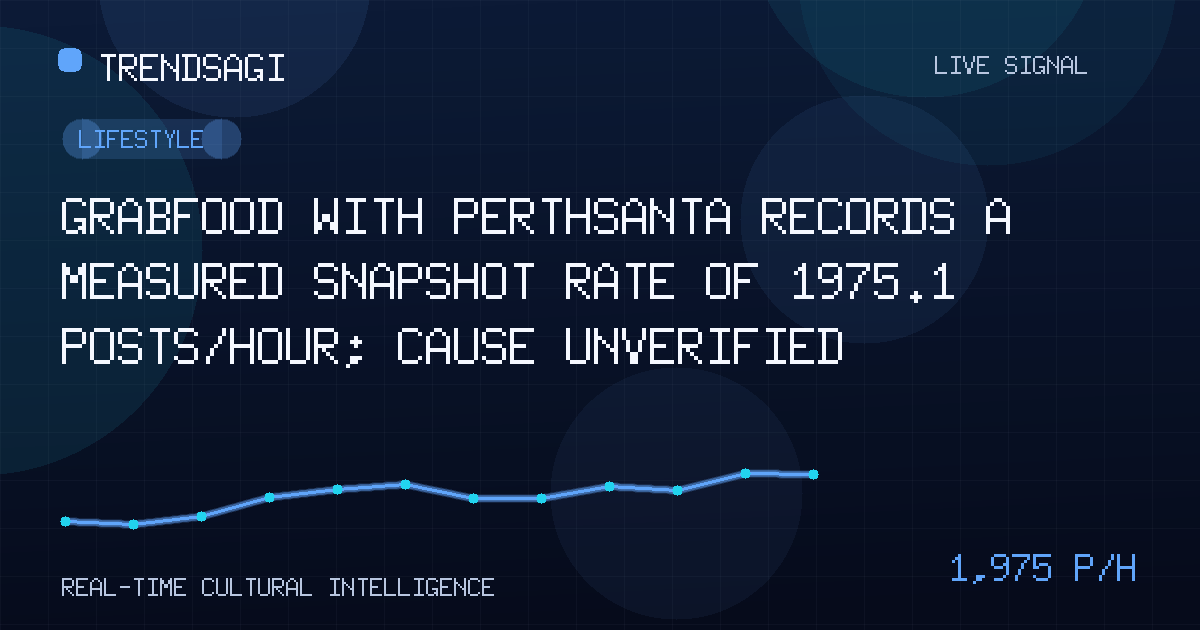
GrabFood with PerthSanta records a measured snapshot rate of 1975.1 posts/hour; cause unverified
GrabFood with PerthSanta recorded a measured snapshot rate of 1975.1 posts/hour, but no verified catalyst explains the movement.
Automated briefing. Generated from stored signal measurements and source-backed research; it is not manually reviewed. Read the methodology and limitations.
Metrics in this briefing are a snapshot associated with its publication date and may not reflect current conditions.
What changed
The direct answer is that “GrabFood with PerthSanta” shows a sharp short-window burst in the recorded social signal, but the available evidence does not establish what caused it. The phrase is not yet safe to present as an official GrabFood campaign, a confirmed event, or a durable shift in food-delivery demand.
The snapshot observed at 2026-09-28T15:55:17Z contained 2322 posts. Across an exact 1803-second window using 3 stored observations, the measured snapshot rate was 1975.1 posts/hour. That figure describes the historical observation window; it is not a live or current rate, a forecast, reach, engagement, or a count of unique people.
| Measure | Recorded value |
|---|---|
| Observation time | 2026-09-28T15:55:17Z |
| Measured snapshot rate | 1975.1 posts/hour |
| Latest snapshot volume | 2322 posts |
The rate and volume are separate measures. Snapshot volume counts the posts present at the observation, while the measured snapshot rate describes the observed change within the stated window. The rate should not be used as a substitute for audience size, and the volume should not be described as a rate.
Why this topic may be moving
No verified public catalyst is established for this signal. The wording does not show what “PerthSanta” denotes, whether it is a person, account, venue, campaign label, or place name, or how GrabFood is connected to it. Nor does the Lifestyle classification resolve the relationship. An exact phrase can travel because a meaningful event prompted it, but it can also spread through repetition, reposting, platform recirculation, or an ambiguous label attached to unrelated posts.
- Original content: creators may be posting about a shared delivery, restaurant, or ordering experience.
- Promotion: a coupon, referral arrangement, menu feature, or sponsored post could concentrate mentions.
- Local event: a venue, creator, or community activity could make the phrase recognizable within a specific network.
- Controversy: complaints, service issues, or disputes can also generate rapid repeated wording.
- Non-organic concentration: duplicate text, automated posting, or large reposting can inflate apparent velocity without broad human attention.
A fast social spike is evidence of changed posting activity, not proof of changed consumer behavior, platform strategy, or commercial demand.
These are verification hypotheses, not explanations supported by a confirmed public event. None should be reported as the cause until an original post, named participant, official account, promotion page, or other attributable evidence connects the wording to the activity.
Why it matters
The immediate significance is attention management. A fast-moving phrase can affect editorial coverage, customer support, merchant monitoring, and platform conversation within the observation period, even if the underlying cause is mundane or low quality. The right response depends on separating genuine participation from repeated content.
- Food-delivery operators should check whether the burst coincides with a campaign, support issue, or localized demand, rather than assuming platform-wide interest.
- Merchants and venues should determine whether “PerthSanta” maps to a real location, account, offer, or menu item before changing staffing, inventory, or communications.
- Creators and Lifestyle editors need to identify the original context so they do not amplify a misleading phrase or mistake coordinated posting for consensus.
- Trend analysts should treat the observation as a candidate event until its persistence, source diversity, and audience composition are known.
For ordinary readers, the practical value is distinction: the signal shows that posts accumulated quickly in the monitored set, but it does not show that people ordered food, that sentiment was positive, or that GrabFood caused anything.
What to watch next
Verification should follow the signal from mention to mechanism:
- Trace the earliest usable posts. Review original posts across the 1803-second window and adjacent windows, recording account identity, timestamp, geography claimed in the post, media, and whether each item is original, quote, repost, or duplicate. This can reveal whether independent accounts participated or a single source supplied most of the volume.
- Resolve the entities. Check whether “PerthSanta” consistently points to the same account, venue, event, location, or spelling. Do not infer a connection to Perth, Santa, a restaurant, or a delivery offer from the label alone.
- Seek attributable confirmation. Look for a dated post from the relevant official account, campaign terms, a menu or offer page, or a direct statement by an identifiable participant. A matching official item should align with the onset, but timing alone still would not prove causation.
- Audit repetition. Compare wording, media reuse, posting cadence, account history, and synchronized phrasing. Heavy duplication or low source diversity would weaken the case for broad organic interest.
- Test commercial meaning. Check verified order or redemption information, menu availability, pricing, service notices, and customer-support themes. Social posts alone cannot establish sales, orders, foot traffic, or platform usage.
- Establish a baseline. Compare the measured snapshot rate and snapshot volume with earlier and later windows using the same collection scope. The current observation can establish a short-window burst, but not whether the burst persisted or faded.
Concrete signals that would change the assessment
Escalate the topic only when several signals converge: independent original posts recur in successive windows; multiple identifiable accounts participate; an official or participant source confirms the event; the phrase resolves to a specific venue, offer, or activity; and the signal remains after the initial repetition. A useful counter-signal is equally important: concentration in a small repost network, inconsistent identity references, no attributable catalyst, or a sharp drop in the next valid window. Those outcomes would favor classifying this as a transient or noisy burst.
Methodology and limitations
The observation time is 2026-09-28T15:55:17Z. The latest snapshot contains 2322 posts. The measured snapshot rate is 1975.1 posts/hour, calculated from 3 stored observations over the exact 1803-second window. It is conditioned on the monitoring scope and observation method. The rate is historical, not live; the snapshot volume is not a rate; neither is a measure of unique authors, engagement, sentiment, geography, sales, or the full public conversation.
No verified public context establishes why the topic is moving, so the cause remains unclear. The strongest responsible interpretation is therefore narrow: this is a fast-moving phrase in a Lifestyle-classified signal that merits source checking, not a confirmed GrabFood trend or behavioral change.
Track This Topic for New Signals
Set alerts for future velocity or sentiment changes around this topic.
Explore Tracking PlansAbout TrendsAGI research
TrendsAGI's automated research pipeline publishes dated signal snapshots, methodology notes, and practical workflows for teams evaluating cultural momentum. Read how signals are scoped, scored, and limited in our research methodology.