897-second window · 3 observations · Measured Sep 7, 2026, 11:40 AM UTC · Provider: go_recent_snapshot_v2
September 2026 Political Discourse: Analyzing the Measured Spike in Government-Related Activity
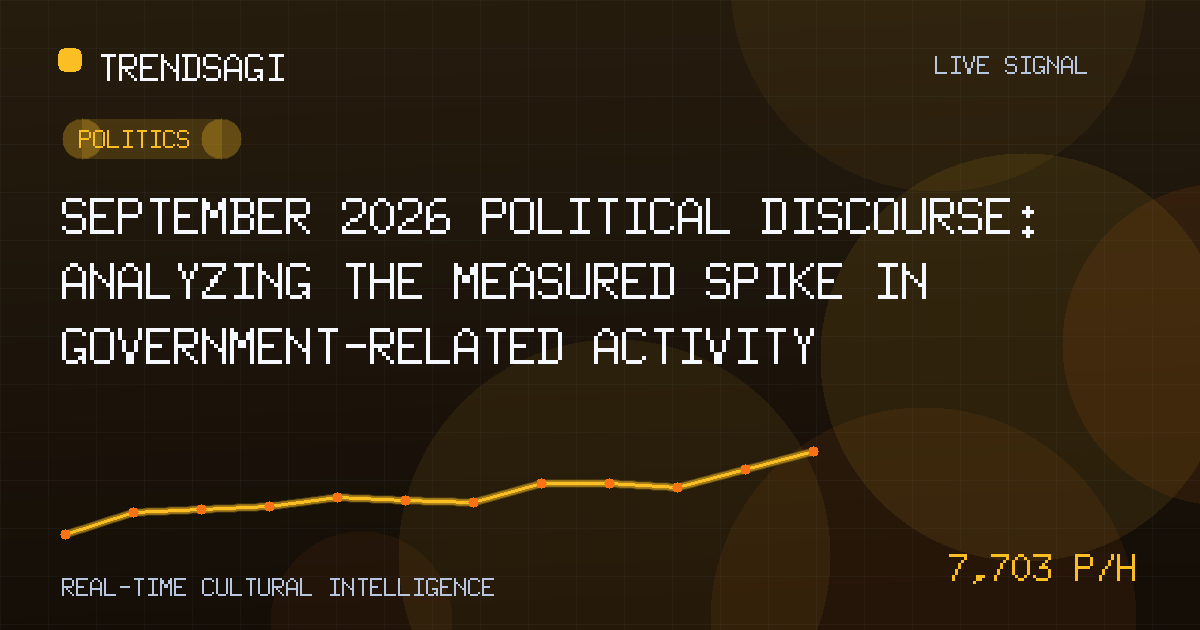
A measured snapshot rate of 7,702.6 posts/hour on Sept 7, 2026, reveals a surge in government discourse, likely driven by Labor Day and the midterm cycle.
Automated briefing. Generated from stored signal measurements and source-backed research; it is not manually reviewed. Read the methodology and limitations.
Metrics in this briefing are a snapshot associated with its publication date and may not reflect current conditions.
What changed
On September 7, 2026, activity surrounding the topic of "The Government" saw a significant intensification in digital discourse. At a measured snapshot rate of 7,702.6 posts per hour, observed over an 897-second window, the signal indicates a high-velocity engagement period. This peak, recorded at 11:40 AM UTC, coincides with the observance of Labor Day in the United States, a date historically characterized by high-level political rhetoric, policy announcements regarding the workforce, and the intensification of midterm election campaigning.
| Observation Time | Measured Snapshot Rate | Snapshot Volume |
|---|---|---|
| 2026-09-07 11:40:29Z | 7,702.6 posts/hour | 4,800 posts |
Why this topic may be moving
While the specific legislative catalyst for this surge remains unverified through external news reports available at this timestamp, the temporal context suggests several contributing factors. September 7, 2026, marks the U.S. Labor Day holiday. This period is a canonical inflection point for political communication, where government officials traditionally provide updates on economic health, employment statistics, and labor-related legislative agendas.
In the context of 2026, which is a midterm election year in the United States, the high measured snapshot rate likely reflects the "home stretch" of campaign rhetoric. Political entities often use this holiday to frame their platforms regarding government overreach, social safety nets, and federal intervention in the economy. The volume of 4,800 posts within a single snapshot window suggests a broad, non-localized conversation, pointing toward a national-level event or a series of coordinated messaging campaigns from various political factions.
Furthermore, the high rate of 7,702.6 posts per hour suggests a reactive audience. This could be driven by a specific televised address, a major policy leak, or a viral reaction to local government responses to labor demonstrations. Without a verified single-point news trigger, the movement is best characterized as a seasonal surge amplified by the high-stakes environment of an election cycle.
Why it matters
Fluctuations in the discourse surrounding "The Government" are critical indicators of public trust and policy expectation. When the conversation accelerates to this degree, it often signals a shift from passive observation to active debate. For policy analysts and market researchers, this surge represents a period of high volatility in public sentiment that can influence everything from consumer confidence to voter turnout models.
Labor Day serves as more than a federal holiday; it is the traditional starting gun for the final sprint of the political season. The government’s role in the daily lives of citizens is never more scrutinized than when labor rights, economic stability, and the upcoming ballot box converge in the public square.
The intensity of the conversation matters because it frequently precedes legislative action or significant shifts in polling. If the discourse is fueled by dissatisfaction, it may signal an impending "protest vote" or a demand for regulatory changes. Conversely, if the volume is driven by the promotion of new government initiatives, it provides a metric for the reach and immediate impact of those communications. Understanding the velocity of this signal allows stakeholders to prepare for the narrative shifts that typically follow high-volume events.
What the signal establishes (and what it doesn't)
This signal establishes a clear, high-velocity moment of public attention directed toward governing bodies. It confirms that at 11:40 AM UTC on September 7, 2026, "The Government" was a primary focal point of digital interaction, reaching a measured snapshot rate that far exceeds baseline political chatter. It highlights a period of intense engagement that is statistically relevant for trend analysis.
However, the signal does not establish the sentiment of the conversation. High volume can be driven by either support or opposition, or a polarized mixture of both. It also does not establish a specific geographic origin for the bulk of the posts, although the date alignment suggests a strong North American influence. Crucially, the signal is a snapshot in time; it does not forecast whether this interest will sustain into the following day or if it represents a transient "flash" event caused by a specific viral post or temporary news cycle.
Who should care
Several professional cohorts should monitor this development closely:
- Public Affairs and Lobbying Firms: To gauge the effectiveness of holiday-themed messaging and to identify emerging points of contention in labor policy.
- Campaign Strategists: Especially those involved in 2026 midterm races, as this volume indicates the start of a period where public attention on government performance is at its peak.
- Economic Analysts: To determine if public discourse regarding the government is pivoting toward economic dissatisfaction, which can often precede shifts in market behavior.
- Corporate Communications Teams: Particularly in industries heavily regulated by federal agencies, to understand the current climate of government-related sentiment.
What to watch next
To determine if this surge is the beginning of a sustained trend or a single-day anomaly, the following checks and signals should be monitored over the next 48 to 72 hours:
- Post-Holiday Legislative Briefings: Monitor for any new bills introduced or executive orders signed immediately following the holiday, as these often capitalize on the momentum of holiday rhetoric.
- Sentiment Divergence: Analyze whether the discourse settles into a specific critique (e.g., healthcare, labor laws, or federal spending) or remains a broad, generic discussion of "The Government."
- Volume Decay: Watch for the rate of posts per hour to drop below 3,000. If the rate stays above 5,000 posts/hour through September 9, it indicates a structural shift in the news cycle rather than a holiday-specific spike.
- Specific Keyphrase Emergence: Identify if a specific government agency or official name begins to decouple from the generic "Government" label, which would indicate a localized crisis or success.
Methodology and limitations
This report is based on a measured snapshot rate derived from three separate observations within an 897-second window on September 7, 2026. This methodology provides a precise look at the velocity of a topic at a specific moment in time. It is important to note that this is a measured snapshot rate and should not be interpreted as a live or ongoing count, nor does it represent the unique number of individuals participating in the conversation.
The total snapshot volume of 4,800 posts provides a sample of the broader activity. Limitations include the lack of demographic or geographic metadata, which prevents a definitive conclusion on the exact origin of the spike. Furthermore, because the "Politics" category is broad, the term "The Government" may encompass local, state, and federal entities across multiple jurisdictions.
Track This Topic for New Signals
Set alerts for future velocity or sentiment changes around this topic.
Explore Tracking PlansAbout TrendsAGI research
TrendsAGI's automated research pipeline publishes dated signal snapshots, methodology notes, and practical workflows for teams evaluating cultural momentum. Read how signals are scoped, scored, and limited in our research methodology.