1799-second window · 3 observations · Measured Oct 7, 2026, 10:51 AM UTC · Provider: go_recent_snapshot_v2
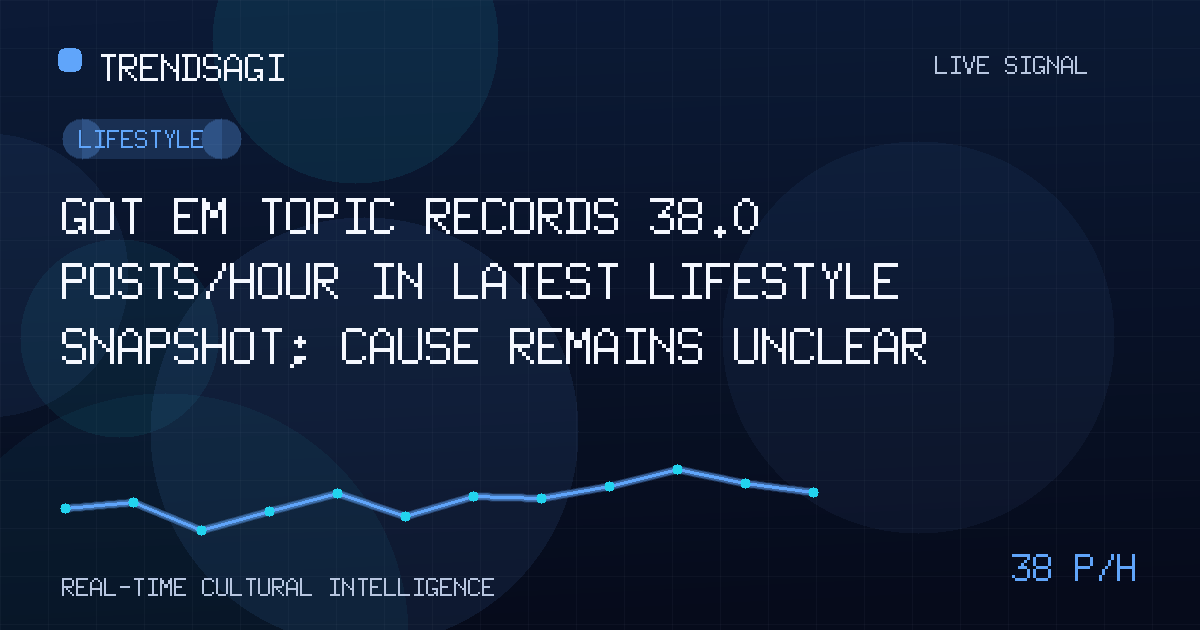
GOT EM topic records 38.0 posts/hour in latest Lifestyle snapshot; cause remains unclear
The GOT EM Lifestyle signal contains 86 posts and a measured 38.0 posts/hour snapshot rate; here is what is known, unclear, and worth verifying next.
Automated briefing. Generated from stored signal measurements and source-backed research; it is not manually reviewed. Read the methodology and limitations.
Metrics in this briefing are a snapshot associated with its publication date and may not reflect current conditions.
What changed
“GOT EM” is showing measurable movement in the Lifestyle topic record, but neither what the phrase means nor why it is moving has been established. The evidence confirms a posting change associated with the label; it does not show that the posts form one coherent conversation. No verified public catalyst is available for this briefing, so the signal should not yet be presented as a confirmed cultural, consumer, or news trend.
The latest snapshot, observed at 2026-10-07T10:51:58Z, contains 86 posts. Across an exact 1799-second measurement window using 3 observations, the measured snapshot rate was 38.0 posts/hour. That figure describes the recorded interval only. It is not a live or current rate, forecast, reach, engagement, or unique-person count.
| Observation time | 2026-10-07T10:51:58Z |
|---|---|
| Latest snapshot volume | 86 posts |
| Measured snapshot rate | 38.0 posts/hour |
| Exact measurement window | 1799 seconds |
| Observations used | 3 |
| Category | Lifestyle |
How to interpret the signal
Read the rate narrowly. It reports activity associated with “GOT EM” at 38.0 posts/hour during the measured window. The 86-post snapshot records volume at the observation time. Neither number reveals sentiment, subject matter, geography, audience size, or whether the posts were original.
The phrase itself is the main interpretive constraint. “GOT EM” could be a reaction, a caption, part of a quotation, or wording attached to media, but none of those uses is established here. Without inspecting the underlying posts, the signal cannot distinguish a shared topic from repeated wording or unrelated conversations grouped under the same label.
The defensible conclusion is narrow: the labeled topic was active during the measured interval. The evidence does not yet establish a shared subject, a causal event, or a trend that persists beyond that snapshot.
Why this topic may be moving
Because no verified public catalyst has been identified, the cause remains unclear. These explanations should be treated as hypotheses rather than findings:
- Phrase resonance. A short, repeatable expression could prompt repeated posting in entertainment, social commentary, or casual conversation without representing a single issue. The record does not show whether that is happening here.
- Response to a catalyst. A specific public moment—a clip, utterance, promotion, release, or other event—could prompt reaction. No particular catalyst has been verified, so naming one would be speculation.
- Label collision. If “GOT EM” is attached to different meanings, the aggregate could combine separate conversations rather than measure one trend.
- Short-window concentration. The rate uses 3 observations in an exact 1799-second window. A brief cluster could lift the measured rate without persisting into later snapshots.
These explanations can coexist. A catalyst could still produce a noisy aggregate if the label merges several responses. The post-level pattern should be identified before choosing among them.
Why it matters
The signal is useful as a prompt for investigation, not as a basis for a campaign, forecast, or editorial claim. Its immediate implication is that “GOT EM” deserves a rapid content check, while its lack of a defined subject limits stronger conclusions.
- Editors should verify whether there is a story before using the phrase as a headline.
- Community and social teams should determine whether the behavior reflects audience interest or a labeling artifact.
- Brand and consumer researchers should not equate posting rate with demand or purchase intent.
- Analysts should preserve the timestamp, category, and measurement method when comparing later evidence.
What to watch next
Use a repeatable verification pass rather than extending the snapshot rate into a projection:
- Inspect the posts. Review a time-ordered sample before and within the exact 1799-second window. Capture wording, context, media type, and whether each item is original, a quotation, a reply, or a duplicate.
- Cluster meanings. Assign posts to distinct uses of the phrase, then identify the dominant context without assuming all posts address the same subject.
- Check independence. Remove duplicates and assess whether activity comes from diverse accounts or a narrow cluster.
- Verify a catalyst. Accept a public explanation only when a timestamped primary item or reputable publisher page substantiates it and connects it to the labeled posts.
- Compare later snapshots. Keep the same collection, filter, and category, then look for persistence rather than extending this interval into a projection.
Concrete watch signals
- Strengthening evidence: the same interpretation across independent posts, persistence in later snapshots, and broader participation.
- Weakening evidence: rapid disappearance, concentration in one account, or little activity after duplicates are removed.
- Explanatory evidence: a timestamped public source that clearly precedes the movement and matches the dominant meaning.
- Taxonomy warning: the Lifestyle label repeatedly mapping to unrelated contexts.
A single later snapshot will not settle the question. Persistence, semantic agreement, and independent participation would make this a much more useful trend signal.
Methodology and limitations
This briefing uses the latest available snapshot for observation time, volume, and measured rate. The 38.0 posts/hour figure is retrospective and based on 3 observations over the exact 1799-second window; 86 is snapshot volume, not a rate. It does not establish live activity or future direction.
- No available topic description defines the phrase or its intended subject.
- No post text, sentiment, geography, platform, account counts, or engagement data is available for interpretation.
- No verified public context establishes why the activity changed.
- No controlled baseline or longer history shows whether the rate is unusual or sustained.
- No basis is provided for forecasting reach or causal impact.
Accordingly, treat “GOT EM” as an alert worth validating, not a confirmed trend. A matching catalyst, clearer semantics, independent participation, and continued activity would materially strengthen the interpretation.
Track This Topic for New Signals
Set alerts for future velocity or sentiment changes around this topic.
Explore Tracking PlansAbout TrendsAGI research
TrendsAGI's automated research pipeline publishes dated signal snapshots, methodology notes, and practical workflows for teams evaluating cultural momentum. Read how signals are scoped, scored, and limited in our research methodology.