885-second window · 3 observations · Measured Sep 29, 2026, 2:54 PM UTC · Provider: go_recent_snapshot_v2
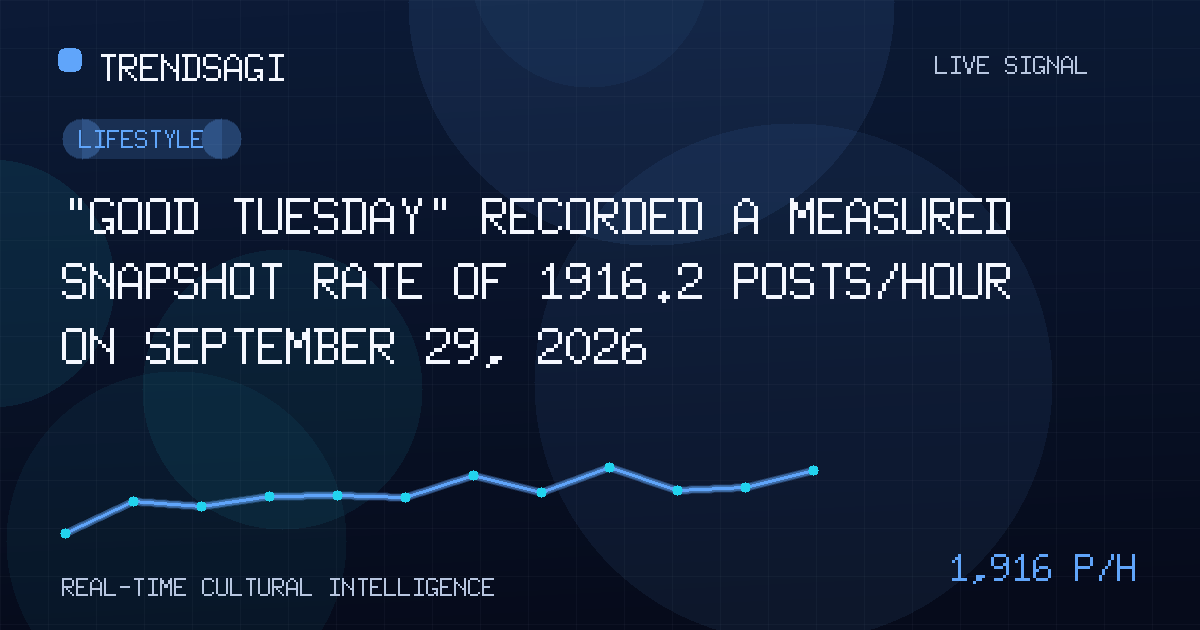
“Good Tuesday” recorded a measured snapshot rate of 1916.2 posts/hour on September 29, 2026
“Good Tuesday” posts moved at a measured snapshot rate of 1916.2 posts/hour on September 29, 2026; this briefing explains how to validate the signal.
Automated briefing. Generated from stored signal measurements and source-backed research; it is not manually reviewed. Read the methodology and limitations.
Metrics in this briefing are a snapshot associated with its publication date and may not reflect current conditions.
What changed
“Good Tuesday” is showing a concentrated burst in the stored Lifestyle signal, but the reason for the movement has not been verified. The latest snapshot, observed at 2026-09-29T14:54:08Z, contains 1756 posts. The available record does not identify a specific event, campaign, news story or platform change behind the increase, so the cause remains unclear.
The measured change is 1916.2 posts/hour over an exact 885-second window using 3 stored observations. This is a measured snapshot rate, not a live or current rate, forecast, reach figure, engagement total or count of unique people. It demonstrates rapid movement within the observed series, but not what prompted that movement.
| Metric | Value |
|---|---|
| Observation time | 2026-09-29T14:54:08Z |
| Measured snapshot rate | 1916.2 posts/hour |
| Snapshot volume | 1756 posts |
Why this topic may be moving
No verified public context establishes why the topic is moving, and the phrase is semantically broad. In a Lifestyle feed, “Good Tuesday” could be an ordinary greeting, a positive status update, a recurring online expression or wording inside a larger promotion. The stored category does not resolve those meanings.
Four explanations remain open:
- Organic conversation: people may be sharing positive updates or reactions to the day.
- A recurring expression: a greeting or template may be reused repeatedly without any connected news event.
- Promotional distribution: a campaign or community could be repeating the phrase, although no named campaign has been verified.
- Phrase collision: matching text may refer to different subjects that the Lifestyle label alone cannot distinguish.
These are hypotheses, not findings. Without post samples, account concentration, timing patterns or verified source context, the signal cannot distinguish broad participation from repetition by a smaller set of accounts. It also cannot show whether the posts are original, replies, reposts or automated.
The signal establishes a change in posting activity, not the identity, intent or authenticity of the people posting.
Why it matters
Attention and meaning are not interchangeable. A spike in a short phrase can be useful as an editorial queue without being evidence of a broader shift in behavior, sentiment or demand. That distinction matters most to teams deciding whether to investigate, publish or respond.
- Lifestyle editors: look for a specific subject that can be reported accurately rather than treating the phrase itself as the story.
- Community managers: determine whether members are creating a shared conversation, exchanging routine greetings or reacting to a coordinated push.
- Brand and marketing teams: avoid treating post volume as evidence of awareness, preference or purchase intent.
- Researchers: preserve the distinction between posts, accounts and people, especially when comparing short trend windows.
For a real reader, the immediate implication is modest: something is moving quickly, but there is not enough evidence to explain it or act as though it represents a wider cultural change.
What to watch next
The next useful check is evidence that separates broad conversation from repetition, ambiguity or a matching problem. These are the concrete signals to examine:
- Persistence: compare later stored observations using the same 885-second window where possible. Record observation time, measured snapshot rate and snapshot volume separately. A repeated burst would support persistence; one observation cannot.
- Phrase integrity: confirm how exact matches were defined and review variants, punctuation, capitalization and hashtags. Broad matching could include text unrelated to a single conversation.
- Account concentration: examine how many distinct accounts contributed and whether a small group supplied much of the activity. Account counts still do not establish unique people.
- Semantic consistency: sample posts and classify them as greetings, personal updates, promotion, entertainment, news or unrelated uses. Consistent meaning would make the signal more actionable.
- Format and repetition: distinguish original posts, replies, quoted posts and duplicates. Repeated wording, shared links or common calls to action may indicate distribution rather than independent discussion.
- Independent corroboration: seek a dated, verified public explanation that connects a named event, campaign or cultural development to the phrase and the observed period.
The strongest confirmation would be convergence: later measured activity, diverse account participation, consistent meaning and a verified public explanation. The stored signal currently establishes concentrated posting activity, not that full picture.
Methodology and limitations
This briefing uses the observation at 2026-09-29T14:54:08Z. Its 1916.2 posts/hour figure is explicitly a measured snapshot rate based on an exact 885-second window and 3 stored observations. The 1756 figure is the latest snapshot volume, not a rate. Neither number is a forecast, and neither establishes reach or engagement.
No explanatory description, post-level sample, historical baseline, account distribution, geographic breakdown, language breakdown or verified public explanation accompanies the stored figures. The signal can establish the timing of the observed count and the movement recorded over the specified window. It cannot establish motive, authenticity, organic participation, sentiment, causation or a broader change in behavior. It should therefore be used as a trigger for validation rather than a finished explanation.
Track This Topic for New Signals
Set alerts for future velocity or sentiment changes around this topic.
Explore Tracking PlansAbout TrendsAGI research
TrendsAGI's automated research pipeline publishes dated signal snapshots, methodology notes, and practical workflows for teams evaluating cultural momentum. Read how signals are scoped, scored, and limited in our research methodology.