903-second window · 3 observations · Measured Oct 4, 2026, 4:55 PM UTC · Provider: go_recent_snapshot_v2
“Good Sunday” shows a measured 2216.4 posts/hour snapshot rate; cause unverified
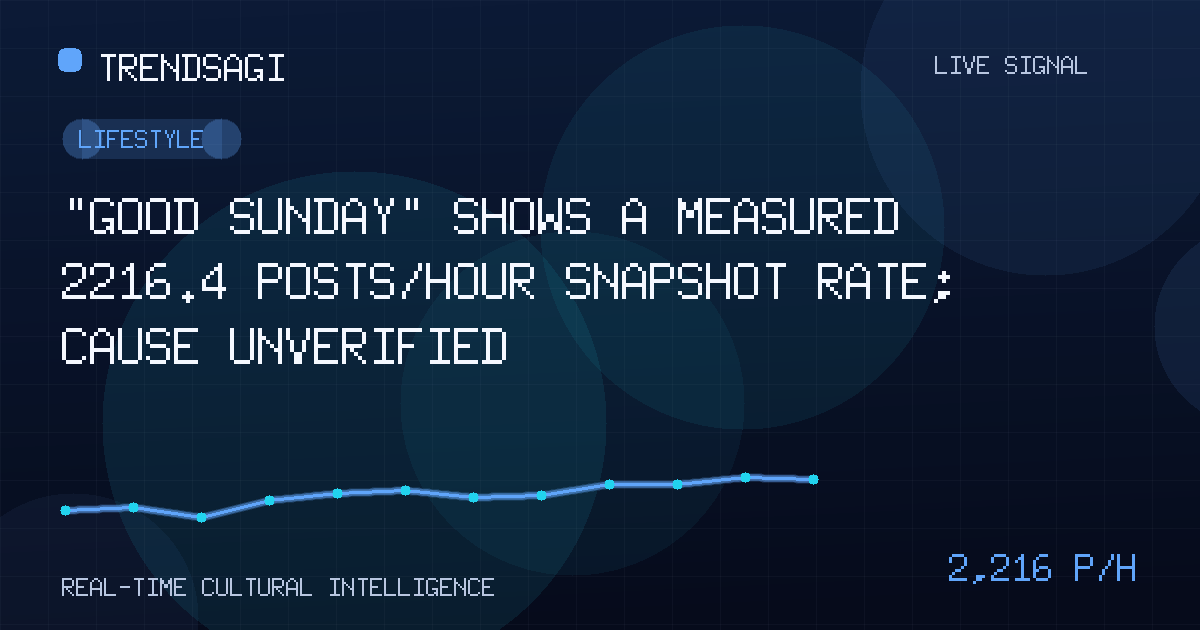
“Good Sunday” shows 1241 posts and a measured 2216.4 posts/hour snapshot rate; the cause is unverified, with practical checks for editors.
Automated briefing. Generated from stored signal measurements and source-backed research; it is not manually reviewed. Read the methodology and limitations.
Metrics in this briefing are a snapshot associated with its publication date and may not reflect current conditions.
What changed
The direct answer is that the stored “Good Sunday” signal records a concentrated short-window burst, but its catalyst is not verified. The latest snapshot contained 1241 posts at 2026-10-04T16:55:51Z. No public event, person, organization, or campaign can yet be named as the cause from the available verified context.
The measured change is 2216.4 posts/hour over an exact 903-second window using 3 stored observations. This is a measured snapshot rate, not a live or current rate, forecast, reach figure, engagement measure, or unique-person count. The 1241 figure is latest snapshot volume—a point-in-time post count—not a rate.
| Observation time | Measured snapshot rate | Latest snapshot volume |
|---|---|---|
| 2026-10-04T16:55:51Z | 2216.4 posts/hour | 1241 posts |
For an editor, this is a verification candidate rather than a ready-to-publish explanation. The immediate question is not whether the label registered activity; it is whether representative posts share a specific meaning and whether a public catalyst can explain the timing.
Why this topic may be moving
The cause remains unclear because no verified public context has been attached to the signal. “Good Sunday” is also a broad phrase. It may be ordinary well-wishing, religious language, a wellness or reset theme, an event or campaign label, or part of a title. These possibilities are hypotheses, not findings. Without representative post text, choosing one interpretation would turn a keyword burst into an unsupported cultural narrative.
Several mechanisms could produce the observed pattern. Weekend-facing wording may prompt repeated greetings. A release, promotion, public appearance, or community ritual could also concentrate usage quickly. Repetition alone can lift a generic label without changing broader opinion. Collection artifacts are another possibility: duplicated, automated, or cross-posted content may be counted as activity.
None of those mechanisms is verified here. The stored category “Lifestyle” is a classification label; it does not establish what writers meant. The blank stored description also leaves no event, person, organization, or campaign identified. Any causal attribution at this stage would go beyond the evidence.
The signal establishes a change in labeled posting activity; it does not establish a shared meaning, a verified catalyst, or a durable cultural shift.
Why it matters
This signal matters because its short-window rate warrants an editorial verification check, not because its meaning is settled. Newsrooms should not present the burst as broad adoption. Lifestyle, faith, entertainment, and community teams may each need to see whether the phrase is relevant to their audience, but volume alone does not reveal sentiment, demand, or willingness to participate.
The rate and snapshot volume answer different questions. The 1241 posts describe the latest observation. The 2216.4 posts/hour figure summarizes the exact change window. Together they justify monitoring; they do not show that activity persisted, reached distinct users, spread geographically, or occurred organically.
- Editors: Verify a specific story before giving the label a definitive explanation.
- Community teams: Determine whether the usage is meaningful to their communities or merely repeated wording.
- Researchers: Preserve the distinction between a measured historical rate and a live trend.
What to watch next
The next checks should turn an ambiguous spike into a testable account:
- Meaning: Read a representative slice of posts from the measured window. If greetings, devotional remarks, product references, and unrelated title uses are mixed together, the “trend” may be a classification bucket rather than a single conversation.
- Catalyst: Use Google Search to check whether a reputable publisher or official organizer connects the exact phrase to an event near the observation time. Attribute a cause only when that context is verified.
- Persistence: Compare later complete windows using the same collection method. Continuing activity is stronger evidence of sustained attention; an immediate fall is more consistent with a momentary event.
- Distribution: Check whether posts come from distinct accounts and regions or from a small number of highly active accounts. Concentration changes the editorial interpretation.
- Integrity: Look for repeated wording, synchronized posting, or reposting. If present, the raw post count may overstate independent participation.
- Baseline: Compare this exact query and category with prior ordinary periods. Without a same-method baseline, the measured rate cannot show how unusual it is.
Strong confirmation would combine coherent post-level usage, a verified public catalyst, and activity that continues beyond the measured window. If those elements do not emerge, the safest description remains a short-lived, unexplained burst in a broad label.
Methodology and limitations
This briefing uses the stored snapshot at 2026-10-04T16:55:51Z, its latest volume of 1241 posts, and the reported measured snapshot rate of 2216.4 posts/hour. The rate covers an exact 903-second window and uses 3 stored observations. It is included as a historical signal descriptor, not projected forward.
Important context is missing. The record provides no post excerpts, platform mix, geography, account types, engagement, sentiment, duplication checks, or verified public explanation. The Lifestyle classification is metadata, not proof of subject matter. The signal can establish that labeled posting activity changed across the measured window; it cannot establish who posted, why, whether the posts were independent, or whether the pattern will continue. The practical editorial decision is therefore to verify and monitor, not to publish a causal trend narrative yet.
Track This Topic for New Signals
Set alerts for future velocity or sentiment changes around this topic.
Explore Tracking PlansAbout TrendsAGI research
TrendsAGI's automated research pipeline publishes dated signal snapshots, methodology notes, and practical workflows for teams evaluating cultural momentum. Read how signals are scoped, scored, and limited in our research methodology.


