954-second window · 3 observations · Measured Sep 28, 2026, 9:57 AM UTC · Provider: go_recent_snapshot_v2
Good Monday logged 2325.4 posts/hour in a stored snapshot; cause unverified
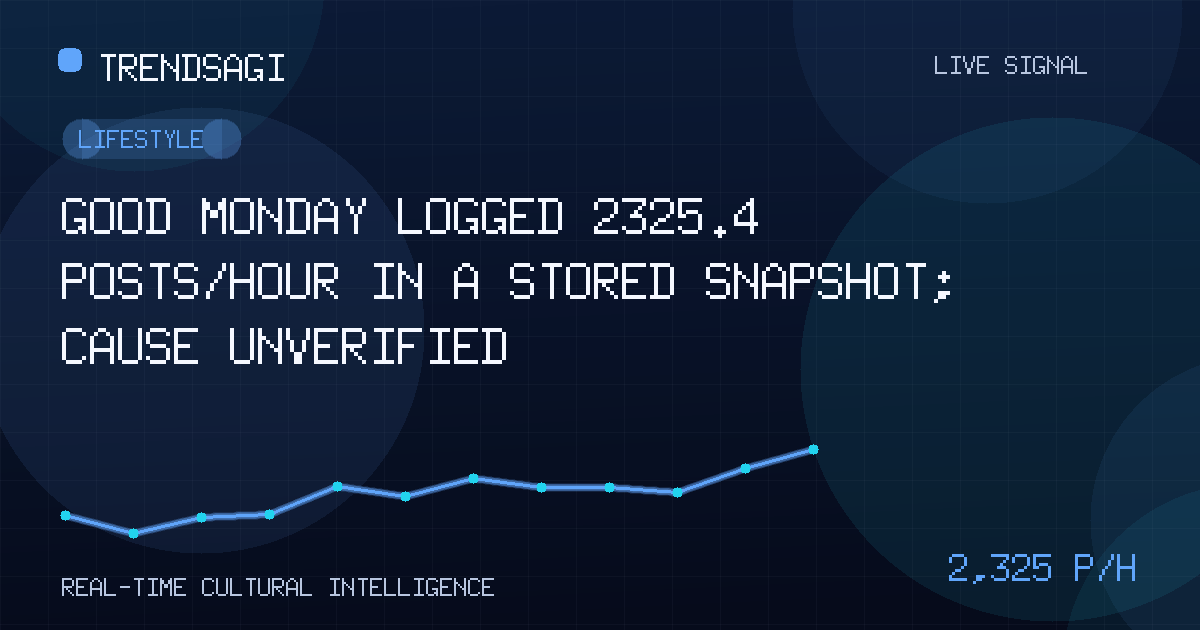
A stored snapshot logged 2325.4 posts/hour for “Good Monday”; the pace is measurable, but no verified catalyst explains the movement.
Automated briefing. Generated from stored signal measurements and source-backed research; it is not manually reviewed. Read the methodology and limitations.
Metrics in this briefing are a snapshot associated with its publication date and may not reflect current conditions.
What changed
“Good Monday” registered a measured snapshot rate of 2325.4 posts/hour at 2026-09-28T09:57:02Z. That rate covers an exact 954-second window using 3 stored observations, and the latest snapshot volume is 2181 posts. The signal therefore captures a concentrated short-window movement around the Lifestyle label, but it does not establish a long-running trend or explain the cause.
| Observation time | Measured snapshot rate | Latest snapshot volume |
|---|---|---|
| 2026-09-28T09:57:02Z | 2325.4 posts/hour | 2181 posts |
The defensible takeaway is narrower than “Good Monday is everywhere”: the label was active at the supplied measured pace during the sampled interval, while the reason and breadth of that activity remain unresolved. Snapshot volume counts posts in the latest stored view; it is not a rate, while 2325.4 posts/hour describes the supplied short-window measurement. Neither figure tells us how many people participated, how often an account posted, or whether people were reacting to one shared event.
Why this topic may be moving
No verified public catalyst is established for this movement. It would be speculative to attribute the burst to a celebrity post, brand campaign, news event, product, or cultural improvement in Monday mood. The label has no stored description connecting it to a particular person or event, and its Lifestyle classification identifies the tracking category rather than proving what the posts were about.
Several mechanisms could produce the observed pattern, but each remains a hypothesis:
- Repeatable positive-message format. “Good Monday” can function as a greeting, affirmation, meme caption, or weekly participation prompt. A compact phrase is easy to reuse, which could create volume without representing a new idea.
- Calendar-linked behavior. The wording is tied to a weekly transition. Posts around the start of a week may cluster as people share routines, intentions, greetings, or reactions to the day; the signal does not show whether this explanation applies here.
- Recommendation or network effects. If the phrase already had visibility, repeated use could help it travel. No platform-level distribution evidence is supplied, so amplification cannot be confirmed.
- Label or classifier spillover. A trend label may include exact phrase matches, close variants, or broader optimistic language. Without examples, semantic drift cannot be ruled out.
Why it matters
A short-window count at this pace can prompt different decisions depending on what is actually happening. A genuine cultural moment deserves context and accurate attribution. A greeting template may instead be useful to editors seeking a recurring participation format. A classifier spillover calls for taxonomy cleanup. Treating these possibilities as the same phenomenon would create a misleading story.
A fast label can be a new cultural moment, a repeatable content format, or a measurement artifact; post-level evidence is what separates those explanations.
- Editorial teams should inspect representative posts before framing the label as a shift in mood, behavior, or culture.
- Community and social teams can monitor the phrase for participation opportunities while avoiding assumptions that sentiment is positive simply because the label is positive.
- Brand and campaign practitioners should not use the rate as evidence of sentiment, reach, or campaign success. Those outcomes require separate data.
- Researchers and analysts should preserve the label’s ambiguity as a finding rather than fill it with an attractive but unverified cause.
What to watch next
The next useful work is verification, not amplification. A durable interpretation would require several forms of corroboration:
- Check phrase fidelity. Review a sample across the full observation window and record whether “Good Monday” appears verbatim, in close variants, or only through a semantic category. This is the fastest way to test whether the label is specific.
- Inspect post behavior. Look for original writing, copied greetings, scheduled replies, duplicate text, promotional accounts, and coordinated posting. Repetition can inflate apparent cultural significance without increasing the number of independent contributors.
- Establish a baseline. Compare later observations with the same collection method, earlier comparable windows, and ordinary Monday language. A single measured rate shows activity, not whether the label is unusually high for this topic.
- Find a dated catalyst. Seek a direct public post from an identifiable organizer, publisher, campaign, or public figure, then corroborate its timing and scale with reputable reporting. A plausible story is not enough; the catalyst must precede and plausibly connect to the movement.
- Track persistence and spillover. See whether the phrase remains active after the initial window, recurs on another Monday, gives rise to related labels, or disappears once a prompt or news cycle passes.
- Measure the audience outcome separately. Obtain unique authors, comments, shares, reactions, geography, and language where available. These measures answer different questions and cannot be inferred from post counts or posts/hour.
A practical decision rule is to classify the signal as durable only if exact-phrase use persists, independent contributors are visible, and a verified catalyst or recurring behavior explains the timing. If the rate quickly recedes and posts are mostly variants of the same greeting, the accurate label is “short-lived phrase activity,” not a broad social shift.
Methodology and limitations
The timestamp marks when the stored snapshot was observed, not necessarily when the underlying behavior began. The 2325.4 posts/hour figure is a measured snapshot rate over the exact 954-second window from 3 stored observations. It is not a live or current rate, forecast, reach estimate, engagement measure, or unique-person count. The snapshot-volume figure is 2181 posts, not a rate.
Those measures should remain separate and should not be recomputed or combined without the underlying series and matching windows. The record also lacks a topic description, post examples, historical baseline, distribution data, and verified external context. It therefore cannot establish who posted, where they posted, what they meant, whether posts were organic, or why volume changed. The responsible conclusion is that “Good Monday” produced a measurable short-window burst whose cause remains unclear pending the checks above.
Track This Topic for New Signals
Set alerts for future velocity or sentiment changes around this topic.
Explore Tracking PlansAbout TrendsAGI research
TrendsAGI's automated research pipeline publishes dated signal snapshots, methodology notes, and practical workflows for teams evaluating cultural momentum. Read how signals are scoped, scored, and limited in our research methodology.


