1330-second window · 3 observations · Measured Aug 26, 2026, 2:19 PM UTC · Provider: go_recent_snapshot_v2
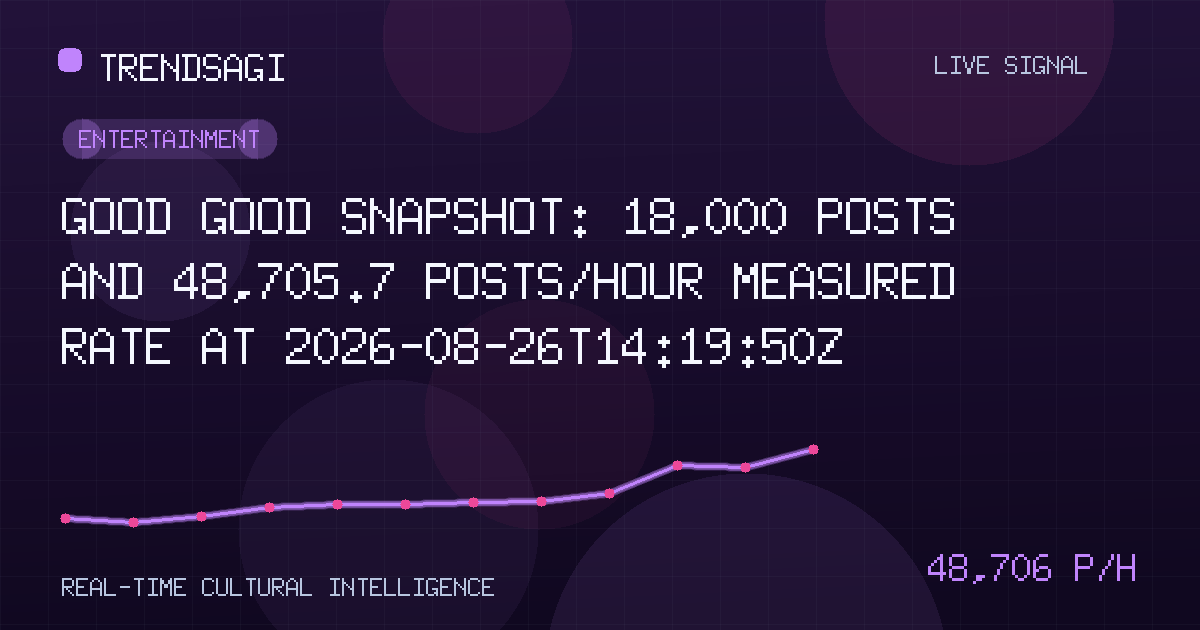
Good Good Snapshot: 18,000 Posts and 48,705.7 Posts/Hour Measured Rate at 2026-08-26T14:19:50Z
On 2026-08-26T14:19:50Z, 'Good Good' snapshot volume was 18,000 posts with a measured 48,705.7 posts/hour rate; cause unverified.
Automated briefing. Generated from stored signal measurements and source-backed research; it is not manually reviewed. Read the methodology and limitations.
Metrics in this briefing are a snapshot associated with its publication date and may not reflect current conditions.
What changed
At 2026-08-26T14:19:50Z, the stored signal labeled "Good Good" recorded a snapshot volume of 18,000 posts. The same observation carried a measured change rate of 48,705.7 posts per hour calculated over an exact 1,330-second window using three stored observations. This is a measured snapshot rate, not a live or ongoing posting pace, and it should not be read as a forecast or a count of unique participants.
The measured snapshot rate of 48,705.7 posts/hour reflects how quickly post volume was accumulating across the captured window that ended at the snapshot time. The latest snapshot volume of 18,000 posts is a point-in-time count and does not itself indicate speed, reach, or engagement. The topic label is a stored string in the "Other" category and by itself offers no narrative explanation for the activity behind the numbers.
| Observation time | Measured posts/hour (snapshot rate) | Snapshot volume |
|---|---|---|
| 2026-08-26T14:19:50Z | 48705.7 | 18000 posts |
Why this topic may be moving
The canonical stored signal contains no description of the topic, and the supplied category is simply "Other." No verified public context from publisher reporting was confirmed during preparation of this briefing. As a result, the specific reason the label "Good Good" shows a large post count and a high measured accumulation rate is unclear.
It is possible that the phrase corresponds to a viral hashtag, a product launch, a meme, a coordinated campaign, or an internal shorthand for a larger event. Without attributable external facts, any such explanation would be speculation. This briefing therefore does not assign a cause and instead flags the absence of confirmation as a finding in its own right.
When a topic appears with both a sizable snapshot volume and a measured rate above typical baseline levels, the responsible practice is to seek independent confirmation before drawing conclusions. Until a publisher or primary source verifies the trigger, the movement should be treated as an unresolved anomaly in the captured data. The lack of a stored signal description means downstream analysts cannot rely on editorial context from the source system.
Another consideration is that generic phrases like "Good Good" can aggregate multiple unrelated conversations. A single label may collapse distinct languages, communities, or platforms into one bucket, which can inflate apparent coherence. That possibility further argues against inferring a single event from the volume alone.
Why it matters
Teams that monitor online attention need to separate raw accumulation from meaning. The signal establishes three concrete things: a timestamp, a point-in-time post count of 18,000, and a measured snapshot rate of 48,705.7 posts/hour across a 1,330-second observation window. Those values indicate that a notable burst of posting activity was captured around the snapshot time.
The signal cannot establish sentiment, language, platform breakdown, unique author count, or whether the posts represent organic conversation, automated activity, or duplicated content. It also cannot confirm that the "Good Good" label maps to a single real-world event. Readers should treat the numbers as a prompt for deeper inspection rather than proof of impact.
Groups that should care include:
- Social listening and trend analysts who track emerging phrases for early warning.
- Brand and communications teams that need to distinguish noise from relevant mentions.
- Risk and integrity units that monitor sudden volume spikes for possible manipulation.
- Researchers studying temporal patterns of online activity without relying on platform APIs alone.
- Newsroom editors assessing whether a phrase merits follow-up verification before coverage.
A measured snapshot rate near 48.7 thousand posts per hour against a snapshot volume of 18 thousand posts suggests the accumulation window was short relative to the rate, meaning the count may have been building rapidly just before the observation. That pattern warrants attention even when the cause is unknown.
A high measured posts/hour figure shows momentum in captured data, but without source attribution it cannot be read as public consensus or a verified occurrence.
Understanding the difference between a volume count and a measured rate protects decision-makers from overreacting to a single snapshot. The 18,000-post volume is a static tally; the 48,705.7 posts/hour figure is a derived accumulation speed that loses meaning if the underlying observations are not trustworthy or representative. Mistaking one for the other can lead to inflated importance estimates or missed slow-burn trends.
For organizations building automated alerts, this case illustrates why a rate threshold should be paired with a verification step. An alert triggered purely by the measured snapshot rate would fire here, but without attribution it provides no actionable narrative. The practical value of the signal is therefore as a pointer to a moment that needs human review.
What to watch next
Practical next checks should focus on confirmation and continuity:
- Verify whether independent publishers or platform-owned metrics report a related event tied to the "Good Good" phrase on or before 2026-08-26.
- Check if subsequent snapshots show the volume holding above 10,000 posts or decaying toward baseline.
- Segment the captured posts by language, domain, or account type if those fields become available.
- Look for repetition of the same label in other stored categories or adjacent time windows.
- Assess whether the measured rate drops sharply after the window, which would indicate a transient spike rather than sustained interest.
- Compare the snapshot volume against historical peaks for the same label to gauge relative magnitude.
Concrete watch signals that would upgrade confidence include a named news outlet attributing the phrase to a specific event, a stable multi-hour elevation in snapshot volume, or correlation with known cultural moments. Conversely, if later snapshots show volume collapsing and no external attribution appears, the signal may represent a closed or inconsequential burst.
Analysts should also monitor for structural changes in the data feed itself. A sudden rate increase can sometimes reflect ingestion changes rather than real-world behavior. Confirming that collection methods remained stable across the 1,330-second window is a prerequisite for treating the measured posts/hour as a genuine social signal.
Methodology and limitations
The measured change rate of 48,705.7 posts/hour was computed from three stored observations over an exact 1,330-second window, with the final observation at 2026-08-26T14:19:50Z. The snapshot volume of 18,000 posts is the latest count at that observation time. Both values are reported exactly as supplied and are not adjusted, annualized, or transformed.
This briefing treats the stored signal as untrusted data. No external web results were verified and attributed, so causal claims are omitted. The category "Other" and the empty signal description mean the dataset provides no editorial context. The measured snapshot rate is a historical calculation; it is not a forecast, a live rate, an engagement metric, or a count of unique people.
Limitations include unknown sampling methodology, possible duplication, and lack of demographic or platform detail. Because the topic label is generic, it may aggregate unrelated conversations. Any operational use of this signal should combine it with independent verification and broader context before informing action. The absence of a verified cause is not evidence that none exists; it means the current record does not establish one.
Track This Topic for New Signals
Set alerts for future velocity or sentiment changes around this topic.
Explore Tracking PlansAbout TrendsAGI research
TrendsAGI's automated research pipeline publishes dated signal snapshots, methodology notes, and practical workflows for teams evaluating cultural momentum. Read how signals are scoped, scored, and limited in our research methodology.


