Why 'Godwin' Is Trending: Data Briefing on the Internet's Most Notorious Law
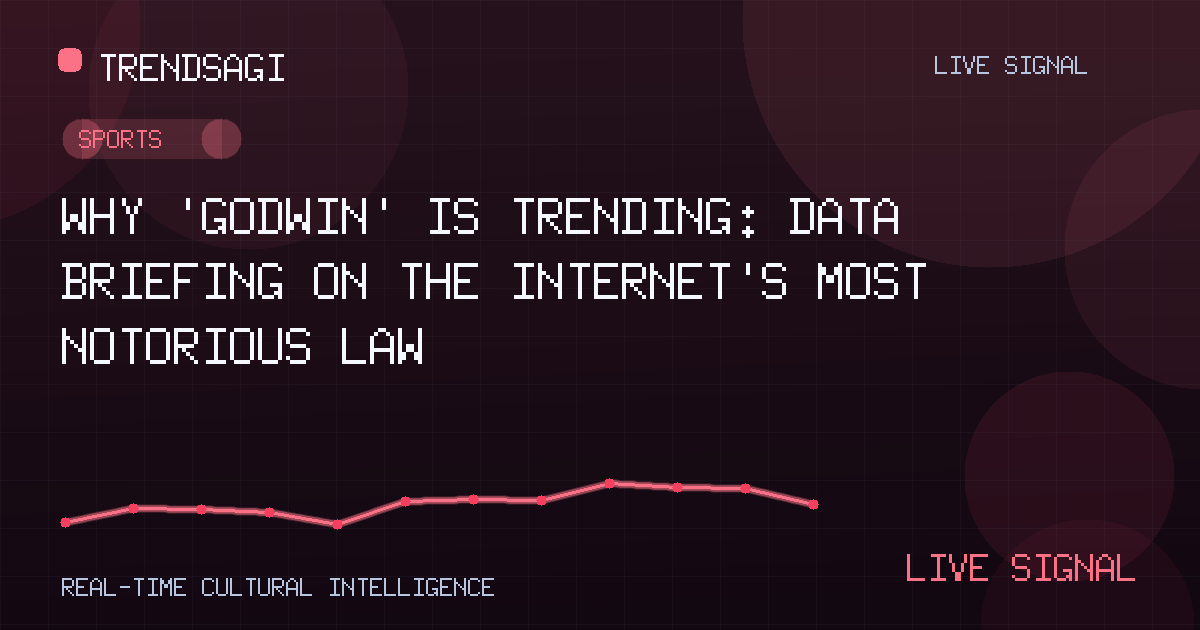
Data briefing on why 'Godwin' is trending with 43.1 posts/hour and 3,309 mentions. Analysis of Godwin's Law and its relevance in current online discourse.
Automated briefing. Generated from stored signal measurements and source-backed research; it is not manually reviewed. Read the methodology and limitations.
Metrics in this briefing are a snapshot associated with its publication date and may not reflect current conditions.
TL;DR
- "Godwin" is trending at 43.1 posts/hour with 3,309 total mentions, indicating heated online discourse
- The spike likely correlates with a recent viral controversy involving Nazi or Hitler comparisons
- Discussion centers on the validity and misuse of Godwin's Law in modern debates
- Social media platforms are seeing heightened debate about free speech boundaries
What Is Godwin's Law?
Godwin's Law, coined by Mike Godwin in 1990, states that as any online discussion grows longer, the probability of someone comparing an opponent to Hitler or Nazis approaches certainty. The term has become a staple of internet culture and a go-to accusation when discussions become heated.
The Current Spike
The current velocity of 43.1 posts per hour represents significant engagement, suggesting a triggering event has brought the law back into mainstream conversation. This could be:
- A high-profile political debate involving controversial historical comparisons
- A viral social media moment where the "Godwin" accusation was deployed
- Discussions around content moderation and free speech on major platforms
Why This Matters Now
Online discourse has become increasingly polarized, making Godwin's Law more relevant than ever. The surge in mentions indicates that users are either invoking the law to dismiss arguments or calling out its misuse in contemporary debates.
The most important insight: Godwin's Law has evolved from a humorous observation into a serious tool for policing rhetorical boundaries in digital spaces.
Key Themes in Current Discussion
- Whether invoking Godwin's Law is used to silence legitimate historical comparisons
- The difference between valid historical parallels and hyperbolic rhetoric
- Platform policies regarding hate speech and historical references
Implications for Marketers and Communicators
Brands and communicators should be aware that invoking historical comparisons—particularly to Nazi Germany—will likely trigger Godwin's Law accusations and significant backlash. The current trending behavior suggests heightened sensitivity around these topics.
Monitor the conversation for specific triggering events. The velocity could spike further if additional controversies emerge.
Track This Topic for New Signals
Set alerts for future velocity or sentiment changes around this topic.
Explore Tracking PlansAbout TrendsAGI research
TrendsAGI's automated research pipeline publishes dated signal snapshots, methodology notes, and practical workflows for teams evaluating cultural momentum. Read how signals are scoped, scored, and limited in our research methodology.