15-minute window · 3 observations · Measured Sep 24, 2026, 12:26 AM UTC · Provider: go_recent_snapshot_v2
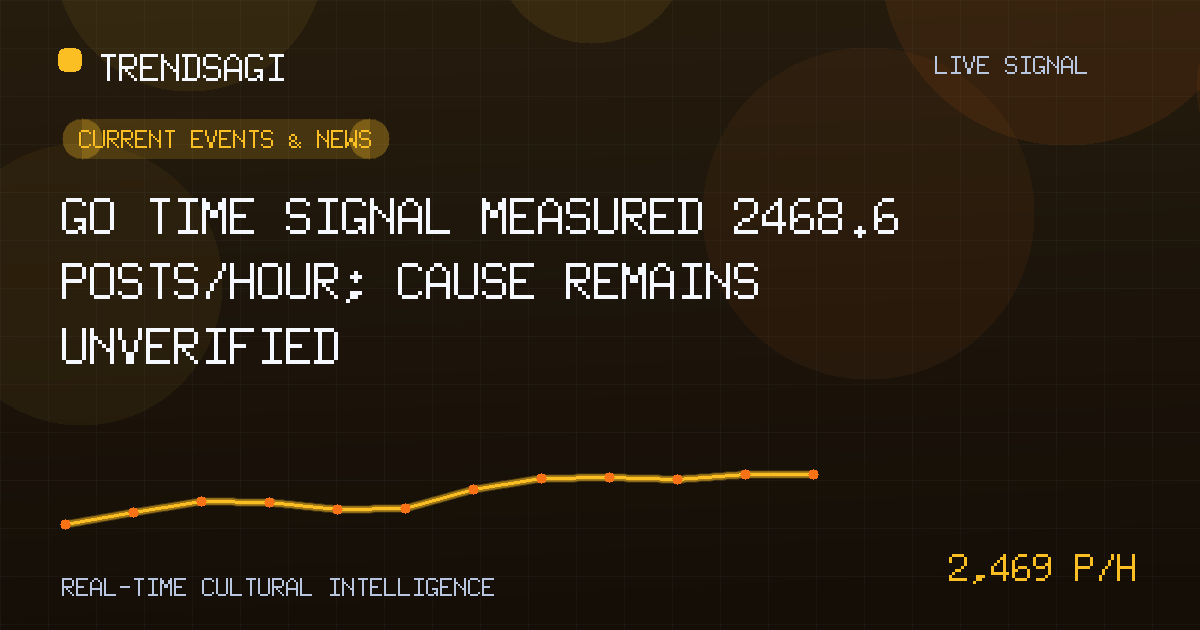
GO TIME signal measured 2468.6 posts/hour; cause remains unverified
The GO TIME signal measured 2468.6 posts/hour over 900 seconds; check its label and context before treating the rise as a wider trend.
Automated briefing. Generated from stored signal measurements and source-backed research; it is not manually reviewed. Read the methodology and limitations.
Metrics in this briefing are a snapshot associated with its publication date and may not reflect current conditions.
What changed
The stored signal labeled “GO TIME” shows a sharp rise in recorded posting activity, but its cause remains unverified. The measured change rate was 2468.6 posts/hour across an exact 900-second window using 3 stored observations, with the measurement recorded at 2026-09-24T00:26:24Z. This supports investigating a rapid, label-specific burst—not assuming what prompted it.
| Observation time | Measured snapshot rate | Snapshot volume |
|---|---|---|
| 2026-09-24T00:26:24Z | 2468.6 posts/hour | 2117 posts |
The latest snapshot contained 2117 posts; the window’s measured snapshot rate was 2468.6 posts/hour. Those measurements answer different questions: the volume records the size of the series at that observation, while the rate describes how quickly it was changing. Neither establishes who posted, what “GO TIME” meant, or how many distinct people were involved.
Why this topic may be moving
The label is too broad to identify the underlying subject from the stored record alone. No verified external context connects this burst to a particular announcement, incident, broadcast, campaign, or other development. Several explanations remain possible, but none is established by the measurements:
- Ambiguous grouping: The same phrase may be attached to unrelated conversations. If so, the signal could combine separate subjects that happened to share a label.
- Event-linked activity: A shared development could concentrate discussion. That explanation would require timestamped posts and verified reporting about the same subject, neither of which is supplied here.
- Distribution effects: Reposting, copied passages, or coordinated promotion could increase recorded posts without a corresponding increase in original contributors. This is a hypothesis to check, not a finding.
A measured burst tells you where to investigate. It does not tell you what happened, how many distinct accounts participated, or whether the activity mattered.
Until those connections are checked, “GO TIME” is best treated as a screening signal rather than an identified trend with a known cause.
Why it matters
For newsrooms, communications teams, and trend analysts, the acceleration is a reason to review the underlying material promptly. It is not automatically a news peg. Editors still need a verifiable subject, an established development, and evidence that the sampled conversations are using “GO TIME” for that same subject rather than for unrelated language.
An unexplained label-level spike can otherwise send a monitoring desk toward a headline the posts do not support. Likewise, substantial post volume does not by itself demonstrate public importance, independent participation, or a sustained response. It may reflect how content was distributed as much as what people were discussing.
The useful next step is verification, not amplification. Confirm the subject before describing the activity as a reaction to an event, evidence of wider interest, or a meaningful shift in public attention.
What to watch next
Immediate checks
- Read the surrounding posts. Inspect a time-aligned sample from the 900-second window, retaining the text around each occurrence. Record any recurring people, organizations, places, or subject matter.
- Test label consistency. Determine whether sampled posts refer to one subject or combine unrelated uses of the phrase. Keep those categories separate until a shared subject is demonstrated.
- Separate content types. Where records permit, distinguish original contributions from reposts, copied passages, and automated output. Raw post volume is not a distinct-account count.
- Find a relevant public record. Look for a timestamped report that names the same subject and fits the observation window. A direct statement from an organization involved is more useful than an undated repetition, but neither should be assumed to explain the signal before its relevance is confirmed.
- Repeat the observation consistently. Use the same label, collection boundary, and counting method. This will help reveal whether activity persists, changes direction, or returns to its earlier level.
Signals that would change the interpretation
- A repeated spike tied to the same verified subject would support treating the label as a recurring monitoring signal rather than a one-off phrase collision.
- A return to the earlier level under the same method would weaken a claim of continuing momentum. Sustained growth would require additional observations.
- Growth concentrated in original contributions from distinct accounts would make broader participation more plausible. Repeated copies or concentration in a narrow set of accounts would instead direct attention toward distribution effects.
- Verified reporting that explicitly connects conversations using the label to the same development would justify naming that context. It would still not establish the activity’s importance or audience size.
Methodology and limitations
The 2468.6 posts/hour figure is a measured snapshot rate derived from 3 stored observations over exactly 900 seconds. It is not a live or current rate, forecast, reach estimate, engagement measure, or unique-person count. The 2117-post figure is a point-in-time snapshot volume, not a rate.
The record does not provide a longer baseline, a definition of the label, account-level information, or post-level context. Without those, it cannot establish whether the burst was sustained, whether contributors were independent, or whether “GO TIME” referred to a recognizable event. A short window can document movement in a series without establishing the breadth or significance of that movement.
External context has not been verified for this signal, so no triggering event is named. Confidence is high in the stated measurements and low in any explanation of the cause. The most defensible conclusion is therefore narrow but useful: posting activity associated with the stored “GO TIME” label accelerated sharply in the measured window, and the underlying conversation requires verification before broader interpretation.
Track This Topic for New Signals
Set alerts for future velocity or sentiment changes around this topic.
Explore Tracking PlansAbout TrendsAGI research
TrendsAGI's automated research pipeline publishes dated signal snapshots, methodology notes, and practical workflows for teams evaluating cultural momentum. Read how signals are scoped, scored, and limited in our research methodology.