1015-second window · 2 observations · Measured Sep 25, 2026, 12:11 AM UTC · Provider: go_recent_snapshot_v2
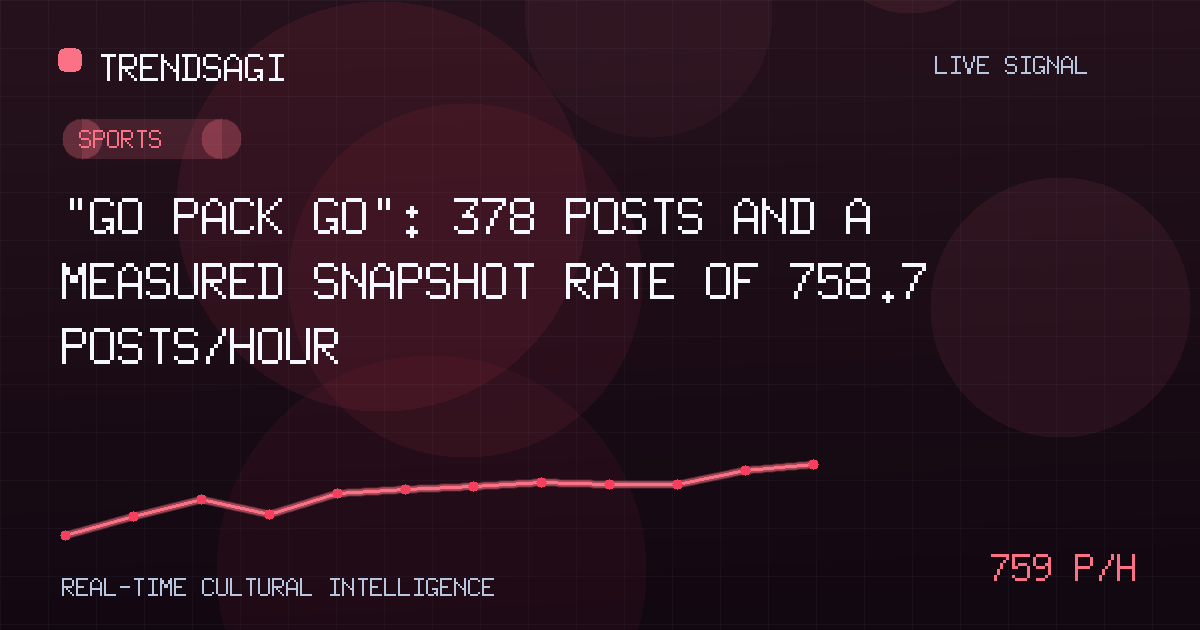
“Go Pack Go”: 378 posts and a measured snapshot rate of 758.7 posts/hour
A 378-post “Go Pack Go” snapshot shows a measured 758.7 posts/hour change; see what it establishes and the essential next checks.
Automated briefing. Generated from stored signal measurements and source-backed research; it is not manually reviewed. Read the methodology and limitations.
Metrics in this briefing are a snapshot associated with its publication date and may not reflect current conditions.
What changed
The stored “Go Pack Go” signal records a sharp measured increase in posts, with 378 posts in the latest snapshot. The measured change is 758.7 posts/hour across an exact 1,015-second window, based on two stored observations measured at 2026-09-25T00:11:40Z. The reason for the movement is not established by the available record.
This is a measured snapshot rate, not a live/current rate, forecast, reach, engagement figure or count of unique people. The 378 posts are the snapshot’s volume, not a rate or an hourly total. Activity rose quickly within the monitored series; what prompted it remains unverified.
| Measure | Stored value |
|---|---|
| Observation time | 2026-09-25T00:11:40Z |
| Measured snapshot rate | 758.7 posts/hour |
| Latest snapshot volume | 378 posts |
The rate uses two observations over the stated 1,015-second window. It should not be read as a count of posts produced during a full hour.
Why this topic may be moving
The cause remains unverified. The stored material contains no verified public context connecting the increase to a particular event. “Go Pack Go” is also an ambiguous label: without sample posts or entity identification, it could refer to a team-related phrase, a supporter response or usage unrelated to sport. The “Sports” category does not resolve those possibilities.
A game result, a team or player announcement, or a supporter campaign are possible explanations to investigate, not established causes. Repetition, duplicate submissions or a change in collection and labeling could also raise a post count. The available numbers do not distinguish ordinary conversation from concentrated, automated or coordinated posting.
A public-search check would need to verify a specific event and compare its timing with the actual posts. A page merely containing the same phrase would not be enough. Even a well-matched article would provide context, not prove that the entire measured increase was caused by that event.
Why it matters
The immediate value is prioritization. Editors, sports media teams and community managers have a reason to inspect the underlying posts before assigning a narrative or publishing a confidently themed item. The rate warrants a prompt check of the label and timeline, but it does not identify a particular team, match or campaign. The 378-post snapshot identifies a batch for review; it does not measure the people behind it.
A measured spike tells you where to investigate, not what happened or how many people participated.
For measurement teams, increased posting activity is not the same as increased public interest. Reposts, repeated chants, coordinated messages and multiple posts from one account can amplify volume without equivalent participation. A small but enthusiastic conversation can also remain geographically or demographically narrow. The two observations do not distinguish either pattern.
Teams and fan communities should not treat the label as proof that attention is directed at them. Publishers likewise cannot use the snapshot to claim audience size, a sponsorship opportunity or a broad cultural breakthrough. Those are different claims, requiring different evidence.
What to watch next
Use a targeted audit before adding an explanation.
- Inspect representative posts. Sample the full snapshot, including the earliest, latest and most-repeated items where the available records permit. Look for references to a named event, team, location or person. Record whether the same wording is being copied and whether the volume reflects distinct contributions or repeated content.
- Confirm the label’s identity. Check whether “Pack” consistently refers to the same entity and whether the surrounding text supports a sports interpretation. If the usage varies, separate the streams before combining their counts. An ambiguous phrase can create apparent momentum without a single underlying event.
- Align the timeline. Compare post timestamps with a verified event or announcement rather than relying on coincidence. Look for a concentrated response after a clearly identified trigger. If posts precede the supposed trigger or cover unrelated subjects, that weakens the proposed explanation and should be reported.
- Check the collection process. Confirm that the platform, query, language and geographic filters stayed consistent across both observations. Review obvious duplicates, automated submissions and labeling changes. A jump caused by collection changes describes a measurement change, not necessarily a behavioral one.
- Test persistence with later snapshots. Keep the observation time, label and counting definition stable. A sustained elevation would show that activity continued; a quick return toward the preceding level would be more consistent with a brief burst. The stored pair cannot establish either outcome.
Concrete watch signals are later snapshots showing continued elevation under the same collection rules, a clear concentration of relevant posts after a verified announcement, and stable volume after obvious duplicates are removed. A rapid reversal, mixed topic meanings or unexplained changes in collection would weaken a trend narrative. None of those follow-up conditions is established by the current pair of observations.
Methodology and limitations
Only two stored observations are available, so neither the start of the increase nor how long it lasted is visible. The record supplies no sample posts, platform, geography, collection method, historical baseline or verified event context. The snapshot volume and measured rate are reported as stored; no hourly post count or audience estimate is inferred.
The increase is an endpoint comparison, not proof of a peak or a sustained trend. Even continued growth would establish increased activity in this particular monitored series, not a platform-wide or population-wide phenomenon. The signal also cannot determine sentiment, motives, organic participation or the source of the increase.
A responsible update should preserve the observation timestamp and counting definition, document later observations separately and disclose revisions rather than blending old and new figures. The defensible conclusion is narrow: the stored “Go Pack Go” series recorded 378 posts in its latest snapshot and a 758.7 posts/hour measured change, while the cause remains unverified.
Track This Topic for New Signals
Set alerts for future velocity or sentiment changes around this topic.
Explore Tracking PlansAbout TrendsAGI research
TrendsAGI's automated research pipeline publishes dated signal snapshots, methodology notes, and practical workflows for teams evaluating cultural momentum. Read how signals are scoped, scored, and limited in our research methodology.