886-second window · 3 observations · Measured Oct 4, 2026, 1:26 AM UTC · Provider: go_recent_snapshot_v2
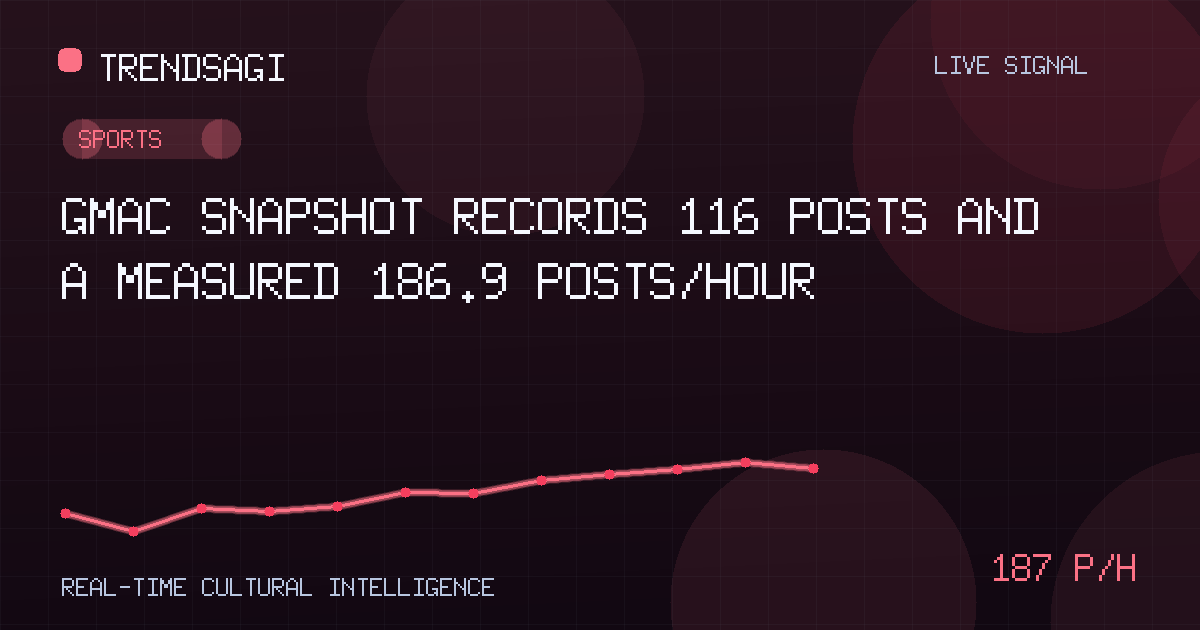
GMac snapshot records 116 posts and a measured 186.9 posts/hour
GMac’s latest stored snapshot has 116 posts and a measured 186.9 posts/hour rate; the cause is unverified, with practical checks for sports editors.
Automated briefing. Generated from stored signal measurements and source-backed research; it is not manually reviewed. Read the methodology and limitations.
Metrics in this briefing are a snapshot associated with its publication date and may not reflect current conditions.
What changed
The snapshot associated with GMac contains 116 posts and records a measured snapshot rate of 186.9 posts/hour. The direct answer is that GMac warrants monitoring, but its cause is unverified: the available evidence does not tie the activity to a specific person, team, match, result, announcement, or controversy. A confident event explanation would go beyond what the signal establishes.
| Observation time | Measured snapshot rate | Snapshot volume |
|---|---|---|
| 2026-10-04T01:26:10Z | 186.9 posts/hour | 116 posts |
The rate was measured at 2026-10-04T01:26:10Z across an exact 886-second window using 3 stored observations. It describes posting pace within that historical window; it is not a live or current rate, a forecast, reach, engagement, or a unique-person count. The 116-post figure is snapshot volume, not a rate, and neither number shows how many different people participated.
Why this topic may be moving
The stored Sports category provides a useful routing label, but it does not identify the underlying subject. The signal also has no description, so GMac cannot be reliably mapped to a named individual, club, competition, product, or other entity from the category alone.
Candidate explanations to test, rather than conclusions, include:
- Event-linked discussion: A fixture, result, injury, transfer, or announcement could prompt repeated posting, but no particular event is verified here.
- Identity collision: GMac could be shorthand, a handle, an acronym, or a misspelling for unrelated subjects. The label alone does not resolve them.
- Amplified repetition: Reposting, syndicated coverage, or coordinated posting could lift volume without a comparable increase in distinct conversation.
- Collection effect: The way mentions were captured, labeled, or grouped could combine posts that readers would not regard as one story.
No verified public context accompanies the signal to anchor the sequence to an identifiable event. Until that context is established, the responsible description is activity around an ambiguous label, not a causal sports narrative.
The measured rate is a reason to investigate the label, not proof that a sports breakthrough, crisis, or shift in public opinion has occurred.
Why it matters
For a sports desk, the immediate value is triage: the rate says where to look first, while the missing context says what not to conclude yet. Labeling the movement as a result, crisis, or fan reaction would create false precision.
Apparent speed can also create pressure to publish quickly, which is when an ambiguous label is most likely to be overinterpreted. Editors familiar with relevant entities, communications teams named in verified posts, and analysts able to inspect source and timestamp distributions are best positioned to resolve it.
- Editorial accuracy: An ambiguous label can attach a real story to the wrong person or event, so identity verification should precede a causal headline.
- Reputation and response planning: Athletes, teams, and organizers should determine whether the label refers to them before preparing a response; no such connection is established here.
- Measurement discipline: The rate can prioritize investigation, but it cannot estimate audience size, influence, or sentiment without baseline, reach, and content data.
The practical implication is not to ignore the signal, but to keep confidence low until the entity, timing, and source checks align.
What to watch next
The next checks should distinguish a real event-driven conversation from an ambiguous or repetitive count. Useful signals to seek include:
- Read the sample: Inspect the 116-post snapshot and classify what each item discusses. Determine whether GMac is the subject, a handle, part of a quoted phrase, or an incidental mention.
- Resolve the label: Compare exact spelling, capitalization, and nearby context with verified sports entities. Do not merge similarly named subjects merely because they share a category.
- Measure concentration: Check whether posts originate from independent accounts or mainly repeat copies. Strong concentration can coexist with limited independent attention.
- Align the clock: Compare timestamp clusters with schedules, results, and announcements. Tight alignment would be a lead rather than proof; weak alignment would weaken the event hypothesis.
- Seek verification: Look for a contemporaneous statement from the relevant person, team, or organizer and independent reputable reporting. If neither anchor appears, retain the ambiguous description.
- Reobserve the trend: Calculate later rates using the same method and compare them with available prior observations. A decline would indicate more transient clustering, while persistence alongside broader independent sources would provide stronger evidence of sustained attention.
- Assess the content: Code sentiment and factual claims only after reviewing the posts themselves. Questions, celebration, criticism, and misinformation cannot be distinguished from volume alone.
Methodology and limitations
The latest stored observation is timestamped 2026-10-04T01:26:10Z. Its snapshot volume is 116 posts. The 186.9 posts/hour figure is a measured snapshot rate based on 3 stored observations across an exact 886-second window. The stored category is Sports, while the signal description is empty.
The record does not provide a prior baseline, raw post text, account identities, original-versus-repost status, geography, platform mix, engagement, or sentiment. It therefore cannot show whether the rate is statistically unusual, how many people were reached, who initiated the activity, whether the posts were authentic, or why the topic moved. It can establish the observed label activity and its timing, making it useful for prioritizing verification, but it cannot yet support a specific explanation or wider claim about public opinion.
Track This Topic for New Signals
Set alerts for future velocity or sentiment changes around this topic.
Explore Tracking PlansAbout TrendsAGI research
TrendsAGI's automated research pipeline publishes dated signal snapshots, methodology notes, and practical workflows for teams evaluating cultural momentum. Read how signals are scoped, scored, and limited in our research methodology.


