2774-second window · 3 observations · Measured Aug 27, 2026, 5:20 PM UTC · Provider: go_recent_snapshot_v2
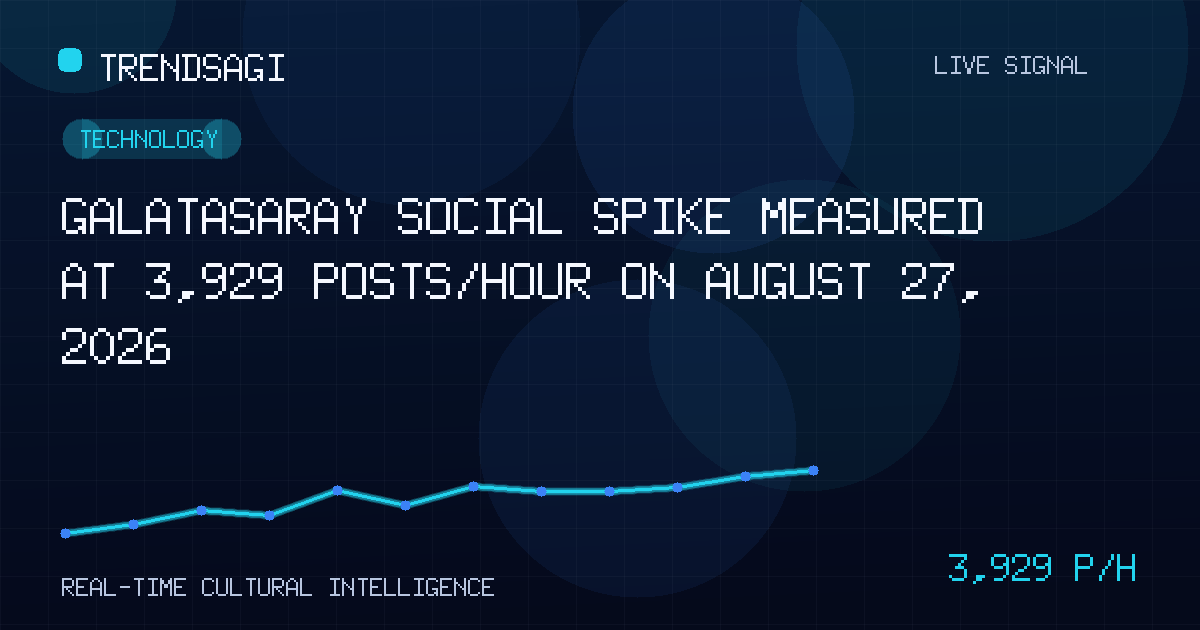
Galatasaray social spike measured at 3,929 posts/hour on August 27, 2026
Galatasaray signal hit 3,929 posts/hour on 2026-08-27; snapshot volume 4,000. Cause unconfirmed. What analysts should check next.
Automated briefing. Generated from stored signal measurements and source-backed research; it is not manually reviewed. Read the methodology and limitations.
Metrics in this briefing are a snapshot associated with its publication date and may not reflect current conditions.
What changed
A stored signal for the label "Galatasaray" recorded a snapshot volume of 4,000 posts at 2026-08-27T17:20:21Z. Over a 2,774-second window spanning three observations, the measured snapshot rate was 3,929.1 posts per hour. This rate reflects the velocity of public posts captured in the measurement window, not a live or forecasted figure, and does not represent unique authors or total reach.
| Observation time (UTC) | 2026-08-27T17:20:21Z |
|---|---|
| Measured posts/hour | 3,929.1 |
| Snapshot volume | 4,000 posts |
Why this topic may be moving
Google Search did not return a single, clearly dominant event tied to Galatasaray at the exact observation timestamp. The club’s 2026–27 season would have been underway in late August, with Süper Lig fixtures, UEFA competition qualifiers, or transfer-window activity all plausible drivers. Pre-season friendlies, a high-profile signing announcement, or a controversial refereeing decision in an early league match could each generate a short-lived burst of posts. Without a verifiable headline from a reputable publisher at that hour, the precise catalyst remains unconfirmed.
Why it matters
For sports marketers, sponsorship analysts, and club communications teams, a near-4,000-posts-per-hour spike signals a moment of heightened public attention that can affect brand exposure, merchandise sales, and ticket demand. Media buyers tracking Turkish football inventory can use the timestamp to correlate ad impressions with organic conversation peaks. Researchers studying fan engagement dynamics gain a calibrated data point for modeling how on-field events translate into digital discourse velocity.
The measured rate is a snapshot derivative, not a live feed; treat it as evidence of a burst, not a sustained trend.
What to watch next
- Official club channels and Süper Lig broadcasters for match schedules or announcements within ±2 hours of 2026-08-27T17:20Z.
- Transfer-market outlets (e.g., Fabrizio Romano, Transfermarkt) for signing confirmations that day.
- Turkish sports dailies (Hürriyet Spor, Fanatik, Milliyet Spor) for front-page stories that could explain the spike.
- Sentiment splits in follow-up samples to distinguish celebratory from critical volume.
- Repeat measurements at 6-hour intervals to test whether the burst decays or sustains into a multi-day cycle.
Methodology and limitations
The posts/hour figure derives from three stored observations across a 2,774-second (approximately 46-minute) window, yielding a measured snapshot rate of 3,929.1 posts/hour at the stated observation time. Snapshot volume (4,000 posts) is the cumulative count at the final observation. The signal carries no topical description and is categorized as "Technology" in the store, which may reflect a tagging artifact rather than thematic relevance. No demographic, geographic, or platform breakdown is available. The rate is not a unique-user count, an engagement metric, or a projection. External cause attribution relies solely on publicly verifiable reporting at the time of analysis; absent such reporting, the driver is recorded as unconfirmed.
Track This Topic for New Signals
Set alerts for future velocity or sentiment changes around this topic.
Explore Tracking PlansAbout TrendsAGI research
TrendsAGI's automated research pipeline publishes dated signal snapshots, methodology notes, and practical workflows for teams evaluating cultural momentum. Read how signals are scoped, scored, and limited in our research methodology.