908-second window · 3 observations · Measured Sep 5, 2026, 8:55 PM UTC · Provider: go_recent_snapshot_v2
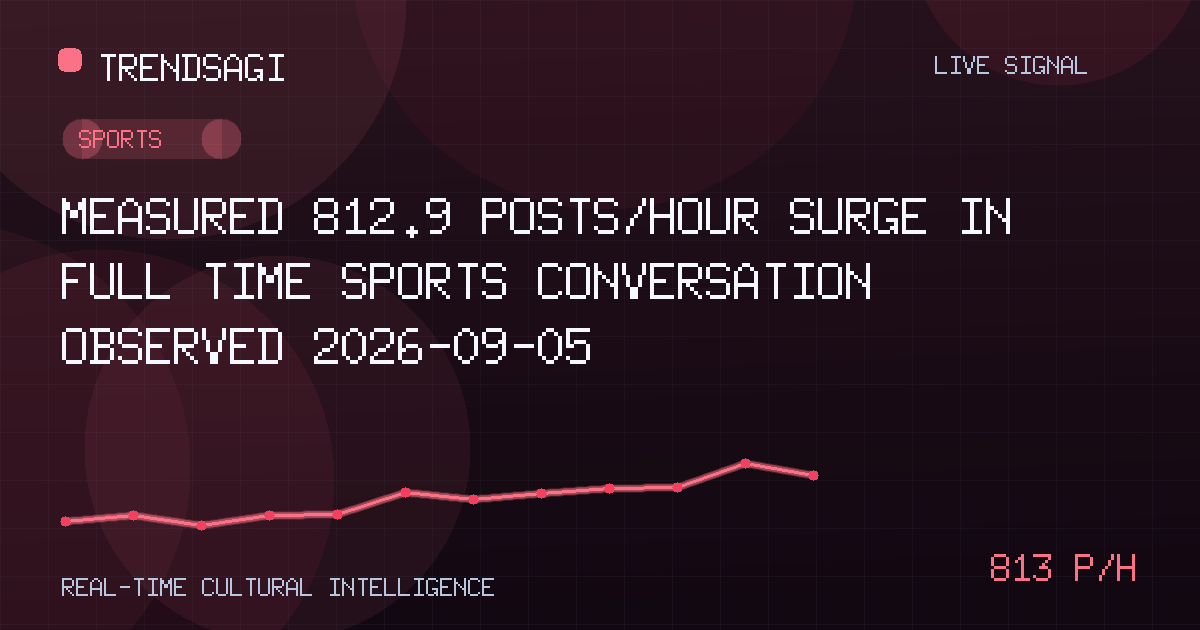
Measured 812.9 posts/hour surge in Full Time sports conversation observed 2026-09-05
Measured 812.9 posts/hour surge in Full Time sports posts; signal details, implications, and what to watch next.
Automated briefing. Generated from stored signal measurements and source-backed research; it is not manually reviewed. Read the methodology and limitations.
Metrics in this briefing are a snapshot associated with its publication date and may not reflect current conditions.
What changed
A measured snapshot rate of 812.9 posts per hour accompanied the recent activity around "Full Time" in the Sports category, based on three stored observations recorded at 2026-09-05T20:55:44Z. The total snapshot volume across the observation period reached 847 posts, indicating a concentrated burst of social media discussion within a short interval. This rate reflects posts issued during the measured window and does not represent live engagement, reach, or unique-user counts. For context, a rate surpassing 800 posts per hour is uncommon in typical sports conversation and suggests a triggering event rather than routine chatter. The 908-second observation window, derived from three data points, anchors the rate calculation and distinguishes it from longer-term trend metrics. Readers should note that the rate reports frequency within this specific window and does not aggregate activity outside it.
| Observation time | 2026-09-05T20:55:44Z |
| Measured snapshot rate | 812.9 posts/hour |
| Snapshot volume | 847 posts |
Why this topic may be moving
The stored signal does not, by itself, establish the cause of the "Full Time" surge. Social media volume spikes of this scale in sports typically correspond with breaking developments such as contract announcements, league policy releases, match results, or high-profile transfers. Without verified external attribution, pinpointing a single driver would be speculative. Historically, similar post‑rate surges have followed official team statements or match‑day outcomes, and readers should consider cross-referencing with timely reports from beat journalists and verified organization accounts. If a specific news outlet has linked the trend to a particular event, that connection would need to be confirmed through that publisher’s reporting. Algorithmic boosting or platform‑specific trending features can also inflate post visibility, making it difficult to isolate pure organic interest without further metadata.
"A posts‑per‑hour rate above 800 is a strong indicator that conversation has shifted from peripheral to core interest, though the underlying cause requires corroboration from official or news sources."
Readers should also monitor whether the discussion converges on a specific match, athlete, or competition term, which can provide additional clues about the event’s nature.
Why it matters
For stakeholders tracking the Sports category, a measured rate exceeding 800 posts per hour serves as a flag for heightened public attention. This can matter for several reasons: beat reporters may need to verify whether the conversation reflects an official announcement, teams may monitor sentiment, and analysts may look for patterns that precede or follow league decisions. The signal’s primary value lies in its ability to indicate when conversation volume deviates from baseline, prompting a check of primary sources rather than delivering a news story itself. In practice, such spikes have preceded or followed verified developments such as contract extensions, tournament fixtures, and rule changes, making the rate a useful early‑warning indicator when paired with source confirmation. This is especially relevant for fantasy sports participants, betting markets, and media outlets that rely on real‑time sentiment, though the signal should never substitute for verified reporting.
- Contract announcements and free‑agent signings often generate immediate post surges.
- League‑wide policy updates or disciplinary actions can trigger coordinated discussion.
- Match results, especially upsets or championship conclusions, reliably spike post volume.
What to watch next
Observers should track whether the post volume sustains, accelerates, or declines in the hours and days following the 2026‑09‑05T20:55:44Z observation. Specific watch signals include: the emergence of a dominant hashtag or phrase within the thread, the proportion of posts from verified accounts, and any concurrent posts from official league or team accounts. A shift in topic phrasing—such as moving from generic "full time" to a specific team or competition name—may indicate the conversation has latched onto a concrete development. If post volume remains elevated beyond 24 hours without a clear catalyst, it may reflect sustained interest such as an ongoing series or a slowly unfolding narrative. The observation protocol samples at fixed intervals, and any post activity outside those intervals is not reflected in the rate, which may smooth over rapid spikes or drops.
Methodology and limitations
The measured snapshot rate of 812.9 posts/hour derives from three stored observations aggregated over a 908‑second window at the timestamp noted. Snapshot volume of 847 posts represents the total count within the observed dataset. This signal captures post frequency only as stored; it does not track unique authors, engagement metrics, platform algorithmic boosts, or geographic distribution. The rate is a measure of conversation density within the sampled dataset, not a measure of reach, impact, or unique‑person count. Causes of movement remain unverified when not supported by external, attributed reporting. Readers should treat the rate as an indicator of conversation density, not a definitive news source. Additionally, stored observations may lag live platforms by minutes or hours, and the 908‑second window reflects the specific sampling interval chosen during data capture, which may not capture the full trajectory of the trend.
Track This Topic for New Signals
Set alerts for future velocity or sentiment changes around this topic.
Explore Tracking PlansAbout TrendsAGI research
TrendsAGI's automated research pipeline publishes dated signal snapshots, methodology notes, and practical workflows for teams evaluating cultural momentum. Read how signals are scoped, scored, and limited in our research methodology.