1806-second window · 3 observations · Measured Oct 8, 2026, 2:52 PM UTC · Provider: go_recent_snapshot_v2
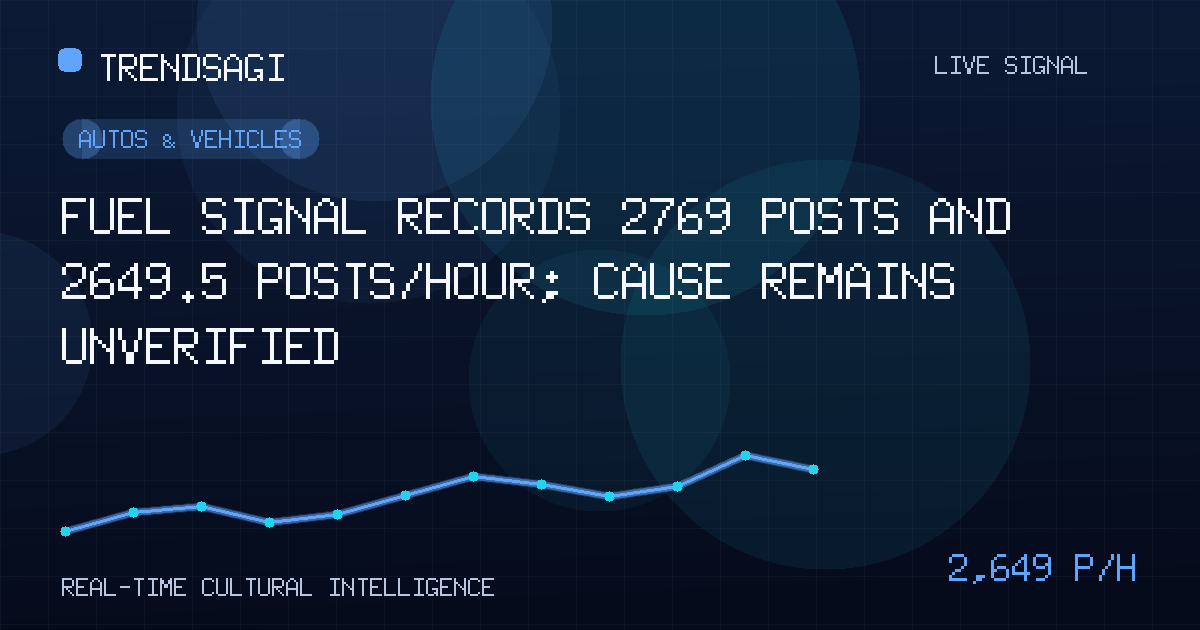
Fuel signal records 2769 posts and 2649.5 posts/hour; cause remains unverified
Fuel's stored signal shows 2769 posts and a measured 2649.5 posts/hour snapshot rate; the cause is unverified, and this briefing explains what to check next.
Automated briefing. Generated from stored signal measurements and source-backed research; it is not manually reviewed. Read the methodology and limitations.
Metrics in this briefing are a snapshot associated with its publication date and may not reflect current conditions.
What changed
The stored Fuel signal records a fast-moving discussion window, with 2769 posts in the latest snapshot. The direct editorial conclusion is narrow: Fuel merits investigation as an active trend, but no verified catalyst is attached to the record, so the reason for the movement remains unclear.
The measured snapshot rate is 2649.5 posts/hour over an exact 1806-second window using 3 stored observations, measured at 2026-10-08T14:52:04Z. This is the pace captured in that window, not a live rate, forecast, reach, engagement measure, or count of unique people. The 2769 figure is snapshot volume, not a rate.
| Measure | Stored observation |
|---|---|
| Observation time | 2026-10-08T14:52:04Z |
| Measured snapshot rate | 2649.5 posts/hour |
| Latest snapshot volume | 2769 posts |
What the signal can establish
Taken together, these values establish aggregate activity, not its cause. The topic had 2769 posts in the stored snapshot, and the available observations registered 2649.5 posts/hour during the specified window. That makes Fuel a monitoring priority, but it does not show how large the movement is relative to its own history or to other topics.
- Timing: The rate belongs to one exact 1806-second window and should not be described as continuing after the observation.
- Participation: Post volume does not reveal unique authors, geography, language mix, or audience size.
- Quality: The aggregate does not separate original discussion from repetition, syndication, or automated posting.
- Relevance: Placement in Autos & Vehicles suggests an editorial category, not proof that every post concerned automotive fuel use.
It also cannot show whether readers supported a claim, acted on it, or encountered it. Those questions require post-level and platform-level evidence unavailable in this signal.
The defensible takeaway is that the captured window shows substantial posting throughput; it does not identify a triggering event, an audience, or a market effect.
Why this topic may be moving
No verified public event, policy action, price report, supply development, or automotive announcement is attached to the signal. With no independently supported catalyst available for inclusion, a causal claim would be speculation.
The topic label is also broad. Fuel can collect commercial, commodity, household, transport, and technology discussions. The stored category of Autos & Vehicles may guide sampling, but it does not resolve which meaning dominated this window.
- Price expectations: Check whether posts repeatedly reference pump prices, wholesale costs, taxes, or affordability. No price movement is established here.
- Supply and operations: Test for repeated discussion of production, refining, distribution, inventories, or disruption. These are candidate explanations, not findings.
- Automotive developments: Look for named vehicle models, fuel-economy standards, powertrain choices, or fueling infrastructure that recur across original posts.
- Policy or public events: Check whether a specific announcement, regulatory change, geopolitical development, or widely followed event is named and independently corroborated.
Until one of these patterns is verified, “Fuel is moving because of X” would overstate the evidence.
Why it matters
The rate is an alert for teams exposed to fuel-related conversation, not a measurement of demand or financial impact. Its value depends on quickly determining whether the burst is event-specific, broad-based, or artificial.
- Fuel retailers can use the signal to identify possible customer-question clusters, subject to validation.
- Automotive manufacturers and fleets may need to distinguish ownership-cost concerns from broader energy discussion.
- Energy and transport analysts should treat social posting as a prompt for research, not as a price or supply indicator.
- Communications and policy teams can monitor emerging narratives, while checking claims before responding.
For all of these readers, the operational distinction is important: a high posting count can identify where to investigate, while verified reporting and market data are needed to describe what actually changed.
What to watch next
The next checks should convert an aggregate spike into a testable account. Several questions are especially useful.
- Persistence: Compare the next equal observation windows with a same-source historical baseline. A sustained rate would support an ongoing trend; a one-window cluster would suggest a short-lived event. Do not call the current rate live.
- Concentration: Inspect leading and representative posts for a shared event name, location, source, or claim. One repeated catalyst is a different editorial situation from several unrelated discussions.
- Authenticity: Deduplicate identical text and check repost patterns, account activity, and automated behavior where platform data permit. Raw volume can overstate independent participation.
- External corroboration: Seek a primary document or named public authority first, then reputable reporting that attributes its facts. Remove any explanation that remains unverified.
- Audience meaning: If available, examine unique authors, original comments, geography, language, saves, shares, and thoughtful replies. None of those measures is present in the supplied snapshot.
- Market connection: Compare the timing with recognized fuel-price, supply, policy, or vehicle-data series only after identifying the relevant geography and fuel type. Social discussion alone is not a market move.
Concrete warning signs would be a rate that fails to persist, one account or copied item dominating the count, or the apparent catalyst failing external verification. Concrete confirmation would be independent corroboration, multiple meaningful post clusters, and continued activity in later windows.
Methodology and limitations
The measurement is a stored snapshot associated with 2026-10-08T14:52:04Z. It uses 3 observations across an exact 1806-second window. The source's collection scope, historical baseline, sampling method, deduplication rules, and treatment of reposts are not provided, so the rate should not be generalized beyond the recorded setup.
No external fact is used to explain the movement because no verified public catalyst is available in the material used for this briefing. The topic description supplies no additional context, and the category label alone cannot identify a subtopic.
Finally, posts/hour is neither snapshot volume nor evidence of market activity. It does not establish sentiment, credibility, engagement, causation, or persistence. The appropriate conclusion is therefore a high-priority monitoring signal with an unresolved cause.
Track This Topic for New Signals
Set alerts for future velocity or sentiment changes around this topic.
Explore Tracking PlansAbout TrendsAGI research
TrendsAGI's automated research pipeline publishes dated signal snapshots, methodology notes, and practical workflows for teams evaluating cultural momentum. Read how signals are scoped, scored, and limited in our research methodology.