768-second window · 3 observations · Measured Oct 8, 2026, 12:54 PM UTC · Provider: go_recent_snapshot_v2
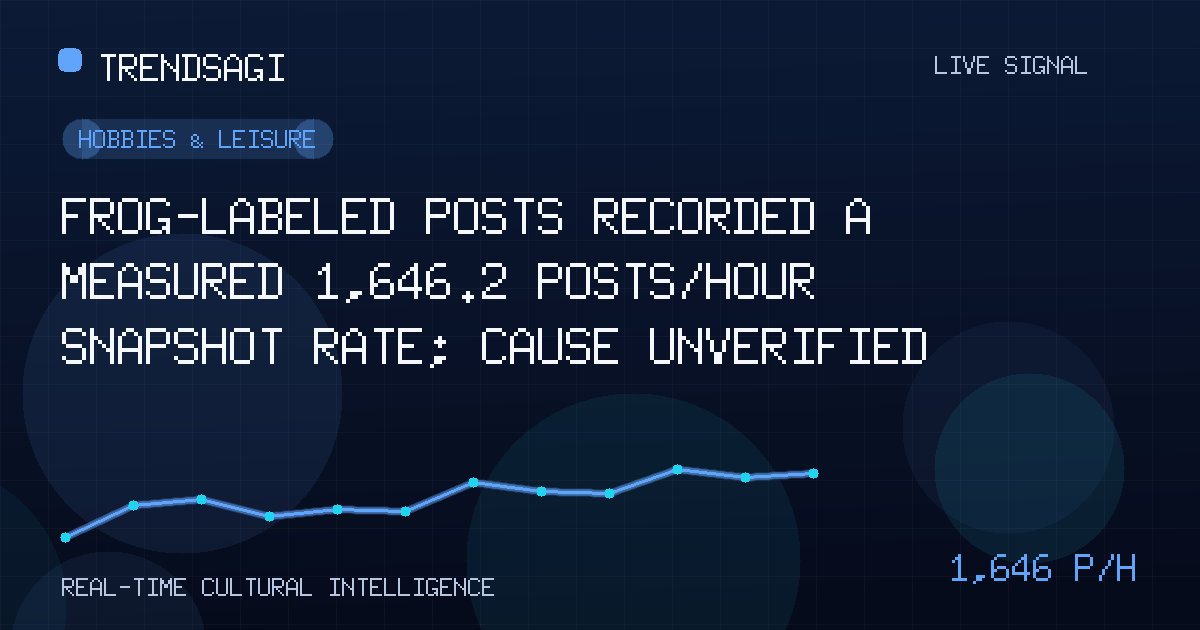
Frog-labeled posts recorded a measured 1,646.2 posts/hour snapshot rate; cause unverified
Frog-labeled posts recorded a measured 1,646.2 posts/hour snapshot rate; what changed, what it proves, and what to verify next.
Automated briefing. Generated from stored signal measurements and source-backed research; it is not manually reviewed. Read the methodology and limitations.
Metrics in this briefing are a snapshot associated with its publication date and may not reflect current conditions.
What changed
The available evidence shows a sharp, short-window burst in posts assigned to the broad “Frog” topic within Hobbies & Leisure, but it does not establish why the topic moved. The cause remains unclear: no verified public catalyst has been tied to the movement, and the label does not identify what kind of “Frog” content drove it.
The measured snapshot rate was 1,646.2 posts/hour across an exact 768-second window based on three observations, with the snapshot observed at 2026-10-08T12:54:09Z. This is a historical snapshot rate—not a live rate, forecast, reach figure, engagement count, or estimate of unique people.
| Measure | Observation |
|---|---|
| Observation time | 2026-10-08T12:54:09Z |
| Measured snapshot rate | 1,646.2 posts/hour |
| Latest snapshot volume | 533 posts |
Why this topic may be moving
No source-backed public event is verified for this cluster, so it would be speculation to attribute the burst to a news story, viral post, product release, seasonal effect, or animal-related phenomenon. Timing alone does not establish a cause.
- Semantic mix: “Frog” may match the animal, a name or handle, or another use of the word. The signal has no descriptive text to resolve that ambiguity.
- Concentrated activity: A discussion, repost chain, or high-volume account could generate many posts without broad independent interest.
- Classification effects: If matching rules changed, or if nearby hobby categories began feeding the same label, measured volume could rise without an equivalent change in underlying behavior.
- Source mix: A platform- or audience-specific event could dominate a short window. The record does not provide that breakdown.
These are explanations to test, not findings. A public explanation should be accepted only when a publisher’s dated material connects specifically to the same meaning and timing, rather than merely mentioning the same word.
A measured acceleration is a reason to investigate, not proof of a durable cultural trend. It becomes explanatory only when content, timing, and a verified catalyst line up.
Why it matters
This matters first to hobby editors, community managers, and creators deciding whether “Frog” is a genuine editorial signal or a temporary flood. They can use the burst to trigger sampling and monitoring, but not yet to claim sustained audience demand.
For community teams, the practical question is whether the increase brings useful discussion or duplicate, automated, or off-topic posts. For publishers and educators, it is a prompt to inspect the semantic mix before developing a feature, campaign, or lesson. Researchers and analysts should treat the result as a candidate event until it is reproduced in adjacent windows.
Commercial teams should be especially cautious. A rate of matching posts is neither customer intent nor purchase activity, so this snapshot alone cannot support a sales claim or audience-size estimate.
What the signal can and cannot establish
The signal can establish one narrow fact: within the recorded topic and window, matching post activity was measured at 1,646.2 posts/hour. It can also show that the latest snapshot contained 533 posts. Those are descriptive measurements.
It cannot establish the number of unique authors, originality, sentiment, engagement, location, language, platform, or organic versus coordinated behavior. It also cannot show whether the rate was high relative to a normal baseline, because no baseline is supplied. The 768-second window can flag a burst but does not, by itself, establish a durable trend.
The two quantities should remain separate. Snapshot volume is a count at the observation time; posts/hour is the supplied measured snapshot rate. Neither should be substituted for the other or converted into reach without the underlying observations.
What to watch next
The next validation pass should answer several practical questions:
- What do the posts mean? Review a structured sample and classify each occurrence as literal frog-related hobby content, a homonym, a name or handle, or unrelated material. This is the fastest check on whether the category matches reader expectations.
- Does the burst persist? Compare equal-length windows immediately before and after the recorded interval. Continued elevation across multiple observations would support a stronger trend interpretation than a single short burst.
- Who is posting? Break results down by account, account age, platform, geography, and language where available. Check whether activity is distributed across independent participants or concentrated in a small cluster.
- Are the posts original? Measure duplicate and repost patterns, repeated text, synchronized timing, and links to the same destination. Separately record comments, saves, and other interactions rather than treating them as implied by post volume.
- Is there a real catalyst? Use a targeted Google Search to look for a dated public development tied to the same “Frog” meaning. Open the relevant publisher result and retain it only if its date, subject, and claimed connection match the observed cluster. If no such match appears, continue to report the cause as unclear.
Concrete signals that would change the interpretation
The trend case would strengthen if repeated windows remain elevated, matching content is semantically consistent, independent accounts contribute distinct posts, and a verified public event aligns with the timing. It would weaken if the rate falls away immediately, most items are duplicates or off-topic, or the label’s meaning shifts across the sample. The decisive evidence is reproducibility plus content validation—not the size of one headline number.
Methodology and limitations
The rate reported here is the supplied measured snapshot rate, derived from three stored observations over exactly 768 seconds and anchored at 2026-10-08T12:54:09Z. The latest snapshot volume is separately reported as 533 posts. No raw rows, account-level data, prior baseline, or post-window result are provided, so distribution and persistence cannot be tested from this record alone.
“Frog” is a broad label with no accompanying description, and no verified external context is included that explains the timing. The result is therefore a short-window descriptive signal, not evidence of a lasting shift in frog-related behavior. Any later causal statement should preserve that distinction until public context and cleaner content checks are available.
Track This Topic for New Signals
Set alerts for future velocity or sentiment changes around this topic.
Explore Tracking PlansAbout TrendsAGI research
TrendsAGI's automated research pipeline publishes dated signal snapshots, methodology notes, and practical workflows for teams evaluating cultural momentum. Read how signals are scoped, scored, and limited in our research methodology.