2696-second window · 3 observations · Measured Oct 9, 2026, 9:10 PM UTC · Provider: go_recent_snapshot_v2
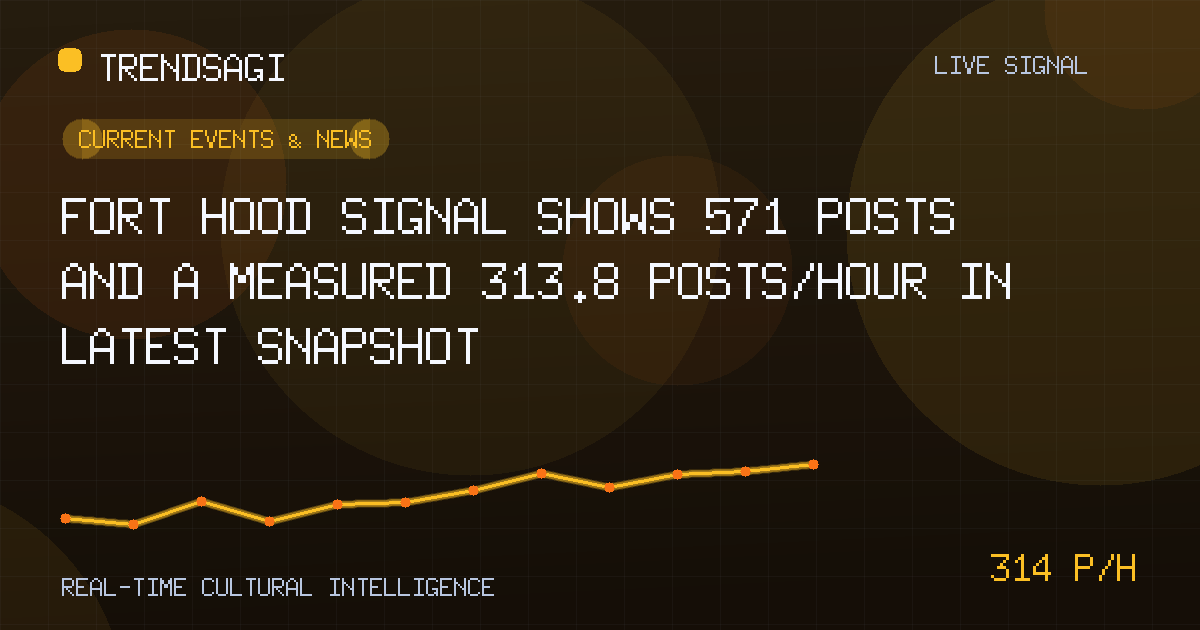
Fort Hood signal shows 571 posts and a measured 313.8 posts/hour in latest snapshot
Fort Hood shows 571 posts in the latest snapshot and a measured 313.8 posts/hour; the cause remains unclear, with key checks outlined.
Automated briefing. Generated from stored signal measurements and source-backed research; it is not manually reviewed. Read the methodology and limitations.
Metrics in this briefing are a snapshot associated with its publication date and may not reflect current conditions.
What changed
Posts grouped under the topic Fort Hood show a concentrated short-window discussion burst: the latest stored snapshot contains 571 posts. The direct finding is elevated observed posting activity around the label, not a verified explanation for what prompted it.
The measured snapshot rate was 313.8 posts/hour over an exact 2696-second window based on 3 stored observations, observed at 2026-10-09T21:10:38Z. It is a historical stored measurement—not a live rate, forecast, reach figure, engagement total, or count of unique people.
| Observation time | Measured snapshot rate | Latest snapshot volume |
|---|---|---|
| 2026-10-09T21:10:38Z | 313.8 posts/hour | 571 posts |
The snapshot volume and measured rate describe different aspects of the record. The 571 figure is the number of posts in the latest snapshot; the 313.8 posts/hour figure describes the pace associated with the supplied observation window. Neither establishes how many people participated, whether the posts were broadly distributed, or whether attention continued afterward.
Why this topic may be moving
The cause remains unclear. No verified public context, publisher report, official statement, or identifiable event has been tied to this movement in the available record. It would therefore be unsupported to attribute the increase to a particular incident, announcement, observance, controversy, or online campaign.
A topic label can aggregate very different activity. The pattern could reflect a genuine new event, scheduled activity, wider reaction to existing news, repeated claims, or machine-assisted posting. These are hypotheses to test rather than findings established by the signal.
- Event check: Determine whether posts refer to one concrete development with a verifiable time and place.
- Source check: Identify where the earliest repeated claims or media references appeared.
- Coordination check: Look for identical wording, abrupt repetition, or accounts carrying the same material without independent context.
The 313.8 posts/hour figure measures the pace inside one stored observation window; it does not establish the identity, intent, authenticity, or importance of the people behind those posts.
The most useful next step is corroboration rather than another unverified summary. Retrieve the underlying posts with timestamps, separate references to specific events from general discussion, and compare the repeated material with verified public reporting available near the observation time.
Why it matters
A fast-moving topic can prompt timely checking before a potentially incomplete account circulates. Yet volume alone cannot show that an incident occurred, that misinformation is present, or that public action is required. The signal is best treated as a reason to investigate, not as proof of what happened.
- Service members, families, and local residents should look for confirmed information before changing decisions based on the discussion label.
- Local media and community organizations may need to monitor whether the conversation contains concrete claims, corrections, or actionable guidance.
- Public-information teams may want to determine whether the burst corresponds to an event requiring timely clarification.
- Researchers, fact-checkers, and trust-and-safety teams may need to examine repetition, source provenance, and possible manipulation.
For all these audiences, the correct response is proportional: investigate meaningful claims quickly, avoid treating popularity as accuracy, and do not infer an emergency or coordinated activity without corroboration.
What to watch next
Several follow-up signals would materially improve interpretation:
- Persistence: Check whether later snapshot volume holds near 571 and whether the measured snapshot rate remains near 313.8 posts/hour. A quick reversal would suggest a short-lived burst rather than sustained attention.
- A matching event: Look for a verified report or official statement whose publication time plausibly precedes the rise and whose subject matches the recurring post content.
- Independent convergence: Determine whether multiple credible publishers are describing the same development rather than repeating one unconfirmed source.
- Reproduction patterns: Examine whether the same text, image, claim, or link is being recopied across unrelated accounts. Repetition can indicate amplification, but it does not by itself prove automation.
- Actionable effects: Watch for verified changes in local conditions, services, access, safety guidance, or official procedures. Those would matter more than raw volume.
- Corrections and narrative shifts: Note whether authoritative clarifications reduce repetition, whether users change their claims, or whether a new unsupported explanation replaces the old one.
The strongest continuation signal would be independent public reporting that aligns with the timing and content of the stored posts. The strongest warning signal would be continued growth without any verifiable event or reliable provenance.
Methodology and limitations
This signal establishes only what the supplied observations report: 571 posts in the latest snapshot and a measured snapshot rate of 313.8 posts/hour across the stated 2696-second window. It does not provide a long-term baseline, a live feed, or evidence that activity remains elevated.
- Post counts are not unique-person counts and do not measure reach, impressions, clicks, or engagement.
- The signal does not establish sentiment, geography, audience composition, authenticity, organic discussion, or coordinated behavior.
- Three stored observations are too limited to distinguish a persistent trend from a temporary spike or to support a forecast.
Confidence should increase through additional stored observations, post-level records, source provenance, and verified public context. Until those checks are available, Fort Hood is an active measured topic signal with an unverified cause—not a confirmed news event.
Track This Topic for New Signals
Set alerts for future velocity or sentiment changes around this topic.
Explore Tracking PlansAbout TrendsAGI research
TrendsAGI's automated research pipeline publishes dated signal snapshots, methodology notes, and practical workflows for teams evaluating cultural momentum. Read how signals are scoped, scored, and limited in our research methodology.