897-second window · 3 observations · Measured Sep 26, 2026, 1:51 AM UTC · Provider: go_recent_snapshot_v2
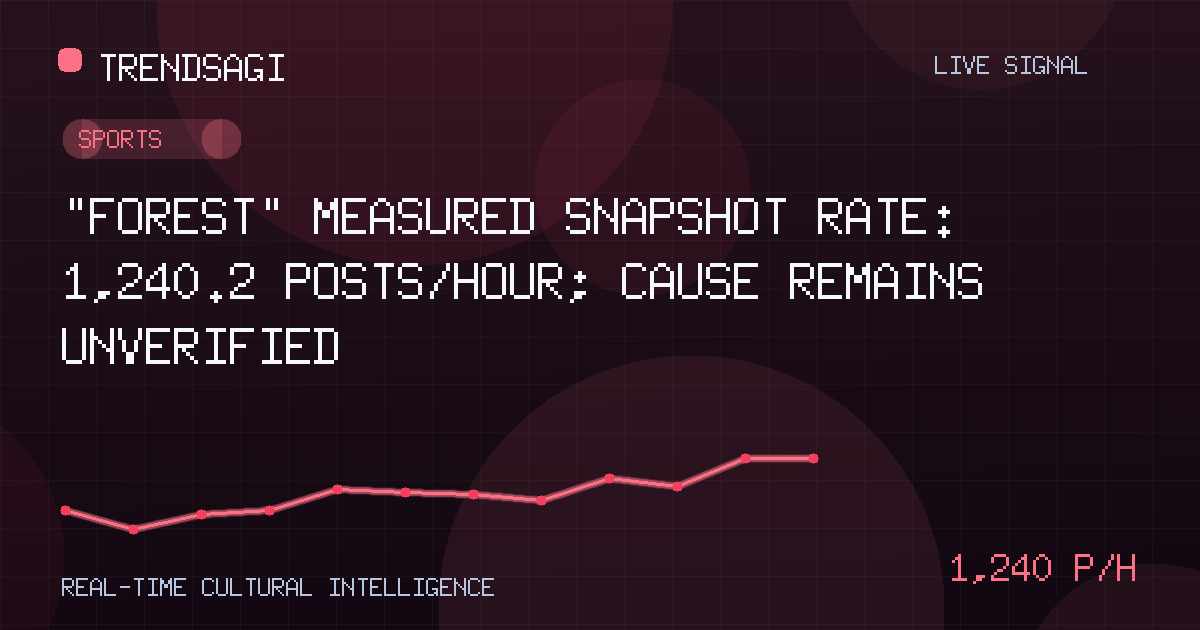
“Forest” measured snapshot rate: 1,240.2 posts/hour; cause remains unverified
The stored “Forest” signal measured 1,240.2 posts/hour across 897 seconds; this briefing separates the observed burst from its still-unverified cause.
Automated briefing. Generated from stored signal measurements and source-backed research; it is not manually reviewed. Read the methodology and limitations.
Metrics in this briefing are a snapshot associated with its publication date and may not reflect current conditions.
What changed
The stored signal labeled “Forest” registers a measured snapshot rate of 1,240.2 posts/hour, but the available evidence does not establish why the topic is moving. The latest snapshot contains 496 posts; that is a volume count, not a rate, forecast, reach figure, or unique-person count.
| Measure | Stored value | Interpretation |
|---|---|---|
| Observation time | 2026-09-26T01:51:48Z | Time attached to the latest stored snapshot |
| Measured snapshot rate | 1,240.2 posts/hour | Rate measured over the stated window |
| Latest snapshot volume | 496 posts | Posts present in the snapshot |
The measured change rate came from 3 stored observations across an exact 897-second window and was measured at 2026-09-26T01:51:48Z. It captures posting frequency in the stored series during that window. It is not a live or current rate, and it does not identify who posted, where the posts appeared, or whether they were original.
No prior baseline is supplied, so the signal cannot show whether this is unusually high, how long the burst has lasted, or whether activity is still rising. The record also does not document whether the rate and snapshot volume use identical coverage. They should therefore be read separately, not combined to create another metric.
Why this topic may be moving
No verified public context accompanies the stored record, so the cause remains unclear. Its category is “Sports,” while “Forest” has no description and has not been resolved here to a specific person, team, place, event, or phrase. The category alone does not prove a sporting connection.
Possible explanations should be tested rather than asserted:
- Referent mixing: “Forest” may be attaching to several entities or uses. A post sample should reveal whether one meaning dominates.
- Event-driven discussion: An announcement, appearance, result, controversy, or scheduled activity may have prompted posts, but no trigger has been verified.
- Content replication: Repeated wording, reposts, quote chains, or automated posting can produce many posts without an equivalent number of distinct developments.
- Collection effects: A sampling boundary, ranking change, or source mix could shape a short window. The supplied record does not show whether any such change occurred.
The signal shows a measured burst in posts labeled “Forest”; it does not establish that a particular public event caused that burst.
Why it matters
For media and communications teams, the immediate value is triage: a fast-moving label can indicate a developing story, a naming collision, or a replication event. For sports desks, the “Sports” classification creates a specific verification task rather than a conclusion. If Forest is not a verified sports entity, routing the signal to a sports workflow could create a false story.
Analysts should also resist using the snapshot as evidence of public reach. Posts can be duplicated, and the record contains no audience, engagement, sentiment, geography, or account-distribution data. The responsible next step is entity resolution and source verification, not a causal headline.
- Sports editors and reporters should confirm the referent before connecting the burst to a match, club, athlete, or competition.
- Communications teams should check whether the label matches a monitored organization, venue, campaign, or common-word collision.
- Trend analysts need a longer baseline and duplicate controls before comparing this signal with normal activity.
- Platform and data teams should confirm that collection rules and category assignments did not change.
What to watch next
The verification sequence should move from identity to trigger, then from trigger to measurement quality:
- Resolve the label. Review a representative cross-section of post text for names, phrases, locations, links, and account context. Group posts by likely referent before summarizing the conversation. This is especially important because the stored description is empty.
- Search for a dated trigger. Use a date-bounded Google Search check built around “Forest” and distinctive co-occurring terms found in the sample. Look for a public source timestamped before the post cluster; prioritize an official announcement, event listing, result, or original report over unsourced summaries.
- Test persistence. Compare adjacent windows produced by the same collection method. A short-lived spike and sustained activity imply different editorial treatments, even if their initial posts-per-hour measurements are identical.
- Audit repetition. Check for duplicate text, quote chains, synchronized posting patterns, and repeated source links. Determine whether the volume reflects conversation breadth or the same item circulating.
- Validate classification. Compare sampled content with the stored “Sports” category. Reclassify only if the sampled referents support that label, and document any mismatch.
Concrete watch signals
The next useful evidence would be:
- A subsequent like-for-like stored window remains at a similarly high measured rate.
- The burst concentrates around a single verified entity rather than several meanings of “Forest.”
- A timestamped public source clearly precedes the observed cluster.
- The sample shows varied original posts rather than repeated copies of one item.
- Independent datasets reproduce the movement under the same label and category.
Methodology and limitations
This briefing uses the supplied stored signal: 496 posts in the latest snapshot and a measured snapshot rate of 1,240.2 posts/hour, derived from 3 observations over an exact 897-second window, measured at 2026-09-26T01:51:48Z. The rate describes observed posting frequency for that window; it is not a forecast, live count, engagement measure, reach estimate, or count of unique people.
Without post text, account data, geography, platform coverage, a historical baseline, or verified public context, the signal cannot establish cause, sentiment, novelty, or broader public interest. “Forest” and “Sports” are treated as stored labels, not verified identities. No causal explanation is assigned because the reason for movement remains unverified.
Track This Topic for New Signals
Set alerts for future velocity or sentiment changes around this topic.
Explore Tracking PlansAbout TrendsAGI research
TrendsAGI's automated research pipeline publishes dated signal snapshots, methodology notes, and practical workflows for teams evaluating cultural momentum. Read how signals are scoped, scored, and limited in our research methodology.


