1145-second window · 2 observations · Measured Aug 26, 2026, 11:23 AM UTC · Provider: go_recent_snapshot_v1
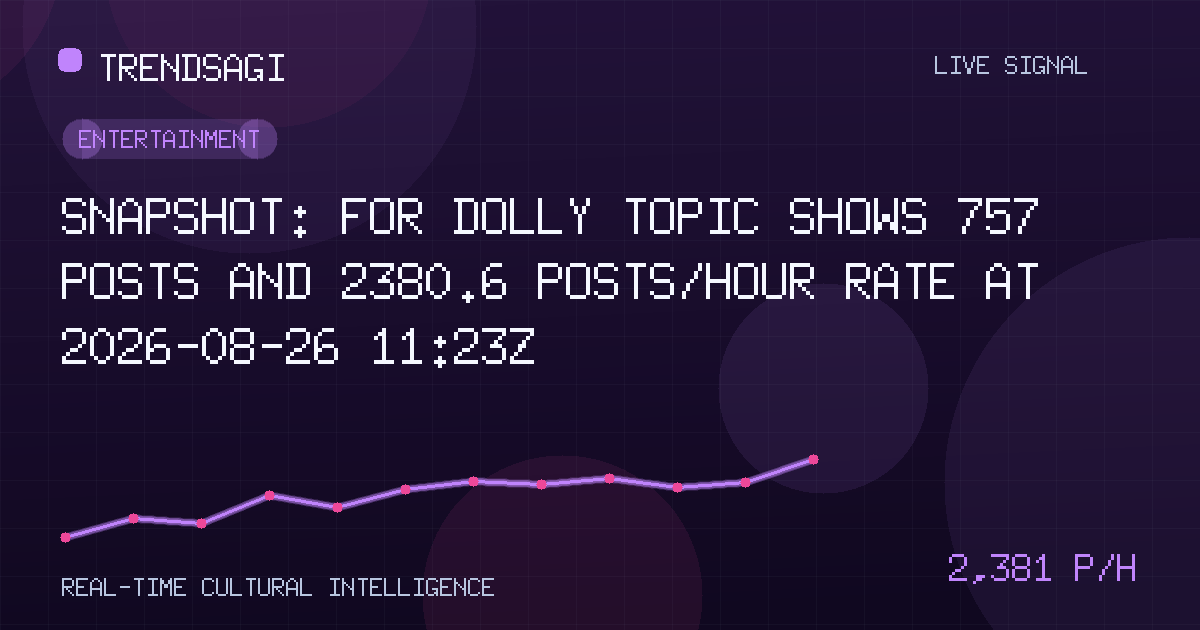
Snapshot: For Dolly topic shows 757 posts and 2380.6 posts/hour rate at 2026-08-26 11:23Z
On 2026-08-26, For Dolly had 757 posts and a measured 2380.6 posts/hour rate over 1145s. Briefing explains what the signal can and cannot show.
Automated briefing. Generated from stored signal measurements and source-backed research; it is not manually reviewed. Read the methodology and limitations.
Metrics in this briefing are a snapshot associated with its publication date and may not reflect current conditions.
What changed
At the snapshot observed on 2026-08-26 at 11:23:25 UTC, the topic labeled For Dolly registered a snapshot volume of 757 posts. This count reflects the number of posts captured in the stored observation tied to that exact timestamp, not a cumulative total across the day or a measure of unique authors.
During an exact 1145-second window ending at that observation, the measured snapshot rate was 2380.6 posts/hour, calculated from two stored observations. This figure is a measured snapshot rate from the recorded window; it is not a live or current posting rate, nor a forecast, reach, engagement metric, or count of unique individuals.
| Observation time (UTC) | Measured posts/hour | Snapshot volume (posts) |
|---|---|---|
| 2026-08-26T11:23:25Z | 2380.6 | 757 |
Why this topic may be moving
The canonical stored signal provides no description of the event or context driving the posts, and the stored category is simply Other. No verified public reporting was available in this briefing to attribute the movement to a specific real-world trigger such as a product launch, news event, or cultural moment. Therefore, the cause remains unclear.
It is possible that the label For Dolly corresponds to a dedicated campaign, a tribute, a music release, a localized conversation, or an internal tagging artifact. Without sampled post content or external confirmation, any specific explanation would be speculation. We omit unverified claims and state plainly that the driver is not established by the data we hold.
A high measured rate over a short window signals concentrated activity, but it does not by itself reveal intent, sentiment, or lasting significance.
If later verification retrieves publisher-confirmed context, that context should be attributed to the specific outlet. Until then, readers should treat the topic as an unresolved anomaly in volume.
Why it matters
Short, sharp increases in post volume around an unspecified label merit attention even when the cause is unknown. The following groups should consider the signal in their workflows:
- Social listening and community teams that monitor sudden conversational clusters for early risk or opportunity detection.
- Brand, artist, or rights-holder monitors where the term Dolly could map to a protected name, product line, or public figure.
- Research analysts studying how raw snapshot rates behave before external events are confirmed or debunked.
- Newsroom trend desks that need to separate measurable spikes from noise before allocating reporting resources.
The signal can establish that a concentrated burst of posts occurred within a defined window and that the point-in-time count was 757 posts. It cannot establish whether those posts are positive, negative, or neutral. It cannot tell us how many distinct accounts contributed, whether the activity is organic or coordinated, or which geographic markets are involved. Treating the measured snapshot rate as a stand-in for audience size would be a category error.
Another limitation is category placement. With the stored category listed as Other, the topic has not been classified into a known vertical such as entertainment, politics, or consumer goods. That absence of classification reduces the ability to compare the spike against historical baselines in a specific domain.
What to watch next
Practical next checks should focus on turning the raw observation into actionable context:
- Retrieve a sample of the underlying posts to identify language, hashtags, and apparent intent behind the For Dolly label.
- Run a verified public search for publisher coverage mentioning the same label or related terms around the observation timestamp.
- Compare the next scheduled snapshot volume against the 757-post baseline to see if the burst decayed or intensified.
- Check whether the stored category changes from Other to a defined vertical, which would refine interpretation.
- Segment any available metadata by region or platform if the source permits, to localize the conversation.
Concrete watch signals that would upgrade this from an unexplained spike to a tracked trend include a second consecutive measured snapshot rate above 2000 posts/hour, a subsequent snapshot volume exceeding 757 posts by a meaningful margin, or verified external reporting that names the same topic. Conversely, a sharp drop in rate and volume over the next window would suggest a transient artifact rather than a developing story.
Methodology and limitations
The measured snapshot rate of 2380.6 posts/hour was derived from two stored observations across an exact 1145-second window, with the final observation timestamp at 2026-08-26T11:23:25Z. The rate is a mathematical conversion of post counts observed in that window and is reported exactly as stored. The snapshot volume of 757 posts is the count at the final observation and is not a rate.
All values in this briefing are treated as recorded observations rather than validated ground truth. No external verification of the topic driver was performed or available, so causal claims are omitted. The absence of a stored signal description means we cannot infer the original intent of the label. Readers should avoid extrapolating the measured snapshot rate to future periods or to total addressable audience.
For teams building monitoring systems, the key takeaway is procedural: a high measured rate is a trigger for inspection, not a conclusion. The current data supports the fact of a burst, quantifies its intensity within a narrow window, and sets a baseline count. It does not support statements about why the burst happened, who drove it, or what comes next. Maintaining that boundary protects against false certainty in fast-moving information environments.
Track This Topic for New Signals
Set alerts for future velocity or sentiment changes around this topic.
Explore Tracking PlansAbout TrendsAGI research
TrendsAGI's automated research pipeline publishes dated signal snapshots, methodology notes, and practical workflows for teams evaluating cultural momentum. Read how signals are scoped, scored, and limited in our research methodology.