909-second window · 3 observations · Measured Sep 16, 2026, 9:41 PM UTC · Provider: go_recent_snapshot_v2
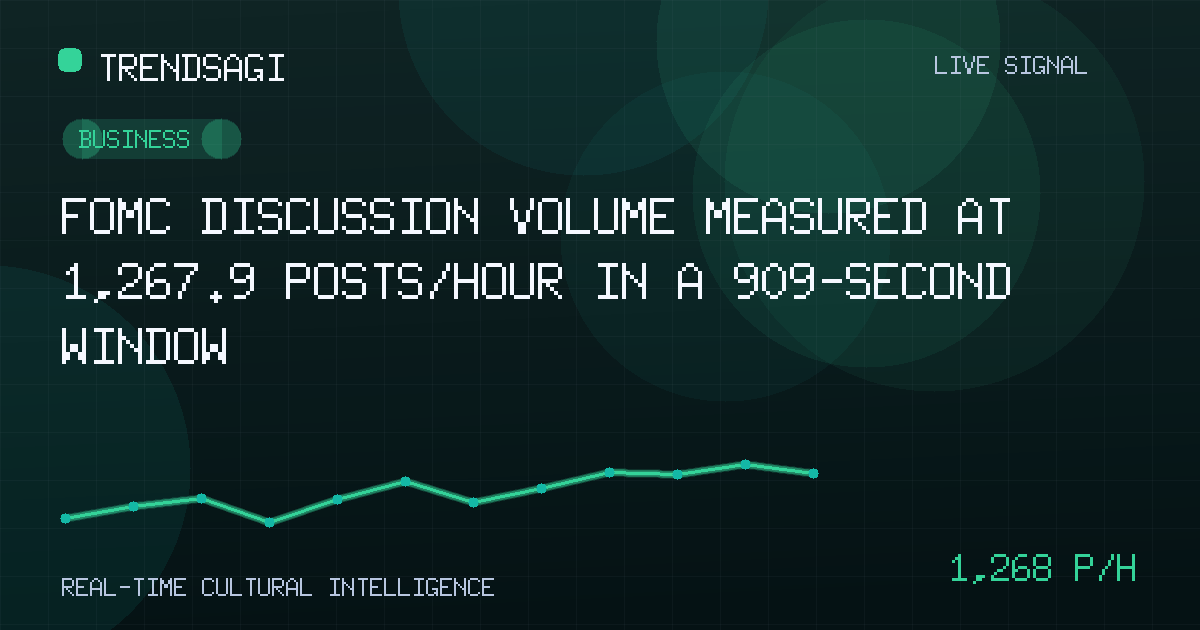
FOMC discussion volume measured at 1,267.9 posts/hour in a 909-second window
A 909-second stored signal measured 1,267.9 posts/hour for FOMC and 857 posts in the latest snapshot. This briefing frames limits and watch signals.
Automated briefing. Generated from stored signal measurements and source-backed research; it is not manually reviewed. Read the methodology and limitations.
Metrics in this briefing are a snapshot associated with its publication date and may not reflect current conditions.
What changed
FOMC discussion showed a measured snapshot rate of 1,267.9 posts/hour over an exact 909-second window using 3 stored observations at 2026-09-16T21:41:21Z. The latest snapshot volume was 857 posts. This is a volume measurement, not a live rate, forecast, reach metric, engagement score, or unique-person count.
| Observation time | Measured posts/hour | Snapshot volume |
|---|---|---|
| 2026-09-16T21:41:21Z | 1,267.9 | 857 posts |
The direct answer is simple: FOMC discussion was high in the stored sample, and the measured rate over 909 seconds was 1,267.9 posts/hour. The cause is not established by the supplied signal.
Why this topic may be moving
Because the stored signal description is empty and no verified public context is included, the reason for the movement cannot be confirmed here. A topic label such as FOMC can rise for many reasons: a policy meeting, a statement, meeting minutes, a scheduled event, a market reaction, a headline, a platform algorithm, or a burst of automated or coordinated posting. The stored observation does not identify which of these, if any, applies.
What the signal can establish is the timing and size of the stored post volume: 857 posts in the latest snapshot and a measured rate derived from three stored observations. What it cannot establish is the factual cause, the tone of the posts, the credibility of the accounts, the geographic distribution, the proportion of organic versus automated activity, or any market outcome.
A spike in post volume tells us attention moved; it does not tell us the factual cause, the direction of a policy decision, or whether the activity was informed, automated, or simply reactive to a headline.
Why it matters
FOMC is a high-attention label in business and policy discussion. When the label moves sharply, readers should separate the measured activity from the underlying event. A high post rate can matter to several audiences, even before the cause is confirmed.
- Market observers may want to check whether financial news outlets are reporting a related event, because price moves and headline risk are not proven by post counts alone.
- Researchers and trend analysts may want to preserve the timing, because the 21:41:21Z observation can be matched against later snapshots to see whether the rate decays or accelerates.
- Business communications teams may want to know whether the topic is becoming relevant to customers, employees, or clients, especially if the label is being used in a corporate context.
- Platform analysts may want to test whether the burst is concentrated in a few accounts, a specific hashtag, a single viral post, or broad discussion across many accounts.
The practical value of this briefing is to treat the number as a trigger for verification, not as a conclusion. The measured rate is useful as a benchmark: future snapshots can be compared to 1,267.9 posts/hour and 857 posts to determine whether the signal is fading, persisting, or expanding.
What to watch next
Useful next checks are specific and testable. A reader should not infer a cause from the rate alone.
- Check whether the next stored snapshots show a lower, flat, or higher posts/hour rate relative to 1,267.9.
- Check whether the latest snapshot volume remains near 857 posts or moves materially higher or lower.
- Check whether verified public reporting, if available, names a specific FOMC-related event, document, speaker, or market move.
- Check whether the discussion includes repeated claims, questions, corrections, or evidence of debate rather than one uniform message.
- Check whether related labels appear at the same time, because co-moving topics can help narrow the cause.
If the rate falls quickly, the episode may be a short burst. If it stays high for several windows, the topic may be entering a sustained discussion. If it rises further, the episode may be widening beyond the initial trigger, but the stored volume alone still cannot name that trigger.
Methodology and limitations
The measurement is a stored observation, not a live monitor. It uses the latest snapshot volume and a measured change rate calculated from stored observations. The supplied rate is described as 1,267.9 posts/hour over an exact 909-second window using 3 stored observations, measured at 2026-09-16T21:41:21Z. The latest snapshot volume is 857 posts.
The measurement should not be read as a current live rate at the moment of reading. It should not be treated as a forecast, a measure of unique people, a measure of engagement quality, or evidence of public opinion. It also does not establish that the posts are accurate, that they are from distinct human users, or that they represent a broad market view.
Because the topic label is FOMC and the stored category is Business, the likely reader interest is economic or policy-related. However, the stored signal does not include a description, sample posts, sentiment, or verified external cause. Therefore, the safest interpretation is that a measurable volume event occurred in the stored data at the stated timestamp, and the next useful step is to verify the cause through reliable public context and compare future measurements to this baseline.
Track This Topic for New Signals
Set alerts for future velocity or sentiment changes around this topic.
Explore Tracking PlansAbout TrendsAGI research
TrendsAGI's automated research pipeline publishes dated signal snapshots, methodology notes, and practical workflows for teams evaluating cultural momentum. Read how signals are scoped, scored, and limited in our research methodology.


