1807-second window · 3 observations · Measured Oct 1, 2026, 1:56 AM UTC · Provider: go_recent_snapshot_v2
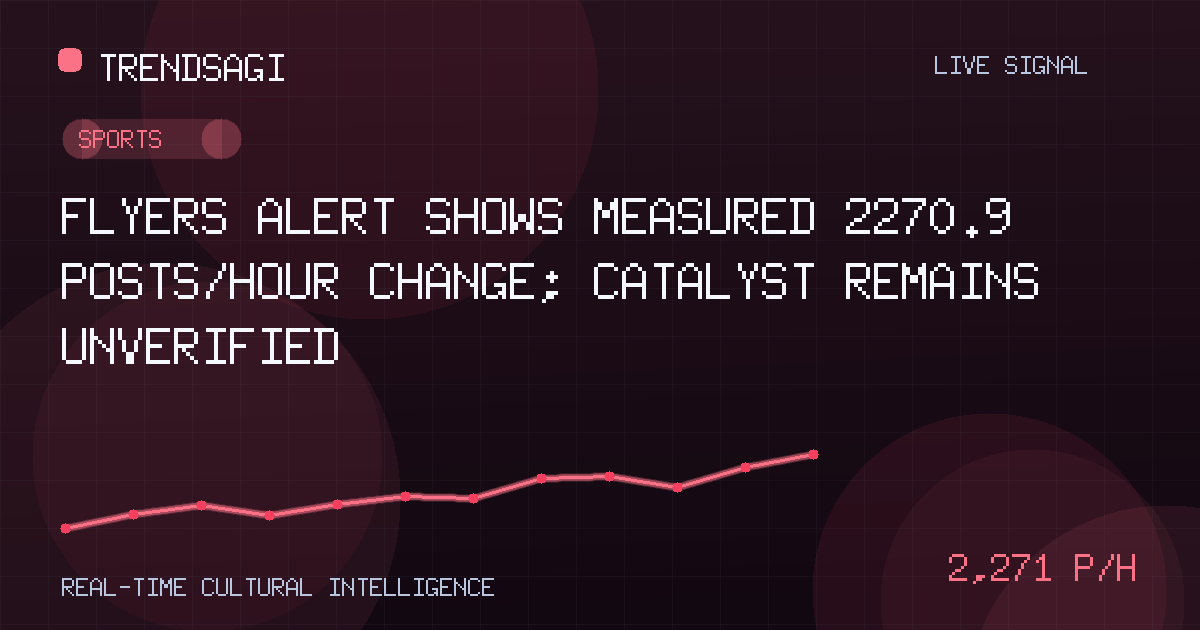
Flyers alert shows measured 2270.9 posts/hour change; catalyst remains unverified
Flyers logged 1800 posts and a measured 2270.9 posts/hour change in the latest Sports snapshot; editors should verify the catalyst.
Automated briefing. Generated from stored signal measurements and source-backed research; it is not manually reviewed. Read the methodology and limitations.
Metrics in this briefing are a snapshot associated with its publication date and may not reflect current conditions.
What changed
The stored “Flyers” signal shows a sharp rise in captured posting activity in the Sports category: the latest snapshot contains 1800 posts, and the measured change is 2270.9 posts/hour across an exact 1807-second window based on 3 stored observations. No specific public catalyst has been verified for this jump, so it is not yet safe to attribute the activity to a hockey game, team announcement, or another event.
The 2270.9 figure is a measured snapshot rate, not a live or current rate, forecast, reach metric, engagement count, or count of unique people. The 1800 posts are snapshot volume at the stated observation time, not a rate. The immediate editorial conclusion is deliberately narrow: activity captured under the label “Flyers” accelerated, but the label’s meaning and cause still require inspection.
| Observation time | Measured posts/hour | Snapshot volume |
|---|---|---|
| 2026-10-01T01:56:35Z | 2270.9 posts/hour | 1800 posts |
Why this topic may be moving
No attributable public explanation has been verified for this observation, and the stored signal has no descriptive account of the posts. Several mechanisms could produce the pattern, but none is confirmed: one event could have caused a burst; several stories could have converged; team-related posts could be mixed with unrelated uses of the label; or collection behavior could have changed. These are hypotheses, not findings.
- Entity ambiguity. The Sports category makes a team-related reading plausible, but it does not identify which team, player, nickname, competition, or other referent appears in the posts.
- Event concentration. Look for shared names, actions, timing, and cited developments. A common subject would support an event-driven explanation, but similarity alone would not verify the event.
- Source mix. Separate original reporting, commentary, fan posts, reposts, and possible automation or duplication. More captured posts do not necessarily mean more distinct reporting.
- Collection effects. Check whether query wording, category routing, or capture limits changed near the observation. A collection change can resemble a public spike.
A fast-moving label is an investigation trigger, not an explanation. It shows that more posts were captured under the same label; it does not show that the posts concern one entity, one event, or one factual claim.
What the signal can and cannot establish
The canonical record establishes the observation time, the volume captured under one label in one category, and the measured change rate. That is enough to trigger verification, but not enough to support a causal news claim.
- Entity identity: A Sports label can contain more than one subject; category assignment is not entity resolution.
- Provenance and accuracy: The signal does not identify which posts are original, authoritative, reposted, duplicated, or accurate.
- Audience response: It does not provide sentiment, engagement, reach, geography, or unique-person counts.
- Persistence: The latest snapshot does not show whether the movement will continue, fade, or reverse.
That boundary prevents a common reporting error: treating post acceleration as proof that a particular story caused the activity. The alert identifies where editorial attention is warranted, not what happened.
Why it matters
For sports editors, the signal offers a speed advantage but also a false-attribution risk. A fast response is useful only if a sampled post and a verified public development establish the relevant subject. Publishing the label alone would leave the causal claim unsupported.
For team, league, and sponsorship communications teams, the volume should not be treated as audience size or favorable attention. Before responding, those teams should confirm that the conversation concerns them, distinguish original posts from repetition, and assess tone from the underlying sample.
For trend analysts, the episode highlights collection quality as a business-critical issue. Query changes, routing errors, duplicated content, and short-lived bursts can distort baselines and trigger unnecessary work if monitoring systems are not audited.
What to watch next
The next step is to turn the broad alert into an evidence chain:
- Inspect a time-ordered sample around the observation. Record the named entity, source type, language or geography, and whether each item is original commentary, reposting, or duplication.
- Look for a shared subject. Repeated references to the same action, announcement, match, person, or controversy would make an event-driven explanation more plausible than generic label use.
- Verify a catalyst through public search. Look for time-aligned reporting or an official announcement that directly matches the sampled posts. Publish an external explanation only when the subject and timing both align.
- Compare subsequent snapshots under the same rules. Use the same query, category, and counting method. Repeated elevated measured rates would support persistence; a quick return to the prior pattern would suggest a shorter-lived burst.
- Audit distribution and collection. Check whether activity is concentrated in a few source types, whether near-duplicate messages dominate, and whether any query or capture change occurred near the observation time.
Concrete evidence of an event would be a dominant shared referent, tightly aligned timestamps, independent corroboration, and continued elevation in later snapshots. If the rate recedes quickly, duplication dominates, or sampled posts lack a common referent, the increase should remain classified as transient or measurement-related pending review.
Methodology and limitations
The rate is reproduced from the canonical stored signal rather than independently recomputed. It was measured at 2026-10-01T01:56:35Z from 3 stored observations over an exact 1807-second window. The 1800 figure is the latest snapshot volume only.
- The record does not include a longer baseline, the underlying post text, source-level counts, or enough methodological detail to test collection stability.
- The measured rate does not establish causation, sentiment, factual accuracy, engagement, reach, audience uniqueness, or behavior after the observation.
- No external fact is asserted because no specific, time-aligned public explanation could be verified for the spike.
The defensible conclusion is therefore limited but actionable: the “Flyers” label showed substantial measured posting acceleration and merits prompt content inspection, but its event, entity, and cause remain unclear.
Track This Topic for New Signals
Set alerts for future velocity or sentiment changes around this topic.
Explore Tracking PlansAbout TrendsAGI research
TrendsAGI's automated research pipeline publishes dated signal snapshots, methodology notes, and practical workflows for teams evaluating cultural momentum. Read how signals are scoped, scored, and limited in our research methodology.